Employees of a Wartime Asylum
Every building in Civil War Washington, D.C. was impacted by the capital’s transformation into a military command center. Last summer, I covered how the war took over the Government Hospital for the Insane, later renamed St. Elizabeths. Opened in January 1855 as the first federal psychiatric facility, Superintendent Charles Nichols not only allowed for soldier patients to be admitted, but offered the asylum grounds to the signal corps and various other encampments. Designed for 250 beds, the hospital was not prepared for the influx of wartime carnage which doubled the population. Patient admissions wavered from unstable citizens to physically and emotionally injured combat soldiers by 1862, and eventually onto traumatized veterans when it returned to normal operations in 1865.
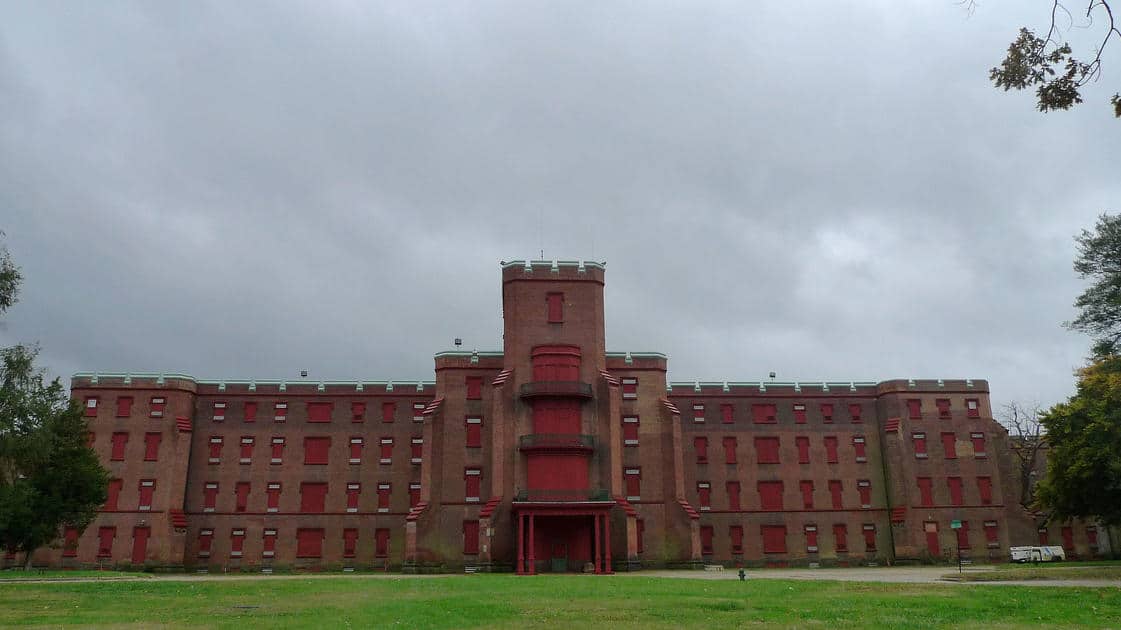
But what about in the middle of the war? How does a requisitioned insane asylum function during national conflict, especially when civilians were still being treated? This information is often scarcely available or scant in detail, leaving much to the imagination as to who remained onsite as the armed forces took over. Luckily, within the U.S., Register of Civil, Military, and Naval Service for 1863, we get a glimpse into who exactly is running this massive complex.[1]
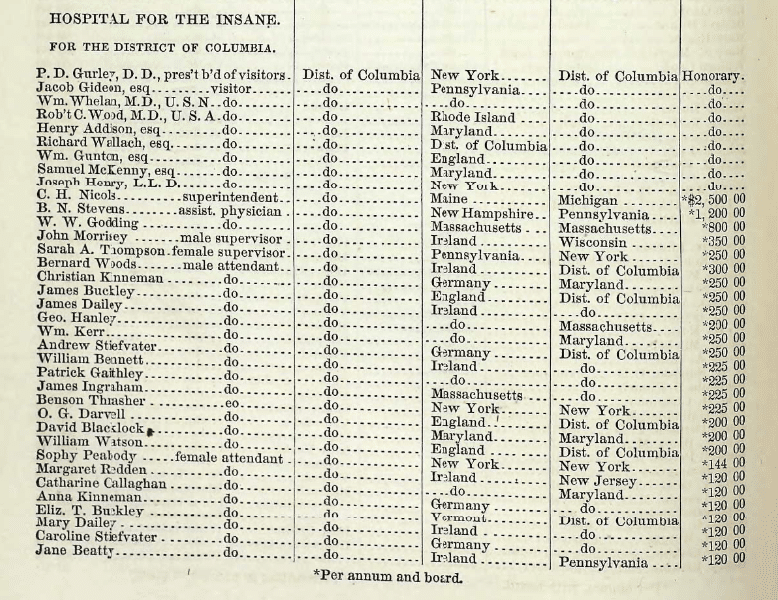
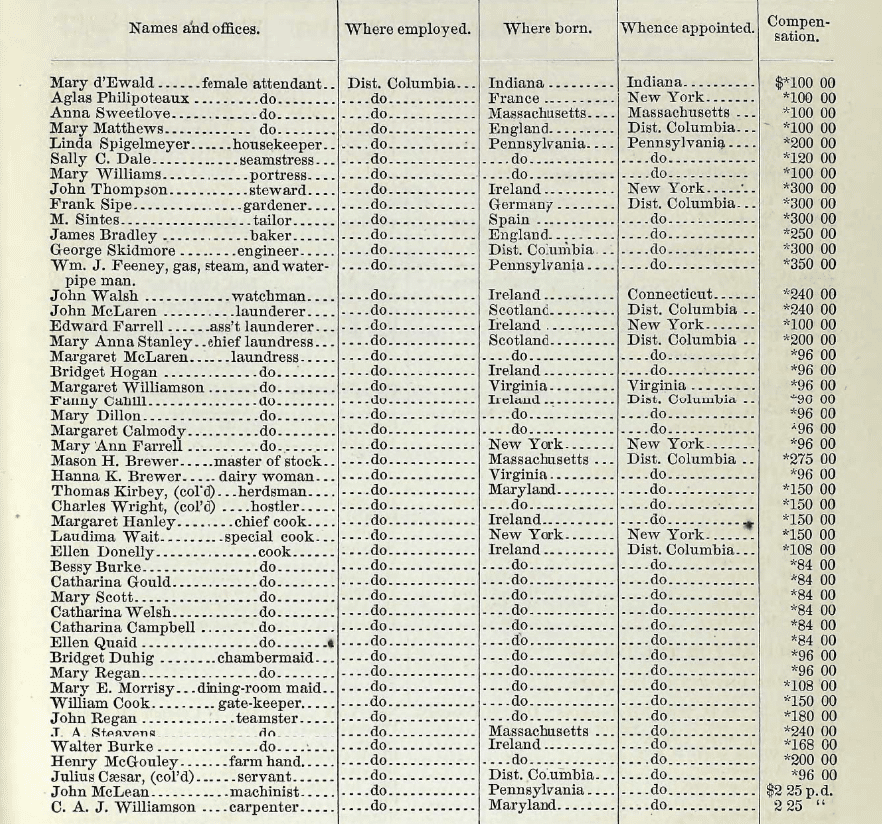
The nationalities of foreign-born employees align with immigration trends of the period, with Ireland, Scotland, and Germany ranking highest. A lone female attendant and one tailor stand out as persons of Spanish and French origin. Three “colored” men are employed at St. Elizabeths in 1863: Thomas Kirbey, Charles Wright & Julius Caesar. Kirbey and Wright were from Maryland and Caesar was likely born in Washington, though it is unclear whether they were free prior to the war or became free by crossing into Union lines under the Confiscation Acts or Emancipation Proclamation. All three employees were hired from within the District, which may indicate the latter option for the former residents of neutral, slaveholding Maryland.[2]
Superintendent Nichols’ salary of $2,500, equivalent of over $66,000 today, could either appear meager for the task of running a wartime asylum or extravagant given that all industries were impacted financially in some way during the Civil War. Supervision, laundry, and cuisine were the three largest departments staff-wise. The slight difference between “housekeeper” and “chambermaid,” the former of which is paid over double the income, can indicate an increase in duties or jurisdiction – especially as more soldiers inundate the grounds. The same could be said for the relatively high number of cooks employed, possibly to accommodate the number of plates provided each day to patients, soldiers, and staff alike.
St. Elizabeths still stands as a massive Kirkbride building, modeled after the treatment methods of physician Thomas Story Kirkbride, although it now houses the Department of Homeland Security. It is quite telling that operations remained essentially normal for a large hospital complex such as the Government Hospital for the Insane, even though its purpose and mission allied with Washington’s overall objectives during the war. Not everything has to dramatically shift in wartime. But by examining seemingly mundane primary sources such as employment roster, we can get a better sense of how institutions adjusted to national conflict.
Madeline Feierstein is an Alexandria, VA historian and founder of the educational & historical consulting company Rooted in Place, LLC. A native of Washington, D.C., her work has been showcased across the Capital Region. Madeline has also written for Emerging Revolutionary War, Civil War Monitor, and the National Museum of Civil War Medicine. She leads significant projects on the history of hospitals, prisons, and wartime America. Her first book, Occupied Alexandria: How the Civil War Transformed a Southern City, will be available in Fall 2026 by The History Press. Madeline holds a Bachelor of Science in Criminology from George Mason University and a Master’s in American History from Southern New Hampshire University. Explore her research and book a guided tour at www.madelinefeierstein.com.
[1] Maryland was unaffected by the Emancipation Proclamation due to its neutral status as a border state, allowing it to still use enslaved labor since it did not count among the “rebel states.”
[2] Ancestry.com. “Government Hospital for the Insane for the District of Columbia, 1863.” U.S., Register of Civil, Military, and Naval Service, 1863-1959. Database (Provo, UT, USA: Ancestry.com Operations, Inc.) 2014, 144-145.


I sure am glad that every building was not affected!
thanks Madeline — great piece … I enjoyed reading your roster of employees as well — some interesting occupations for a mental hospital … were you looking specifically for this reference or did you happen across it?
I also noted that the superintendent was not a physician … that’s not surprising given that the purpose of these facilities was not treatment of mental illness, but custodial care and isolation from society.
Hi Mark! Thanks so much. And actually, I found it while looking at the primary source for a specific surgeon – unrelated to the hospital. Love when things like that happen. As for the superintendent, Charles Nichols was actually a physician. He was previously the superintendent of the Bloomingdale Asylum in New York 🙂