Book Review: Civil War Camps and Soldier Health: Sanitation and Military Effectiveness in the Union Army

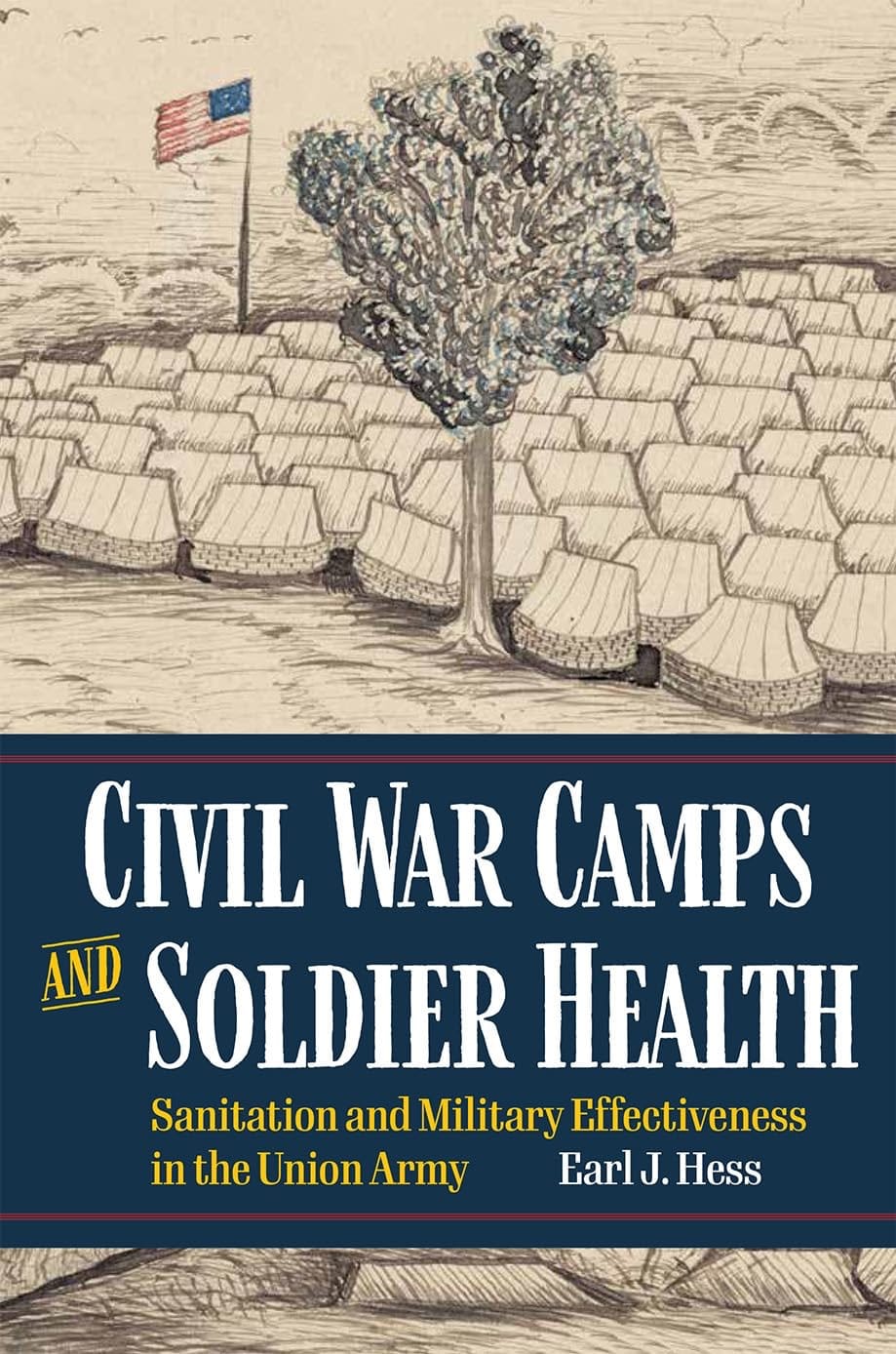
Civil War Camps and Soldier Health: Sanitation and Military Effectiveness in the Union Army. By Earl J. Hess. Kent, Ohio: The Kent State University Press, 2026. Paperback, 344 pp. $39.95.
Reviewed by Sheritta Bitikofer
The story of Civil War camp sanitation has been told primarily through soldiers’ narratives. Officers and privates alike had plenty to say on the topic in letters and memoirs. While these stories are like gold to the average historian looking to recreate a vivid image of camp life, another resource remains largely unmined. In Civil War Camps and Soldier Health: Sanitation and Military Effectiveness in the Union Army, Earl J. Hess has taken great pains to analyze a cross-section of the camp inspection returns documented by U.S. Sanitary Commission officials.
In over 1,400 returns, which are housed in the New York City Public Library, lies a wealth of information regarding the sanitary conditions of semipermanent encampments across the Union army between 1861 and 1864. Commission workers covered fifteen subject areas, including the camp’s environmental situation, types and conditions of shelters, the soldiers’ clothing, personal cleanliness, slops (disposal of food waste), sinks (disposal of biological waste), the quality of food rations, the methods of cooking, the camp’s water, if alcohol was an issue, the general morale of the men, the efficacy of recruit examinations, vaccinations, the state of regimental hospital facilities, and officer supervision to enforce proper sanitary practices among the troops.
It would take an individual several years to evaluate all the returns. Hess took it upon himself to take a sampling of 280 returns, carefully picking inspections conducted between 1861 and 1864, as well as across all geographical locations in which the Union army was stationed during those years, and unit types including Black regiments, to make his selection as representative as possible, all to find any similarities or differences across all the units over time and location. Hess asserts that exploring the details contained in these returns “allows us to craft the deepest and most comprehensive picture of camp life in the Civil War yet presented.” (9)
Before jumping into the meat of his findings, Hess devotes a chapter to telling the story of army sanitation and the commission inspectors who completed the returns he selected. Then, each subsequent chapter tackles the subjects contained within the returns. Hess begins the chapter by giving historical and contemporaneous context to the subject. For instance, in the chapter on clothing, he explains the attitudes and regulations governing soldiers’ clothing in the French army decades before the Civil War to explain decisions made by the Federal government regarding the Union army’s clothing. Then, Hess gives an overview of what soldiers experienced, citing their words to tell the story of things such as their feelings about the sinks or how they divided up their mess parties in order to cook their rations.
These preludes to the return findings help to set the stage for the empirical data Hess gathered from the returns. His method for rating the return’s outcome was broken down into “Good,” “Fair,” or “Bad” based on the yes or no answers given by the commission inspectors in the return or the comments they left to explain their observations. So, if an officer found the camp to have poor drainage or their shelters were inadequate to protect the soldiers from sickness, then the camp might receive a “bad” rating from Hess. However, if the soldiers displayed meticulous personal cleanliness and the water was clean, they would receive a “good” or “fair” score.
To address the second part of his subtitle, Hess discusses the efficacy of the officers in charge of these volunteer forces to uphold the Sanitary Commission’s ideals in all matters of camp sanitation. Ultimately, the commission had no authority to police the camps. They could only make suggestions as to how commanding officers could change routines or methods. It was up to the officers to implement those suggestions. And as many historians know, clashes between officers and outside influences were frequent, whether they be the medical staff assigned to their units or a non-governmental entity trying to tell them what will keep their soldiers out of the sickbed. While it was not the overall majority of the time, this “clash of opinion, hurt feelings, and resentment” between the commission officers and commanding officers could lead to advice on sanitary practices falling on deaf ears. (269) Hess also dedicated a chapter to sanitary conditions in Confederate camps, though they have no body of documentation like the Sanitary Commission returns to give us a statistical approach to understanding their situation. The bulk of the comparisons are drawn from primary source accounts.
Many of the statistical findings and assertions based on the pattern of ratings found in the 280 returns Hess evaluated were fascinating and sometimes contradictory to popular assumptions made about Civil War camp life. Hess’ work is thorough, enlightening, and truly a new, valuable piece to the historiography on Union encampments and sanitation.


Thanks for the great review. Hess is almost always blazing new trails with his scholarship.
Hess is one of the unsung ACW authors out there today, doing yeoman’s work putting out one amazing work after another. I don’t know where he finds the time.
Dr. Earl J. Hess is the man. He continues to cover all the bases (the effects of rifled warfare, infantry tactics, cavalry, supply & logistics, entrenchments, siege warfare) and more with his books.