Minted in Controversy: The 1925 Stone Mountain Half-Dollar
ECW welcomes back guest author Tom Elmore.
Between 1892 and 1958 Congress authorized the minting of 180 gold and silver coins to commemorate 53 different national events, occasions or people, among them, the controversial 1925 Stone Mountain Memorial Half-Dollar.
The idea for the coin came from sculptor John Gutzon de la Mothe Borglum (1867-1941). He had been hired in 1914 by the Georgia United Daughters of the Confederacy (UDC) to make a monument to the Confederacy on Stone Mountain, a giant granite formation located 16 miles east of Atlanta, Georgia.[1]
Borglum’s vision was to carve a sculpture on the mountain. It would feature a central set of three mounted figures: Lt. Gen. Thomas “Stonewall” Jackson, Gen. Robert E. Lee and Confederate President Jefferson Davis. Four other generals, to be determined later, were to follow the trio. These seven figures would be followed by a second group of sixty-five officers. A third group was to feature Lt. Gen. Nathan Bedford Forrest leading his cavalry. Borglum estimated a cost of $2 million (about $66.4 million today) and eight years to complete his concept. [2]
In 1916 owners of the mountain granted a deed to the Stone Mountain Confederate Monumental Association, with the understanding that the carving was to be completed in 12 years or the deed would be forfeited. Due to World War I, actual carving did not begin until June 18, 1923. On January 19, 1924, the head of Lee was unveiled, while work had started on Jackson’s head.[3]

When he was not carving, Borglum was fundraising. He thought a Stone Mountain coin would be an easy way to raise money, and he lobbied Washington for such a coin. On March 6, 1924, the U.S. House unanimously passed a resolution authorizing the coin noting that it honored “the valor of the soldiers of the South, which was the inspiration of their sons and daughters and grandsons and granddaughters in the Spanish-American and World Wars, and in memory of Warren G. Harding, President of the United States of America.[4]
The bill called for a maximum of five million coins to be minted. It was passed unanimously by the U.S. Senate days later and was signed by President Calvin Coolidge on March 24,1924.[5]
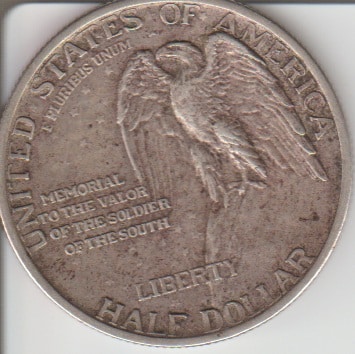
Borglum personally designed the coin. His original plan was for the obverse (front) to have Jackson, Lee and Davis as they would appear on the mountain. The reverse would have an eagle and the tribute to Harding with another tribute to Southern soldiers. Borglum thought it would be an easy task, but meeting government design specifications proved otherwise, resulting in Borglum ultimately submitting nine different designs before getting one approved .[6]
When Treasury Secretary Andrew Mellon asked why the words “In God We Trust” were over the head of Lee, Borglum replied it was because the South trusted Lee. Mellon also wanted to know why there were thirteen stars above the figures, to which Borglum replied, “It all depends on which side of the Mason-Dixon Line you happen to live.” In the north it could be for the thirteen original colonies. These explanations placated Mellon.[7]
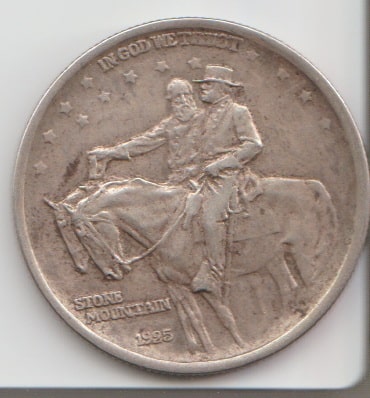
The final design, submitted in October 1924, featured only Lee and Jackson on the front because Borglum thought it was a better coin design. The tribute to Harding was dropped due to revelations of his administration’s scandals. This created a problem because the Philadelphia mint refused to produce the coins without the tribute since it had been ordered by Congress. (Coolidge resolved the issue.) The first 1,000 coins were minted on Jackson’s birthday, January 21, 1925, and issued to the public on March 25. It was hoped to have a ceremony at the White House with Coolidge getting the first coin, but the president declined.[8]
The coins are 90 percent silver containing 0.3617 troy ounces of silver. The remaining 10 percent is copper. All 2.314 million coins, which are still legal tender, were minted in Philadelphia and had no mint marks. It was the second largest mintage of a commemorative coin at the time. The half-dollars were sold for $1 (about $18.40 today).[9]
Back in Georgia, Borglum had new problems. A crack had been found where Jackson’s head was supposed to be carved, forcing Borglum to change the sculpture so that Jackson looked forward instead of facing Lee. It was discovered too late to change the coin’s design, thus the coin would not look like the planned carving. But that was not Borglum’s biggest concern.[10]
Atlanta businessman and politician Hollins Randolph had taken control of the Monumental Association. Publicly he wanted to lead it to advance his political career. However, he used his position to fatten his pockets and those of his friends. Members of the group’s board of directors that had been working with Borglum from the beginning, mainly UDC members, were replaced with Randolph’s cronies. This created tension between Randolph and Borglum, which was further fueled by Randolph being a Democrat while Borglum was a Republican.”[11]
Also, fundraising had halted as the Monumental Association expected a financial windfall from coin sales. This frustrated Borglum because he had not been paid in months and had legitimate questions about where the funds from the coin sales were going.[12]
Borglum took his concerns to Washington and personally asked Coolidge to stop distribution of the coins. He also shared his concerns with the Associated Press. This was the final straw for Randolph, who had Borglum fired on false allegations.
In anger, Borglum destroyed all his molds and took his papers with him. The association took out a warrant for Borglum’s arrest claiming all molds and papers related to the Stone Mountain carving belonged to them. But Borglum fled to North Carolina, where the governor refused to extradite him. He went on to carve the heads of four presidents on Mt. Rushmore in South Dakota.[13]
As for the coins, they were distributed to 3,000 banks across the country. The association hired agents and publicists to promote the coins across the country. However, the controversy over Borglum’s firing harmed sales and about one million coins were returned to the mint to be melted down. Interestingly, the coins were not mentioned in any of the 1924 and 1925 issues of Confederate Veteran Magazine, the official publication of the United Confederate Veterans. Not surprisingly, the Grand Army of the Republic opposed it.[14]
Borglum’s concerns about the association were justified. A 1928 audit showed that in the previous three years the association had collected $977, 235 of which only $164,352 (19 percent or 27¢ on the dollar) was spent on the monument. The rest was spent on expenses, including $223,806 on salaries (about 23 percent). This was the end of the association.[15]
An estimated 470,000 Stone Mountain half-dollars still exist. They are often sold at coin shows, Civil War shows, and online coins and auction sites. It is considered one of the easiest and cheapest commemorative coins to obtain. Depending on the coin’s grade or condition, a collector can usually find one for under $100. (Fluctuations in the silver market can affect their value.)[16]
Today almost everything associated with the Confederacy is a source of controversy, and the Stone Mountain Memorial, completed in 1972, is no exception, with some critics calling for the carving to be blasted off the mountain. Somehow, it seems fitting that a coin born in historical political controversy would also be attached to a modern social controversy.
Tom Elmore is a member of the American Numismatic Association. He has contributed several articles to ECW on the Civil War in pop culture.
Endnotes:
[1] David B. Freeman, Carved in Tone-The History of Stone Mountain (Macon, GA., Mercer University Pres, 1997), 57-61.
[2] Freeman, 60-61. Dollar values from Measuring Worth, www.measuringworth.com.
[3] Freeman, 63, 70, 75. Borglum worked non-stop for six weeks to finish Lee’s head.
[4] Freeman, 81, United State Mint, www.usmint.gov/learn/coins-and-medals/commemorative-coins/commemorative-coins-1892-1954, Stone Mountain Memorial Half Dollar, U.S. Mint, www.usmint.gov/learn/coins-and-medals/commemorative-coins/stone-mountain-memorial-half. Harding had died unexpectedly on August 2, 1923, probably from heart disease.
[5] 1925 Stone Mountain Memorial Half Dollar, American Numismatic Association, www.money.org/1925-stone-mountain-memorial-half-dollar, Freeman, 81, 83-85.
[6] Freeman, 82.
[7] Freeman, 82.
[8] Freeman, 82-83, 99; 1925 Stone Mountain Memorial Half Dollar, American Numismatic Association, www.money.org/1925-stone-mountain-memorial-half-dollar.
[9] 1925 50C Stone Mountain (Regular Strike), Professional Coin Grading Service, www.pcgs.com/coinfacts/coin/1925-50c-stone-mountain/9378.
[10] Freeman, 76.
[11] Freeman 76-78. Henry Augustus Lukeman was hired as Borglum’s replacement as designer/sculptor. What is on the mountain today is based on his original concepts, modified by Walker Hancock and Roy Faulker.
[12] Freeman, 83-85.
[13] Freeman, 85-86.
[14] Freeman, 99-100; Stone Mountain Memorial Half Dollar. 1925 Stone Mountain Memorial Half Dollar, AMPEX Knowledge Center, May 25, 2022, learn.apmex.com/learning-guide/coin-collecting/commemoratives/stone-mountain-memorial-1925. There were promotions with rail lines, banks, insurance companies and Coca-Cola. Some coins were “double stamped” and sold at higher prices.
[15] Freeman, 119-123; The owners of the mountain reclaimed their deed. Randolph died in 1938 at the age of 66.
[16] 1925 50C Stone Mountain (Regular Strike).


I have one! Several years ago, my husband worked at the Sheetz gas station in Locust Grove, Virginia. He found it among the change in the cash register there and brought it home (he only paid the 50 cent face value for it). Neither of us knew that such a coin existed until he found that one.
Thank you for the interesting and informative article.
thanks Tom … this tale has everything: reconstruction, fiduciary malfeasance, monument wars, the Lost Cause, the GAR and the UCV/UDC, United States currency with Confederates on it, and coin collecting — great story!!
Tom, thank you. An interesting story. Question – how did Coolidge resolve the absence of Harding tribute issue?
He personally told the Philadelphia mint to move forward with the coin is all I know.
He personally told the Philadelphia mint to go ahead and produce the coin.