Sifting out the Hearts of Men: Major Generals in the Union Army
ECW welcomes back guest author Kyle Hallowell.
Of the nearly 1 million men who served in the Union armies, only 492 men held the rank of major general in its four different grades.[1] As the war expanded in scope and scale, the need for major generals became acute. This demand forced the Federal Government, states, and Regular Army to “sift out the hearts of men” and determine which ones displayed the ability to lead “armies-in-miniature” and fill key staff positions. This was done by developing a process to identify, promote, and protect competent officers.
To do this, the U.S. government had to overcome obstacles presented by politics, parochialism, and the availability of qualified personnel. This process was aided by attrition and increased domestic political support for the Republican Party, which enabled the promotion and removal of men regardless of seniority. Working in tandem, Lincoln, Congress, and the War Department ultimately created a system that produced victory.
Before going further, it is necessary to state that four different grades of major general existed, and several men, such as George G. Meade, served at different grades during the war.[2] Bearing this in mind, when comparing major generals, it is necessary to note whether they hold their commissions in the Regular or Volunteer Army and if their rank is brevet or full. In hierarchical order, the four ranks of major general are: major general, U.S. Army; brevet major general, U.S. Army; major general, U.S. Volunteers; and brevet major general, U.S. Volunteers. Within these ranks, seniority was determined by comparing the amount of time an officer served at that rank, a factor known as date of rank. Full rank promotions were granted to major generals in the U.S. Army and in the U.S. Volunteers; however, promotions in the U.S. Army were permanent and granted the recipient retirement pay. This guaranteed expenditure of federal government money gave Congress the authority to confirm officers nominated by the President to serve as major generals. In contrast, brevet promotions were temporary and honorific in nature and came with no lawful guarantee of retirement pay; therefore, the majority of major generals were brevet.
At the outset of the war, the United States was constrained by its decades-old practice of maintaining a small Regular Army in peacetime, supplemented by volunteers in wartime. This concept allowed the Federal Government, the states, and the Regular Army to have their interests considered when promoting men to major general. However, these varying interests and the lack of an established retirement system resulted in a glacially slow promotion rate and officers remaining on active duty until infirmity. In addition, the financial obligation of guaranteed retirement pay incentivized Congress to promote a few nominated officers and avoid making a hasty decision. The demands imposed by the war quickly rendered this practice obsolete, necessitated rapid promotion of officers, and presented rare opportunities for the parochial interests of Congress and the professional soldier class to ensure long-term influence within the U.S. Army.
Early in the war, the Regular Army was expanded, but not to a large enough size to fight the war on its own, requiring supplementation by volunteers. A separate and distinct army was raised, titled the U.S. Volunteer Army, which was composed of regiments recruited from the states. When the federal government called on the states to raise these regiments, the governors turned to men with military training to serve as colonels of these regiments. This system allowed for patronage and helped to buttress political support for the war.
However, the Federal Government retained the right to promote general officers, which served as a means of patronage and a method to ensure the Army would be led by trained professionals.[3] As the Union armies grew, the formation of corps became necessary, prompting Lincoln to issue Executive Order No. 2, which directed the creation of corps and created legal justification for more major generals.[4]
Because these two separate armies existed simultaneously, it was possible for the same person to hold different ranks in both. This is important because when the war ended, the U.S. Volunteer Army would be demobilized, and the Regular Army would return to duty. If a Regular Army officer was a major general in the U.S. Volunteers and colonel in the Regular Army, upon demobilization, he would revert to the rank of colonel. This made promoting a man to major general in the U.S. Volunteers a less vexing proposition than doing so in the Regular Army, though it carried less prestige. The majority of major generals held commissions of volunteers, and their promotion incurred little risk to the professional soldiers. This is where the preponderance of the much-maligned “political generals” held their commissions.
The differentiation between these ranks directly served the interests of the professional soldiers, who ensured that their peers were promoted in influential staff positions and department commands within the Regular Army. The distribution of personnel across the different grades of major general, as shown in Figure 1, confirms this.[5] This parochialism also had an added benefit; it ensured that dilettantes did not hold positions requiring specialized knowledge of military science, typically known by professionally trained soldiers.
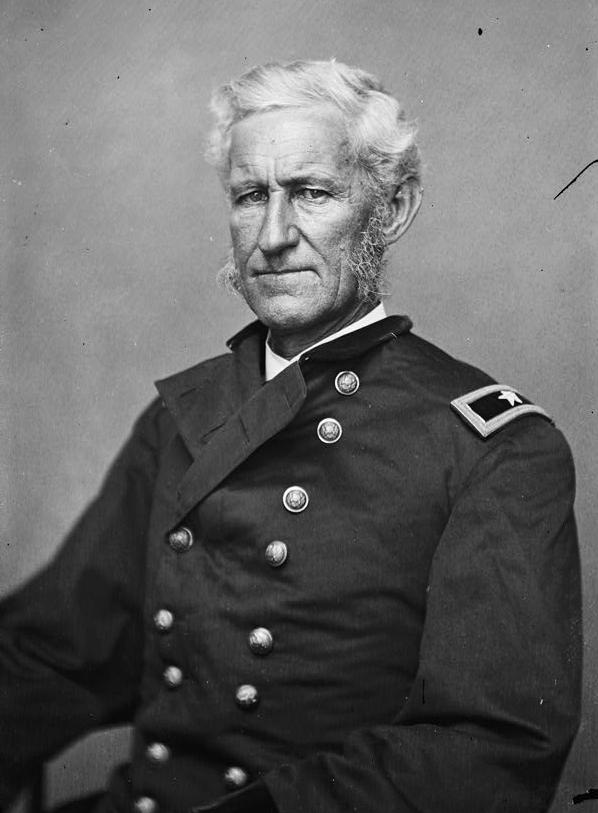
While many volunteer officers led corps and divisions, very few served in key staff positions, such as adjutant general. For example, Brig. Gen. Lorenzo Thomas, who previously served as Winfield Scott’s chief of staff, was made adjutant general of the U.S. Army in 1861 and promoted to major general on March 13, 1865. Thomas’s opinion was valued by Abraham Lincoln, as evidenced by his accompanying Assistant Secretary of War Charles A. Dana to observe and report on Ulysses S. Grant’s administrative abilities in April 1863.[6]
Of the 11 Regular Army major generals, eight went to West Point, and all commanded armies, departments, or both.[7] The three who did not attend West Point were Winfield Scott, John C. Frémont, and John E. Wool, all of whom were already serving as general officers or had previously served in that capacity prior to the war.
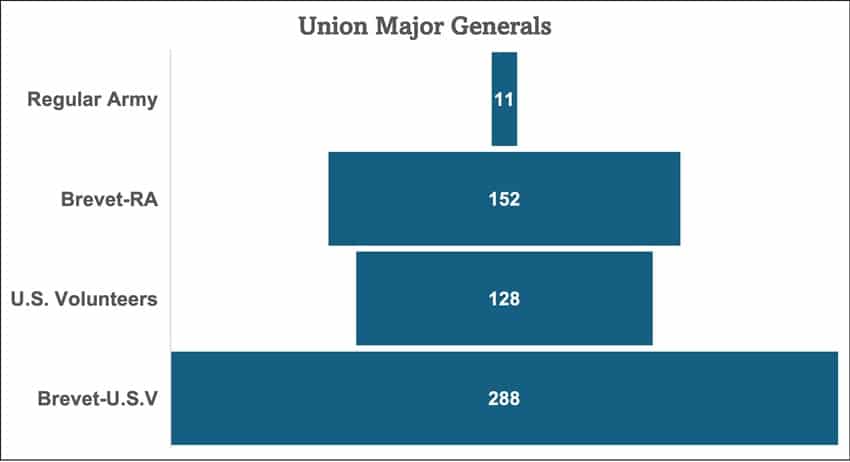
Of the 152 brevet major generals in the Union Army, 99 served in a line command, 40 in a staff position, and 13 in both. Of the 152 brevet-major generals in the Regular Army, 124 of them went to West Point, with the preponderance of them serving in line command positions.[8] Only five non-West Point-educated men served in staff assignments: Joseph Holt as judge advocate general, and John Rawlins and Daniel Butterfield as chiefs of staff. The other two, Charles Thomas and George Gibson, were career officers commissioned decades earlier and had the requisite experience to be identified as professional soldiers. Notable non-West Point graduates include Daniel Butterfield and Daniel E. Sickles.
Lincoln derived his political support from a coalition of opposing groups and had to ensure that members of these groups were represented in the Army, which forced him to appoint men with minimal to no military training as major generals and to retain those who had proven less than capable. In contrast, many of the Union’s most successful major generals benefited from having a political benefactor. These appointments highlight the political aspect of promoting men to the rank of major general.
The first man promoted to major general in the Regular Army during the war was George McClellan, who, along with Irvin McDowell, benefited from their connection to Secretary of the Treasury Salmon P. Chase and the state of Ohio.[9] The last officer to be promoted to brevet major general in the Regular Army during the war was Francis Fessenden, whose father was a senator from Maine, and two of his uncles were congressmen. Fessenden received a commission as a captain in the Regular Army in 1861 and was promoted to major general on March 13, 1865.[10]

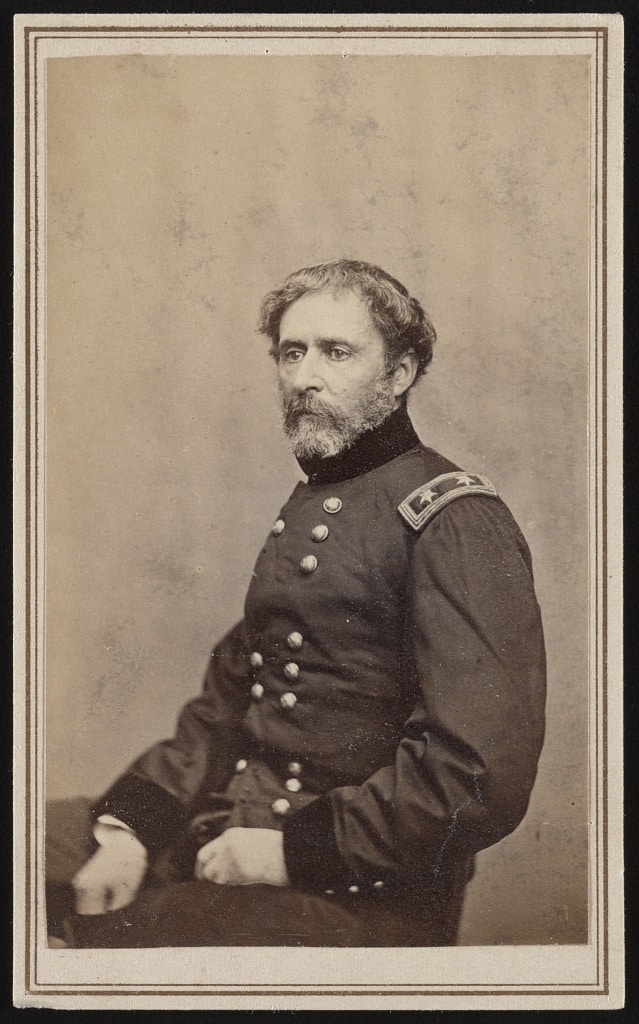
Following McClellan, John C. Frémont, the first-ever Republican nominee for president, was promoted to major general. Nathaniel P. Banks, an abolitionist republican, and Benjamin Butler, a democrat, were promoted and given high commands to ensure bipartisan support for the war. Once Lincoln was re-elected and his reliance on bipartisan support was reduced, Butler was fired.
At the outset of the war, the federal government was plagued by the presence of feeble or inept officers who held higher dates of rank than younger, more capable men.[11] Officers with earlier dates of rank legally had a claim to occupy high positions and could only be removed if sufficient justification existed or the political fallout from doing so could be minimized.
To overcome this, Lincoln decided to override the traditional practice of awarding rank and command based on seniority and delegated this authority to his Army commanders.[12] This decision cleared the way for men of ability to rise. For example, George Gibson was 86 years old and still on active duty as the Army’s commissary general when he died in 1861. His death cleared the way for the younger Joseph P. Taylor, who died three years later. These deaths were fortuitous for the Union Army because they resulted in the promotion of Amos B. Eaton to the post of commissary general of subsistence. Eaton proved essential to reforming the supply and provisioning system for the Union Army.[13]
Through repeated trial and error, the U.S. government developed a process that overcame politics, parochialism, and the lack of qualified personnel to ensure that competent men served as major generals. While this process did not always yield optimal results, the Union leveraged the talent of its major generals to achieve victory.
Kyle R. Hallowell is an active-duty U.S. Army Strategist assigned to the Headquarters, Department of the Army in the Pentagon. He holds a master’s in International Policy from Texas A&M University and a BA in History from Norwich University. He has been passionate about the Civil War since childhood and lives in Northern Virginia with his wife and sons.
Endnotes:
[1] Frederick Phisterer, Campaigns of the Civil War-Statistical Record of the Armies of the United States (Edison, New Jersey: Castle Books, 2002).
[2] Meade was promoted to major general-U.S. Volunteers on 29 November 1862 and then promoted to full rank Major General-U.S. Army on 18 August 1864
[3] The first man promoted to major general in the Regular Army after Winfield Scott was George McClellan, who was from Ohio, which was the home state of Secretary of the Treasury and Presidential aspirant, Salmon P. Chase. Following McClellan, John C. Frémont, the first ever nominee for President was promoted to major general.
[4] “Executive Order—President’s General War Order No. 2,” The American Presidency Project, The University of California Santa Barbara, accessed 30 June, 2026, 2026, https://www.presidency.ucsb.edu/documents/executive-order-presidents-general-war-order-no-2.
[5] Note that figure 1 is based on the total number of generals in that grade specifically and includes officers who were major generals at different grades, such as Ulysses S. Grant and George G. Meade.
[6] T. Harry Williams, Lincoln and His Generals, First Vintage Civil War Library Edition ed. (New York, NY: Vintage Books 2011, 1952, 2011), 227.
[7] The methodology I used for determining this was to refer to the lists provided in Campaigns of the Civil War-Statistical Record of the Armies of the United States and research the listed individuals.
[8] I used the same methodology as above.
[9] Stephen W. Sears, George B. McClellan: The Young Napoleon (Houghton Mifflin Harcourt, 2014), 72.
[10] Phisterer, Campaigns of the Civil War-Statistical Record of the Armies of the United States.
[11] Ethan S. Rafuse, ed., Corps Commanders in Blue: Union Major Generals in the Civil War, Conflicting Worlds: New Dimensions of the American Civil War (Baton Rouge, Louisiana: Louisiana State University Press, 2024), 85.
[12] H.W. Halleck to Maj. Gen. George G. Meade, 27 June 1863, Original Records, 27 (1):61.
[13] Matt Callary; Rich Kohr, Food and Nutrition at the Battle of Gettysburg, Addressing Gettysburg (Callary, Matt, 2025).


If you look at a list of the highest ranking union officers at the end of the Civil War, one will find an awful lot of men from Ohio. Was there something in the water? Or was there undue politics? Then consider General Grant at the top. Born and sent to West Point from Ohio. Then family moved to Illinois where his father garnered more politicians for him there. No wonder he survived several catastrophes which would have undone better generals. All others were out with one catastrophe!
Compare to General George H. Thomas from Virginia. He made the list with no political pull. And with General Grant and General Sherman undercutting him most the way. Think of the military skill required for that feat. One can say that Grant had the ultimate political power of firing Thomas for any perceived mistake. And he tried. But that darn Thomas keep winning battles.
Excellent point – I’ve long wondered about that – and look at how many Presidents from Ohio we had immediately following the war….
Great stuff – clearly and cogently presented. Very valuable for historians.
thanks Kyle, good stuff … have you done any demographics on these various general officer cohorts: average (or median age), home state, occupation, etc? And I had a quick seniority question: For a long serving MG of volunteers (like Banks or Butler), would they rank a more recently promoted MG in the regular army.
Sir,
Thanks for your question; age wasn’t a metric I considered in my research. However, based on my knowledge, the average age of a Major General dropped as the war progressed. Notable examples include James McPherson, George A. Custer, and Oliver O. Howard. I have also found it highly poetic that Grant is promoted to Lieutenant General at 43, the same age as Washington when he was promoted to General, which was then a three-star rank. War is a young man’s game.
Regarding home state, that may be the topic of a future article, as I have long been interested in Ohio’s influence during the war compared to other states. However, I can tell you that of the 18 Union Major Generals at Gettysburg, New York is the mode, with it being the home state of Butterfield, Doubleday, “Dangerous Dan” Sickles, and Slocum.
thanks Kyle … more good stuff … i had no idea there were that many two stars from NY at Gettysburg … and i never made the connection between Grant and Washington getting both their three stars and army command at 43 … that was a good thing for George as he had long haul as CG of the Continental Army — eight years, without one day of leave.
Excellent piece – highly informative and interesting.
Brevet commissions were permanent, not temporary. Being assigned to duty according to one’s brevet grade by order of the President was, at most, temporary…
This is a nice, succinct piece of scholarship. Well done.