Back Behind the Mic to Record my Own Book
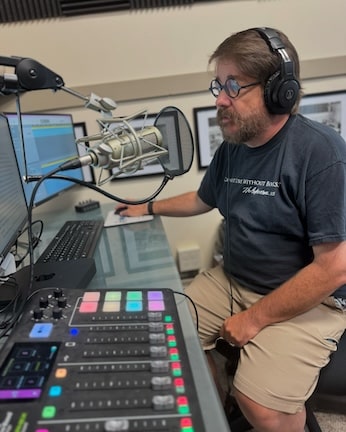 It was just over forty years ago when I first stepped behind the mic at a radio station. I was sixteen and a junior in high school. It was career day, which I was not taking particularly seriously, and I requested to shadow a disc jockey for the day. This would be easy and fun, I thought. It was an experience that changed my life.
I visited a small AM station in Penn Yan, New York: WQKA. The man who would become my mentor and lifelong friend, Mark Feiock, put some index cards and news from the wire in front of me in their production studio. I was told that they would record me doing a newscast. But they did not tell me that I would be reading the news live. Faculty and staff back at my school were told this would happen, so the whole school tuned in. Apparently, I did well. The management at the radio station considered it an audition, and they subsequently offered me my first job in radio. This led to nearly a ten-year career that would take me to more than a dozen stations in New York and New England. It was a great, if not particularly well paying, trip while it lasted.
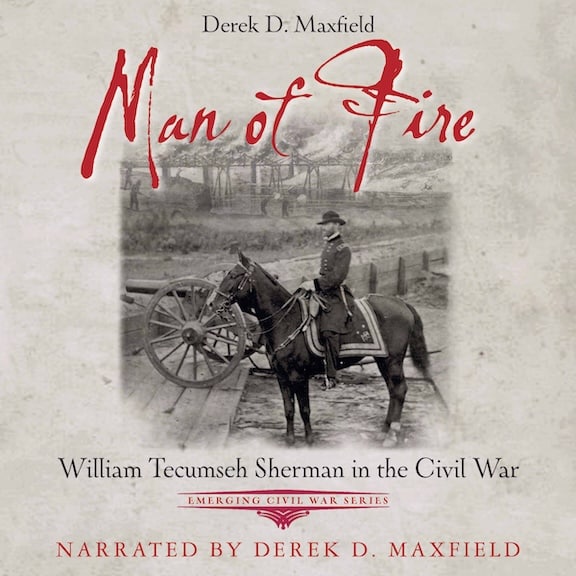
Fast forward to 2024. My ECW book Man of Fire: William Tecumseh Sherman in the Civil War had come out the previous year. It was a book that was deeply personal to me, and I strongly advocated for the opportunity to record the narrative for the audiobook. My request was granted, and I began to ponder the technical requirements and logistics.
It came to my attention that Go Art! (Genesee-Orleans Regional Arts Council) in Batavia, New York–where I had held my book launch party for Man of Fire–had a studio that I could use. There was a grant that meant that I would not have to pay a fee for use. It seemed like the perfect situation. So over the summer I recorded the narrative in about six weeks.
I kinda thought that getting behind the mic again would be like riding a bike–it would just all come back to me. The rust was apparent from the beginning, and early recordings were rough. It did not help that I was unfamiliar with the audio technology and had to learn on the fly. I also realized that I needed to use my voice differently. In my career as a professor of history, I was accustomed to using my classroom voice and projecting. Instead, I needed to modulate and think “NPR voice.” That adjustment led to better results, and I found that I developed a rhythm and everything became easier.
I believe that if an author has the capacity, they should record their own books. They know their story, can anticipate the text, know the pronunciations, and know where to place an emphasis. Besides, it is a great experience and brings you closer to your work (though reading your work can also suggest to you that your writing would have benefited from better phrasing!).
And now, Man of Fire, the audiobook, is available on Amazon via Audible. Despite the long wait and various obstacles, I am glad for the experience. It brought back fond memories of my early radio career and checked off a major item on my bucket list. But it would not have been possible without the good folks at Go Art!, my wife Jess who guided me as I navigated the audio technology (so different from cart machines and magnetic tape), my editor ECW’s own Darren Rawlings (who has the patience of a saint), Chris Mackowski, editor of the ECW Series, and his son Jackson, who is an amazing audio engineer. And though I tested his patience time and again, the whole enterprise would not have been possible without the support of Ted Savas, my publisher. I am deeply grateful to them all.
Now, rush out and get that audiobook! Let me know how you like it. (Click here to order)


An interesting challenge. How long did it take? What is you have a voice like Mickey Mouse?
I wish you would have included a link to buy the audiobook
We added one, but here it is for you, as well:
https://www.audible.com/pd/Man-of-Fire-Audiobook/B0HCPQY5H4?source_code=ASSGB149080119000H&share_location=pdp