Confederate Naval Assets on the Big Black: Dot, Charm, and Paul Jones
ECW welcomes back guest author William M. Koch.
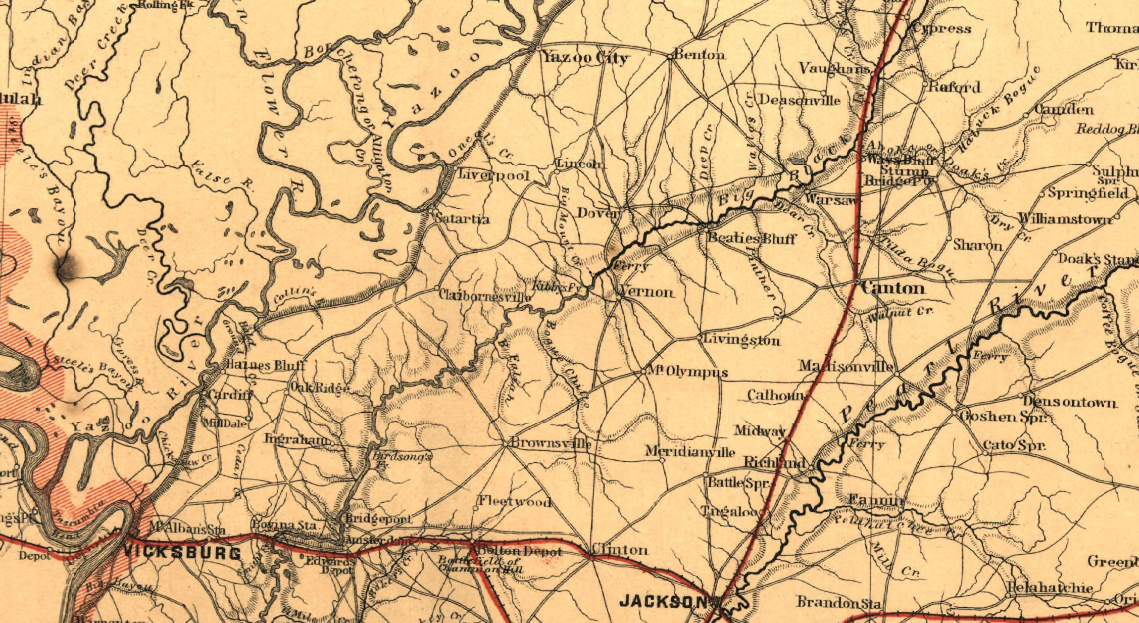
On May 16, 1863, Confederate Lt. Gen. John C. Pemberton’s army was defeated by Maj. Gen. Ulysses S. Grant and his army at the battle of Champion Hill. One of Pemberton’s divisions, commanded by Maj. Gen. William W. Loring, was cut off during the retreat and was unable to rejoin Pemberton. A Confederate rear guard commanded by Brig. Gen. John S. Bowen attempted to hold a position on the east side of the railroad crossing of the Big Black River to buy time for Loring, whom Pemberton did not know was marching away from any potential junction of the two forces. Bowen’s troops were routed on May 17, and during the retreat, the steamboat Dot, which was serving as an ad hoc bridge, was burned.[1] Five hundred yards downriver, the steamboats Charm and Paul Jones were burned as well.[2] What was the history of these ships, and how did they end up on the Big Black?
The sidewheel steamer Paul Jones was built in 1855 at McKeesport, Pennsylvania. Originally running between Pittsburgh and New Orleans, the vessel served as a young Samuel Clemens’ (later to be known as Mark Twain) introduction to the life of a steamboatman. After a brief period being owned by a group of New Orleans towboat companies, the Paul Jones came under the management of Capt. Franklin Keeling in October 1858. Keeling ran the steamboat on the route from New Orleans to the Ouachita River town of Camden, Arkansas.[3]
Paul Jones and a ferryboat were evidently near Vicksburg, Mississippi in August 1862, and by mid-November 1862, Paul Jones was one of a number of steamboats which, according to intelligence received by Union Maj. Gen. William T. Sherman, were on the Yazoo River.[4] The vessel was earmarked for an early March 1863 attempt to salvage the wreck of the Union ironclad Indianola, but Bowen reported the ship to be “in a disabled condition” as of March 19 at Allen’s Mills.[5] Allen’s Mills was evidently located along the Big Black River, and Paul Jones was trapped on that body of water when Grand Gulf, Mississippi was taken by Union forces on May 3.[6]

Charm, a sidewheel steamer, was built at Cincinnati in 1860 and spent her antebellum days in the Vicksburg and Yazoo River areas.[7] The boat was unloading supplies at the Confederate fortified position at Columbus, Kentucky on the morning of November 7, 1861, when Grant attacked a Confederate encampment across the Mississippi River at Belmont, Missouri. Charm joined several other steamers in transporting reinforcements and supplies across the river and was repeatedly hit by Union fire during the battle.[8]
Charm later played a form of hide-and-seek with Union forces on the Mississippi River. On March 11, 1863, Charm was tasked with transporting cannons from the Big Black Bridge downriver to Grand Gulf, but a change in plans led to the vessel instead running down to the Red River, collecting supplies from areas upstream of the Red, and then returning to the Big Black, taking advantage of a temporary lapse in the blockade of the mouth of the Red River.[9]
Charm and the steamboat Hine ferried two of Bowen’s regiments and part of an artillery battery from Grand Gulf across the Mississippi to contest Grant’s move down the Louisiana shore of the Mississippi River in early April 1863. Later that month, an attempt by Charm to supply the garrison at Grand Gulf was driven off by Union naval gunfire when the attempt coincided with a Union reconnaissance. The steamboat ferried part of Brig. Gen. Edward D. Tracy’s brigade across the Big Black on the morning of April 30, as part of Confederate preparations for what became the battle of Port Gibson. Like Paul Jones, Charm was also trapped on the Big Black by the fall of Grand Gulf.[10]

Less is known about the Dot, which was built in 1862.[11] Dot had run down the Red River with a load of 200,000 pounds of bacon and navigated up the Mississippi River to the Big Black, reaching the Big Black Bridge on April 8. Like Paul Jones and Charm, Dot was also trapped in the Big Black by the occupation of Grand Gulf. At the Big Black Bridge, on May 15, the vessel’s machinery was removed, and Dot was positioned lengthwise across the river to serve as an approximation of a bridge before being destroyed as Confederate troops retreated.[12] The ship’s owners were paid $24,000 as compensation for the loss of the ship.[13]
Edwin C. Bearss’ incomparable Vicksburg trilogy mentions a fourth steamer isolated on the Big Black by the fall of Grand Gulf, the Bufort. The vessel is further stated to have been located at Big Black Bridge in early May, loaded with 115,512 pounds of rice while Dot had at that time a cargo of harness.[14] This is derived from a single reference in the Official Records in the form of a correspondence from one of Pemberton’s aide-de-camps to Bowen dated May 5, 1863.[15] Way’s Packet Directory does not list a Bufort, Beaufort, or Buford.[16] Whether this represents a minor vessel otherwise lost to history, an alternate name of another vessel, or a Confederate intelligence error is not clear.
What remains of these wrecks today? The wreck of Charm was exposed in 1962 by riverbank erosion, and what was left of Charm and Paul Jones was visited by divers in August of that year. The wrecks have been visible during periods of low water a few times since, and part of Charm’s machinery was put on display at the Grand Gulf Military Park.[17] Presumably remains of metal fittings or charred timbers are still left from Dot, although the removal of machinery when the vessel was converted into a makeshift bridge may have taken away most of the metal parts substantial enough to survive 160+ years in river water.
William M. Koch has had a strong interest in the Civil War since a childhood visit to Wilson’s Creek National Battlefield. He is a certified public accountant and resides in southwestern Missouri.
Endnotes:
[1] William L Shea and Terrence J. Winschel. Vicksburg is the Key: The Struggle for the Mississippi River (Lincoln, NE: University of Nebraska Press, 2003), 137-139.
[2] Edwin C. Bearss. The Vicksburg Campaign. Volume II: Grant Strikes a Fatal Blow (Dayton, OH: Morningside House, Inc., 1991), 677-678.
[3] Frederick Way, Jr. Way’s Packet Directory, 1848-1994 (Athens, OH: Ohio University Press, 1994), 364.
[4] The War of the Rebellion: The Official Records of the Union and Confederate Navies, Series I, Volume XXIII, 296-297, 487-488.
[5] ORN, Series I, Volume XXIV, 412, 497.
[6] The War of the Rebellion: The Official Records of the Union and Confederate Armies, Series I, Volume XXIV, Part III, 175; Bearss, Grant Strikes a Fatal Blow, 431, 656.
[7] Way, 81.
[8] Nathaniel Cheairs Hughes, Jr. The Battle of Belmont: Grant Strikes South (Chapel Hill, NC: University of North Carolina Press, 1991), 65-69, 26, 139
[9] Edwin C. Bearss. The Vicksburg Campaign. Volume I: Vicksburg is the Key (Dayton, OH: Morningside House, Inc., 1985), 603-604, 689.
[10] Bearss, Grant Strikes a Fatal Blow, 33, 348, 656; ORN, Series I, Volume XXIV, 605-606.
[11] Way, 132.
[12] Bearss, Grant Strikes a Fatal Blow, 97-98, 656; ORA, Series I, Volume XXIV, Part II, 69.
[13] S.H. Lockett to P. Murphy, February 1864, D-17, Confederate Vessel Papers: Papers Pertaining to Vessels Involved with the Confederate States of America (Records Group 109), National Archives Building, Washington, DC.
[14] Bearss, Grant Strikes a Fatal Blow, 452-453, 656.
[15] ORA, Series I, Volume XXIV, Part III, 834.
[16] Way, passim.
[17] W. Craig Gaines. Encyclopedia of Civil War Shipwrecks (Baton Rouge, LA: Louisiana State University Press, 2008), 83, 87; Way, 82, 364.


Very interesting. I’m familiar with Loring from my 1861 research when he fought in western Virginia. I had no idea he was sent out west.