AI and the Mysterious Mountain at Spotsylvania Court House
 An image came up on my Apple News feed this week that immediately caught my eye and simultaneously surprised me.
The image advertised an article in History of War titled “The Bloody Angle: Inside the Civil War’s most brutal 20-hour hand-to-hand combat.” (In the interest of full disclosure, the article was part of the Apple News+ feature, which I don’t subscribe to, so I haven’t read the actual article.) Here’s the image someone used as a thumbnail to help advertise the article:
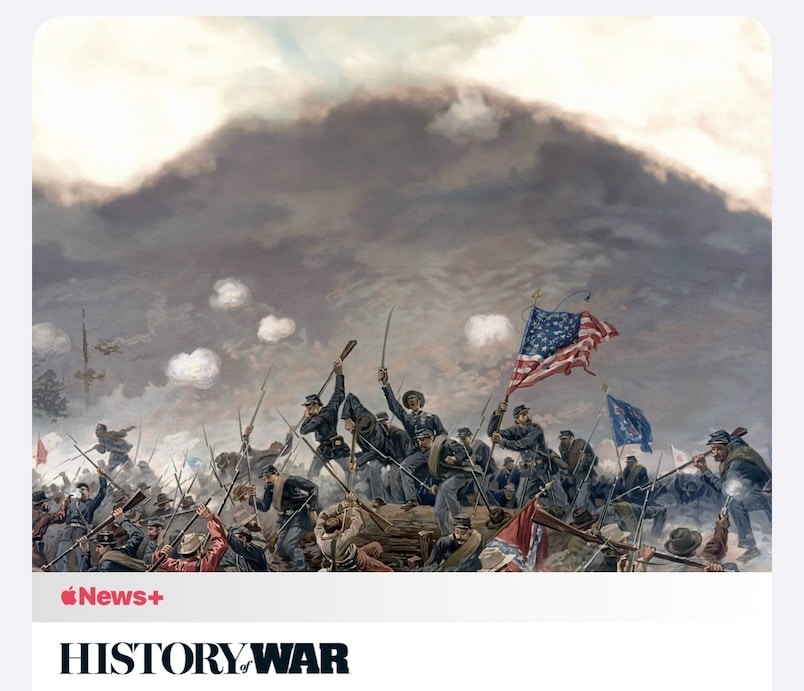
The bottom of the image features combat depicted in a widely circulated 1887 painting by Thure de Thulstrup, The Battle of Spotsylvania Court House. A lithograph of the image hangs in my home, and for years, a version of the image appeared on the brochure for Fredericksburg and Spotsylvania National Military Park. It’s one of the few paintings in existence that depicts the battle of Spotsylvania Court House.
What struck me, though, was the juxtaposition of part of that painting against a backdrop that seems to suggest a tall mountain in the background.
There are no mountains on the Spotsylvania battlefield.
One part of the battlefield is known as Laurel Hill, but that’s little more than a gently sloping field with lots of tumultuous hills and swales around it. In fact, that’s the best way to describe nearly the entire Spotsylvania battlefield: tumultuous hills and swales.
There was an actual Laurel Hill about a mile or so to the east of the battlefield, but the part of the field we today call Laurel Hill was actually part of Sarah Spindle’s farm and is more appropriately called Spindle Field. It sits to the east of the Bloody Angle, depicted in the painting.
To the west of the Bloody Angle stands Myers Hill, shrouded in woods today but mostly open at the time—but in the completely opposite direction of the perspective shown in the painting.
In neither case are any of the hills large enough to loom menacingly in the background.
I might seem nit-picky here but for two reasons. First, when I give tours of the battlefield, I concentrate a lot on topography. It’s a key part of nearly any battlefield, but it really dictates the flow of events at Spotsy. Tying the battle narrative to the ground makes the whole thing story into place for a visitor.
Second—and, really, the much larger point—is that so much AI-generated history material is showing up online these days that the line between real and fabricated content is getting blurrier and blurrier. This image might not even be A.I., to be honest, but the fact that I can’t even tell is part of the problem.
My friend Nick Sacco, a historian in St. Louis, made an interesting video about this very topic earlier this week. Nick did a little digging about an “author” who’s written more than 70 history books, including one on Ulysses S. Grant. Nick’s assessment: “A lot of new history ‘scholarship’ is AI slop.”
If you follow Nick’s work at “History Beyond Black and White” (and if you don’t, you should—fascinating stuff!), you know he uses digital technology to colorize historical black-and-white photos—a process he does by hand using a digital pen and pad connected to his laptop. “I do everything from researching the colors (to the best of my ability), to editing the photo, to applying color,” he told me. He’s been doing it for five years, but lately, “AI colorizations have flooded the internet and really degraded what to me is an interesting art form.”
While he sees a potential use for AI as a tool for processing large data sets, he’s “generally opposed to AI usage in the humanities, liberal arts, and creative arts more broadly.” He used the example of the AI “author” in his video to make his point.
My friend and longtime collaborator Kris White offered me another example this week. He asked AI to generate a map of the “theaters of the Civil War.” Here’s what AI gave him:
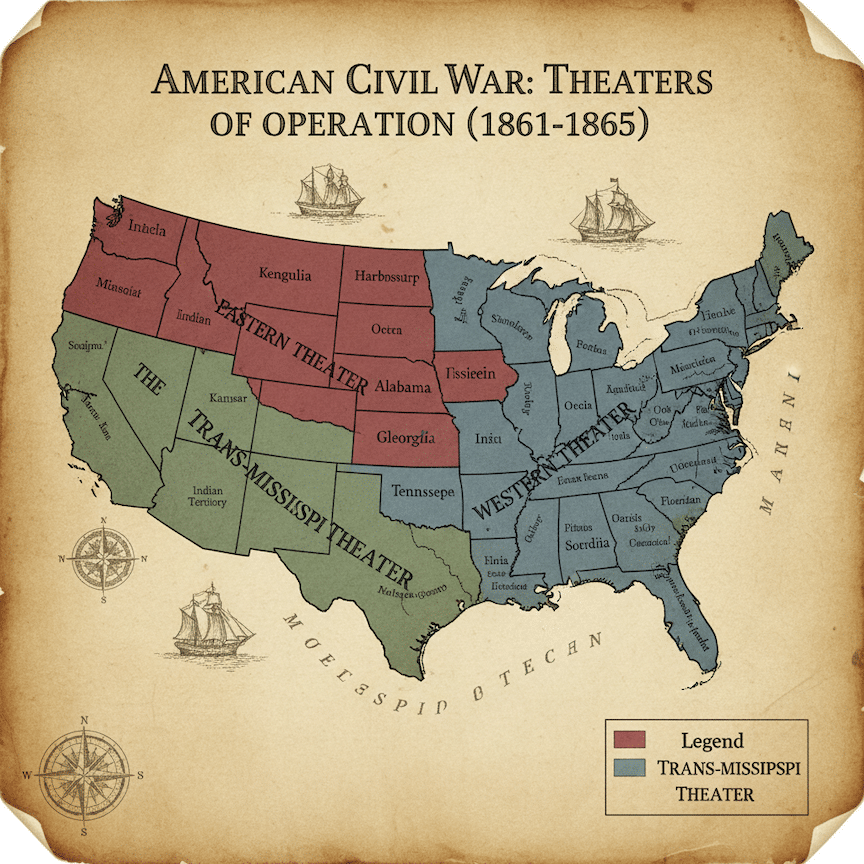
For anyone curious about the prompt Kris used, here’s what he input:
“Create a slide for a presentation. It’s a map of the United States in 1861. It should have an old-timey feel to it. The map is showing the theaters of the American Civil War. Different colors should be used for each theater. Theater 1 is the eastern theater, which is from the North Carolina/Virginia boarder to Harrisburg, Pennsylvania to the Atlantic Ocean to the Appalachian mountains. Theater 2 is the western theater, which runs from the Mississippi River to the Atlantic Ocean and Gulf of Mexico and south of the Ohio River. Theater 3 is the the United states west of the Mississippi River.”
Notice that A.I. didn’t even get basic things like the names of the states correct.
Kris tried the same exercise with several different AI generators and came up with different results from each one. Kris saw the red flags immediately, but a lazy person or, more likely, someone who doesn’t know any better, might be tempted to say “good enough” and use the first thing an AI generator spits out. It’s little wonder that so much “AI slop” is showing up online.
Nick isn’t the first person to use that phrase (although I laud him for using it!). I hear an increasing chorus of credible historians expressing the same frustration: AI-generated content is becoming more and more common, which is problematic because so much of the audience is not discerning or discriminating.
This is, of course, a problem that extends beyond the bounds of just history. Social media feeds are full of AI–generated content, and unfortunately, much of it has been designed to mislead or even misinform. Algorithm-curated click-bait is everywhere, specifically designed to generate instant emotional responses that amuse us or soothe us or make us afraid or angry. Those emotional appeals are specifically designed to end-run around the critical thinking parts of our brain. We react emotionally before we even have time to think—and of course, once we’ve decided how we feel about something, it becomes a lot harder to change our minds about what we think about it. The use of AI to create even more-sophisticated content makes that problem exponentially worse.
As someone who teaches in a school of communication, I spend a lot of my professional time teaching information literacy. I often feel underwater from the get-go. There’s so much bad content out there because it’s easy to create and distribute and, unfortunately, so many “creators” are perfectly content to be lazy and/or unethical and use AI to generate material.
The key is to be on the lookout for it, to be aware that it’s trying to provoke and titillate. The algorithms are intended to give you content you want, that reinforces what you believe, and so it’s easy to get trapped in a feedback loop.
And this is the most dangerous (and frustrating) part: so many people are convinced they’re immune to that sort of manipulation. “I never fall for that stuff,” they say. They know better. They are discerning enough. Maybe that’s true, but in my experience, a fish doesn’t know it’s submerged in water, either.
I’m not opposed to AI, by the way. In the communications field, it’s a fact of life. I can’t tell my students “don’t use it,” because when they get into the professional world, they’ll have to use it. The key is to teach them how to use it effectively and responsibly.
That said, I’m still skeptical of the technology (for a whole host of reasons beyond the scope of this piece). When AI-generate content is presented as factual or actual—or once people start believing it to be so—serious issues arise. People can be too easily fooled by AI-generated content, particularly because so many of them confidently believe they can’t or won’t be fooled by it. We become complicit in the problem.
Have I made too much of a virtual mountain out of an AI molehill? Maybe. But until mountains appear on the Spotsylvania battlefield, I’m going to keep a skeptical eye on the digital landscape—and I encourage you to, as well.


I guess it’s a relief that when AI kills us all it won’t actually know what it’s shooting at.
I especially like “Gleorglia”. You have to admit there are some very creative States’ names. Some sort of foreign and/or archaic language constructions are mixed in there, possibly Greek and Latin, or Gaelic/Early English/other, but it isn’t easy to reason back to what it was going through at a million bits per second to come up with those, including the different type faces. Maybe it’s in early training stages for the Civil War, but it did get ‘Alabama’ right, just not where we’ve always thought it is.
It still amazes me how bad AI is at certain things. You would think it would be able to just take a map of the U.S. somewhere in its database and use that as a base to construct the image. But my favorite expression when it comes to AI is “garbage in, garbage out.” It’s a tool, and like any other tool, it’s really good at doing certain specific things. A hammer won’t help you screw on a bolt. The problem of “AI slop” is that Internet algorithms drive traffic to content mills, where the goal is quantity over quality. All that matters is getting eyeballs on the page, they don’t care about what the information is. You used to have to pay a bunch of freelance writers to churn that stuff out, but now AI can do it for virtually no cost. However, I do find AI incredibly useful for proofreading and feedback, teasing out ways to look at a subject that I never would have considered otherwise.
Speaking of AI products being imaginary, how about some of the tales we get from real people, like staged Gettysburg photos by Alexander Gardner, General Gordon (1) claiming a bullet hole in his hat kept him from drowning in his own blood at Antietam (how convenient,) or (2) his claiming he met Union General Barlow on the battlefield at Gettysburg, or Dr. Legrand Capers famous story, or “Tell Hill he must come up.”
AI is amazing. It searched resources I didn’t know existed. It saved me tons of time, provided me further avenues to go down, and is a useful sounding board. Because of AI my final product is improved and at no cost to me.
My results from the query above were crazy. The best I can say it did was that I got four colors. I think you may be asking alot of AI all at once? Maybe if you had taken baby steps and built upon your results the end would have been better. The actual AI engine that produced those egregious results wasn’t specified, too bad, but at least you got a map of the United States, unlike my initial result. I couldn’t recreate the dramatic AI image of that Spotsylvania Battle scene but I got a fiery explosion added to it when I asked AI to make the scene more dramatic.
In real life I asked Chat PGT Beauregard, if you will, to search the Southern Claims Commission files for a name, and it couldn’t find the SCC online, but it did find some resources that referenced potential hits. I’m not taking AI results at face value, I check the links AI provides if something looks good. In one case it said the guy was a blacksmith, in another it said he was a constable. I’m still checking, could be both.
ECW actually introduced me to the Chat AI, and the article provided good instruction, including to ask for links, thank you again to that generous author.
The garbage that can be spewed out for legal research is astonishing sometimes. There are a number of instances around the country over the past year or so where courts have hammered attorneys for filings that contain “hallucinated” citations, etc. As a rough/anecdotal guess, when I’ve toyed around with it, it’s more or less accurate perhaps 50% of the time – at least as a prompt for accessing the actual sources. It’s often dead wrong by simply misinterpreting or misapplying the question.
I’m glad to know how colorizing historic BW photographs work. AI productions stink.
Good thought provoking article. I use ChatGPT to check spelling and grammar after writing articles.