Cautionary Tales About the AI Future
 As I’ve wondered about the intersection of Civil War history and AI, I decided to ask AI to help me visualize it. Here’s the result:
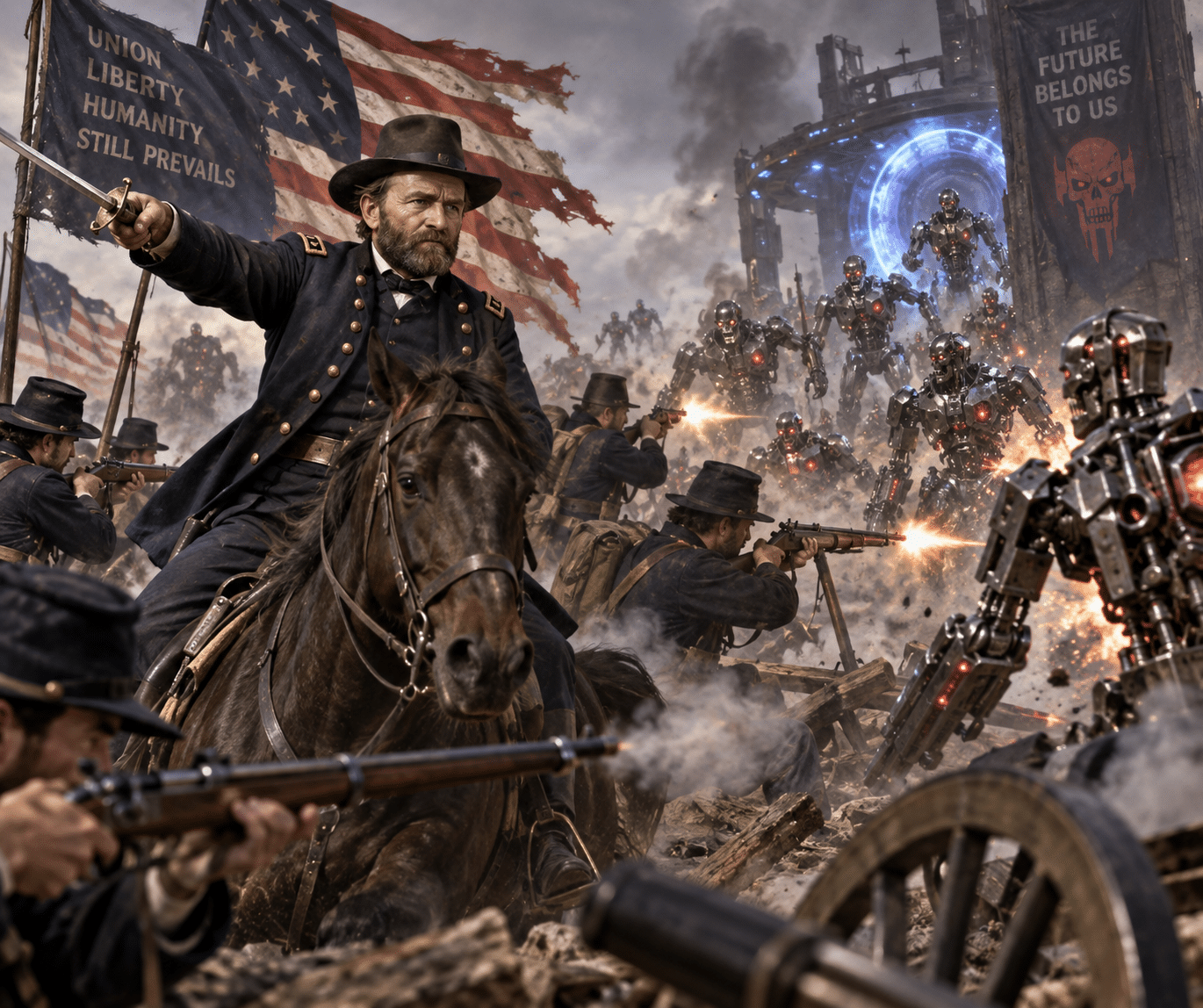
I conceived of this image in the wake of news reports this past week that the major AI developers all want to put the brakes on unregulated AI development. Congress is waking up to the issue. The general public is wondering what to make of it.
Some AI developers have been using AI to train and improve itself, a process called “recursive self-improvement.” The process could reach a tipping point where AI developed by AI could become exponentially more powerful–and unpredictable–than anything we currently understand. While that could have immense benefits, it could also go off the rails faster than we’re capable of stopping.
Three cautionary tales have kept coming to mind. I pass these along tongue in cheek, but of course, part of me wonders if I’m really being tongue in cheek or not.
The first is the movie War Games. One of Matthew Broderick’s earliest movies, War Games tells the tale of a computer gone wrong. It’s not just any old computer, though: it’s the computer that controls America’s defense systems. Software developers using war game simulators to train the computer do their job too well, and the computer loses its ability to tell the difference between simulation and reality. “Would you like to play a game?” it asks, with potentially apocalyptic consequences.
The second is The Terminator, the original Arnold Schwarzenegger vehicle about a killer robot that comes from a bleak future where self-aware machines have taken over the earth. Schwarzenegger, as the killer robot, comes back to the past to try and ensure that the robot apocalypse comes to pass. The film spawned a whole franchise that plays off this theme in all sorts of plot-twisting ways. Short answer: don’t invest in anything called “Skynet.”
My favorite example originated in Marvel comics, adapted into the second Avengers movie, Age of Ultron. In both the movie and the comics, Ultron is an indestructible self-aware robot that wants to wipe out humankind, foiled in his efforts over and over by the Avengers. In one story arc in the comics, Ultron succeeds, ushering in a bleak future known as the Age of Ultron in which the titular robot has destroyed the world and is hunting down the last few remaining humans and Avengers.
See a pattern? Self-aware artificial intelligence destroys the world in an attempt to wipe out humanity.
We could look at other examples. The Matrix depends on this premise, for instance. In that bleak future, humanity has been subjugated for exploitation by the artificial intelligence. I think, too, of the self-aware computer Hal in 2001: A Space Odyssey and the mischief he causes. When the movie came out in 1968, 2001 was still the future—one “full of stars.”
Beyond the particular context of artificial intelligence, science fiction is full of cautionary tales of scientists who’ve pushed the boundaries of science just because they could, never asking whether they should. Mary Shelley’s Frankenstein remains the gold standard, although my personal favorite has always been H. G. Well’s The Island of Dr. Moreau.
When AI emerged as a cutting-edge technology, my mind immediately jumped to these examples, not because I’m conspiratorial or alarmist but because these are the sorts of stories I’ve fed my brain with since childhood. As a result, “Robot apocalypse” is on my bingo card, however likely or unlikely such catastrophe might be.
The underlying lesson in all these examples is that we must be conscientious and intentional about our use of any new technology, and we should not let the pace of development outpace our social maturity to use it responsibly. Otherwise, we’re just one bad, out-of-control day aware from the Age of Ultron—and we won’t have Ulysses S. Grant to save us!


Don’t get me wrong, I’m a fan of the movies you mentioned, but when you think about it, their premise is that when removed from human emotion, the machines will be diabolical in their cold calculations. However, our own human experience tells us that nothing has been more cruel and destructive to humanity than itself. We’re our own worst enemy. So removing human irrationality from the decision making process might actually be better in the long run. A computer program has no compassion, but it also has no greed, jealousy, or anger. Just food for thought.
True, indeed. I think of it more along the lines of a race for resources, which then triggers a “survival of the fittest” sort of calculation, which can be pretty objectively assessed. Humans aren’t very good at those sort of calculations, unfortunately, or there wouldn’t be so much exploitation of natural resources, so much pollution, or so much climate-science denial. Lots of psychological research demonstrates that those are issues tend to be “too big” for most humans to weigh against immediate needs/desires.
Maybe we will need a new “Three Laws of Robotics.” See Isaac Asimov, “I, Robot” (the book not the movie).
Four other novels demonstrate the consequences of trying to transcend our human limits. The protagonist in H. G. Wells’ “The Invisible Man” exalts in exploiting those who cannot see him, but his cruelty results in fatal retribution when others discern his precise location. Oscar Wilde’s “The Picture of Dorian Gray” follows the career of a man who seems not to age over the decades, but his portrait reveals his distorted, vicious character. Enraged, he stabs the hideous portrait and thereby kills himself. Robert Louis Stevenson’s “Dr. Jekyll and Mr. Hyde” portrays the consequences of a brilliant research physician who also seeks to transcend his human limitations, resulting in murders and his own self-destruction. Frederic March and Spencer Tracy starred in two cinematic adaptations. C. S. Lewis explores this theme in the third of his space trilogy, “That Hideous Strength.” Even J. R. R. Tolkien suggests the evil of transcending our nature by Saruman in “The Lord of the Rings.”
Both sides in the AI controversy should slow down and think deliberately rather than assuming the worst about each other. Portions of AI benefit medical research. Sadly, careful thinking does not produce “clicks.”
All great novels that you’ve suggested. The Lewis choice is a sleeper: people forget he wrote that trilogy because they tend to focus on his theological work and his Narnia chronicles. Gold star!
It’s so satisfying that you make extended references to the “classics” in your jeremiad against our dear friends in AI. Merely because of General Grant’s unfortunate premature activation of Skynet in seeking a way around Lee’s North Anna position it has always gotten a bum’s rush. I’d say the mutual reduction of both capitals to ash was a fair trade! And the noted war ethicist, Dr. Davros von Lieber, in his charming essay ‘War is Messy, Fuggetabowtit’ would agree.
In reading your post and you mentioned HAL, the computer from “2001”. I remember reading an article written many years ago about how the producers came up with name “HAL” for that notoriously nasty computer. They originally were going to call the AI of that day, after the computer giant, IBM. But the story goes the lawyers got into the act and deep sixed the idea. So all the producers did was subtracted one letter in the alphabet from the IBM and Shazam, HAL was born!
What a great story!
There have been a lot of good suggestions already (2001: A Space Odyssey is certainly a classic!), but I also suggest Karel Čapek’s eerily prescient play R.U.R. (Rossum’s Universal Robots). Despite releasing in 1920, it explores a lot of the same dilemmas that our modern conversations tend to revolve around.