Book Review: Emancipation War: The Fall of Slavery and the Coming of the Thirteenth Amendment

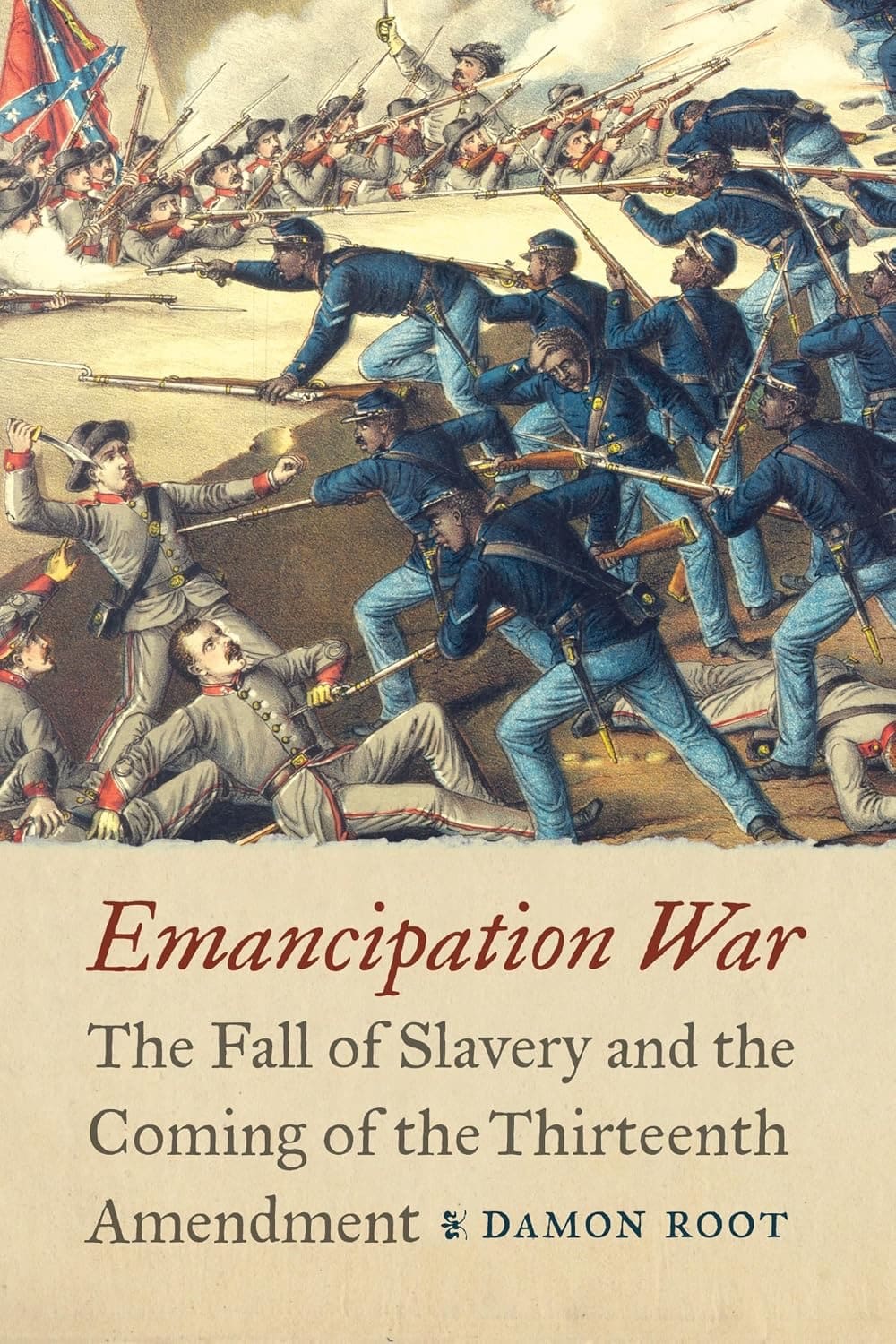
Emancipation War: The Fall of Slavery and the Coming of the Thirteenth Amendment. By Damon Root. Lincoln, NE, Potomac Books, 2026. Hardcover, 168 pp., $19.52.
Reviewed by Kevin C. Donovan
In March 1861 Abraham Lincoln used his first inaugural address to express support for the ratification of a proposed 13th Amendment to the Constitution, one that would expressly prohibit the federal government from interfering with slavery in states in which it existed. Three years later, Lincoln endorsed another 13th Amendment. This one would abolish slavery throughout the country. Moreover, on September 22, 1861 Lincoln had expressed horror at the suggestion that a presidential “proclamation” could free the enslaved, an action which he insisted would be ‘simply “dictatorship.”’[1] Yet Lincoln subsequently issued just such a radical proclamation.
What accounts for these wildly divergent actions, which appear to reflect dramatically altered principles? Theories could include a wartime leader desperately grasping at whatever tool seemed at the time to offer the best chance for victory, or perhaps a politician who had always personally opposed slavery but sagely bided his time until the nation was prepared for his moving against the institution. Both theories would credit Lincoln with the role of dominant actor in an ultimately successful crusade to abolish slavery by Constitutional amendment.
In Emancipation War: The Fall of Slavery and the Coming of the Thirteenth Amendment, author Damon Root offers another theory. Root chooses to take Lincoln at his word when Lincoln admitted: “I claim not to have controlled events, but confess plainly that they have controlled me.” (2) From that thesis, Root proceeds to identify the events, and the people behind them, that not only influenced Lincoln but positively “compelled him to move” against slavery. (2)
After an initial chapter laying out the dueling political arguments and judicial decisions on the slavery issue in the decades leading up to war, Root commences to address what he sees as the key events that ultimately led to the 13th Amendment, but with Lincoln being carried along by events rather than leading them. The first event was Maj. Gen. Benjamin Butler’s decision to treat three fugitive enslaved persons as “contraband of war,” not liable to forced reparation. This decision, which Root describes as a “turning point” of the entire war (31), not only effectively forced the Lincoln administration publicly to back Butler’s approach but led to Congressional action to codify Butler’s theory, resulting in the First & Second Confiscation Acts. These furnished legal tools for the liberation of those enslaved by individuals supporting the insurrection. Emancipation as a war measure thus found its first expression. The action of three brave escapees had generated a new federal policy. This was an event not initiated by Lincoln but sparked by the actions of others.
This series of events energized anti-slavery political elements who pressed Lincoln for further blows against slavery. At the same time, Lincoln had to bat back rouge radicals in the military such as Maj. Gen. John C. Fremont and David Hunter, who were unilaterally issuing military orders freeing enslaved persons in their departments. Each time, Lincoln was fiercely lobbied to support those measures and harshly criticized when he revoked them. Lincoln was affected by the lobbying. Root notes that when Lincoln met with border state politicians in July 1862 to urge acceptance of a compensated emancipation program, he warned them that pressure was increasing on him to act. Indeed, only two weeks after this meeting, Lincoln read to his Cabinet his draft emancipation proclamation.
Root argues that other actors external to Lincoln stepped up to influence him to change course at key moments. For example, Lincoln’s September 1862 Preliminary Emancipation Proclamation did not claim to rest upon Presidential war powers, but upon prior Congressional legislation. But after a high-profile public written debate between two eminent legal scholars—including a former Supreme Court justice who attacked the proclamation as an unconstitutional seizure of property in language echoing Lincoln’s own position of the year before—Lincoln’s final Emancipation Proclamation was rewritten to adopt the sweeping war powers theory that had been advocated by a Boston lawyer in rebuttal.[2]
In September 1862 Lincoln expressed grave doubt that Black soldiers could fight. Yet their subsequent battlefield achievements, publicized by glowing reports reaching both his desk and the public, persuaded him not only to change his mind, but adopt aggressive Black recruitment policies. Again, the actions of others changed Lincoln’s stance.
Root notes that even after issuing his Proclamation, Lincoln feared that it would not withstand legal challenge. A Constitutional amendment was needed. Yet it was others, including Senators Charles Sumner and Lyman Trumbull, who took up the heavy lifting of moving the 13th Amendment forward. While Lincoln supported those efforts, he stayed in the background, allowing him to be borne ahead by others’ work until finally ready publicly to urge passage.
It might have been useful for the author to provide explanations of Lincoln’s thinking underlying certain of his positions that he ended up changing. For example, Lincoln felt so strongly that he had no Constitutional authority to free the enslaved by proclamation because the Constitution prohibits Bills of Attainder, that is, non-judicial action that declares a person a criminal (e.g., a traitor) and directs punitive property forfeiture.[3] Granted, however, Root’s purpose is to show how Lincoln changed as a result of others’ actions, not necessarily to explore his original mindset.
Root uses a mix of primary sources, including Lincoln’s own words and writing, and secondary works to bring to light a wide cast of characters who had significant impact upon Lincoln’s opinions and actions. He weaves people and developments together into an interesting story, offering a Lincoln as one he himself claimed: a man often controlled by events, rather than controlling events himself. Root’s work certainly is an interesting perspective well worth considering.
[1] Henry Louis Gates, Jr., and Donald Yacovone, Editors, Lincoln on Race & Slavery (Princeton University Press, Princeton, NJ, 2001), 219.
[2] The marked differences in approach between the Preliminary and Final Emancipation Proclamations are explored in Kevin Donovan, “Lincoln’s “Second Thoughts” on the Emancipation Proclamation,” Emerging Civil War (Feb. 28, 2025), https://emergingcivilwar.com/2025/02/28/lincolns-second-thoughts-on-the-emancipation-proclamation/.
[3] For a discussion of this enduring concern throughout the consideration of the Confiscation Acts, see John Syrett, The Civil War Confiscation Acts: Failing to Reconstruct the South (Fordham University Press, New York, NY, 2005).
So much for the “great man theory” of history. Would you call this a history from below, or was Lincoln simply caught up in the spirit of the times?
The latter. At least that is the thesis of the book.