Judging an A.I. Book by Its Cover
 Emerging Civil War is pleased to welcome guest Nick Sacco. Nick is a St. Louis-based historian and owner of History Beyond Black and White.
For those of us who are enthusiastic readers, the idea of not judging a book by its cover is a mantra. The philosophy is simple. Our personal biases, first impressions, and expectations can lead us to rush to judgement too quickly. We run the risk of making premature conclusions about an author’s writings without giving a fair review of his or her arguments, often based on a book cover the author did not design.
While I have always tried to not judge a book by its cover, the infiltration of AI into the book publishing industry is testing my patience and has me questioning this philosophy.
As a student of Ulysses S. Grant, I like to keep an eye on the latest scholarship around his life. I periodically check university and popular presses to see if any relevant titles have been released. While there has been no major Grant biography published since Ron Chernow’s book nearly ten years ago, there remains a nice collection of scholarship by the likes of Charles Calhoun, Chris Mackowski and Frank Scaturro, John Reeves, Ryan Semmes, and Louis Picone that keeps the field moving forward. However, the number one source of new “scholarship” on General Grant in recent years is AI slop.
All you have to do is go to Amazon and search “Ulysses S. Grant” to see how bad it’s gotten. Filter your search by publication date and you’ll be inundated with recent AI book covers. A Paws in Time; The Siege of Petersburg; Ulysses S. Grant: The Drunk They Wrote Off Who Won the War. All of these books and more feature AI book covers.
One book particularly irritated me. Humble Hero: The Story of Ulysses S. Grant for Kids by Brian Thomas features a cartoonish Grant that is very obviously AI. Grant sports a fishing hat and a modern belt buckle, no doubt infuriating uniform purists nationwide. After looking at the cover, I decided to dig deeper. Who is Brian Thomas, and what are his credentials to be considered an expert on General Grant?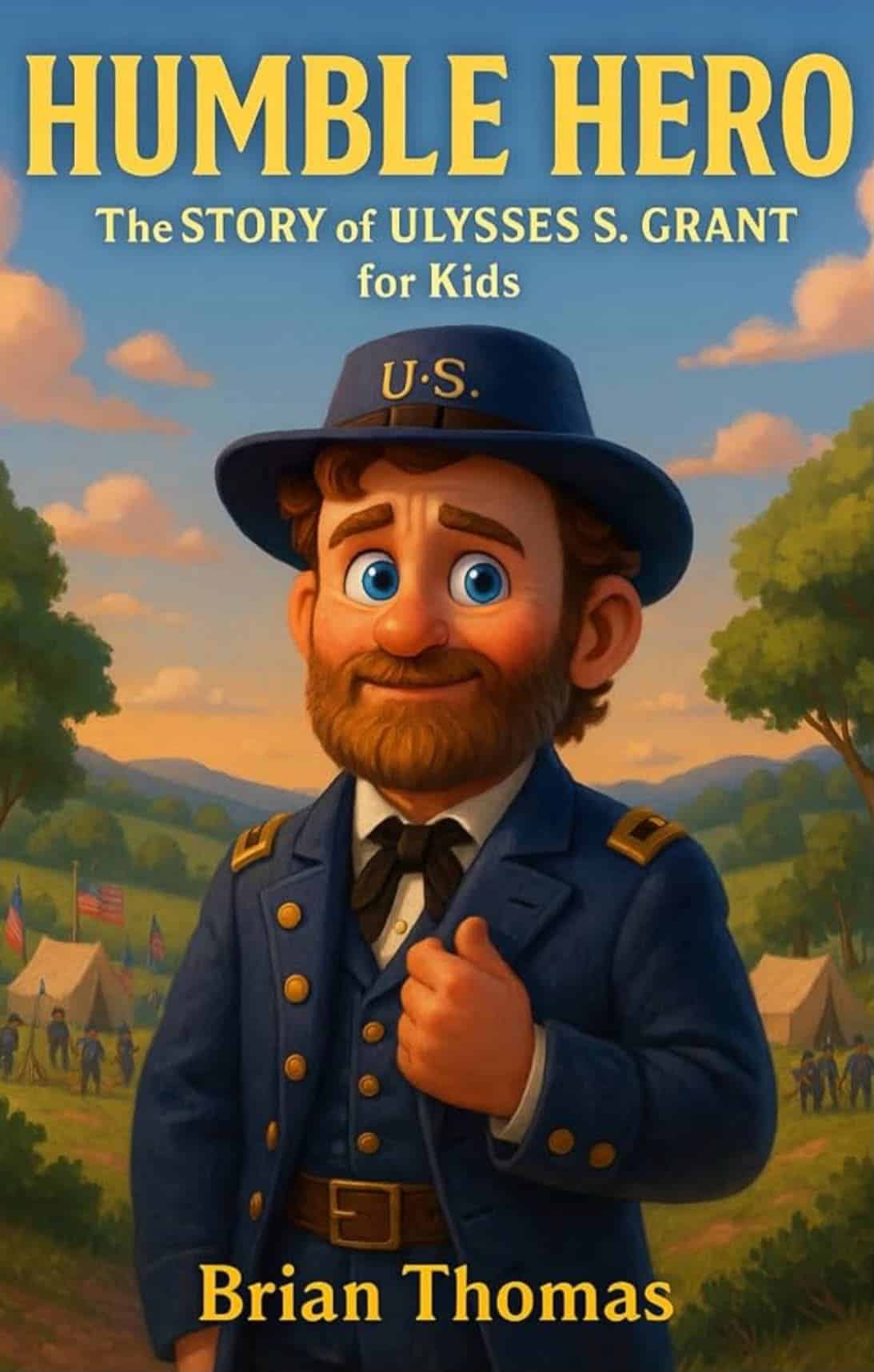 I clicked on Brian Thomas’s Amazon page and immediately became suspicious. There was nothing there. No picture, no bio, no information whatsoever. And yet, Thomas has more than 70 publications to his name that are available for purchase. Even more amazing is that all of the titles I clicked on were published within the past 18 months. All had AI slop covers. All were about 150 pages in length. That comes out to about 10,500 pages of text, or roughly 584 pages of text per month written and published by Brian Thomas over the past 18 months. One would think that someone producing at such a prolific rate would have a significant digital footprint.
I then turned to Google’s AI search engine, Gemini, and asked for more information on Brian Thomas. Unsurprisingly, Gemini got confused and offered contradictory information. It initially pointed me to a Dr. Brian Thomas who had no publications on Grant and was not a historian. Then it pointed me to a motivational speaker who appears to have passed away several years ago before AI became mainstream. I told Gemini it had the wrong person and it then admitted that it could find no information on Brian Thomas. After digging around on my own, I found that all of Thomas’s books were published via Lulu, a self-publishing platform that requires no author verification of any sort. Although I did not buy Humble Hero, I am very confident in asserting that “Brian Thomas” is an AI author. Publishing more than 70 books in about 18 months’ time indicates to me that this is not a real person.
AI slop books are spreading online because various entities, from self-publishing platforms like Lulu to sellers like Amazon and Barnes & Noble allow these books to publish and are actively profiting from them. A recent feature by writer Kashmir Hill explored one AI “author” who is even more prolific than “Brian Thomas.” The “author” in Hill’s essay has written 445 books through ChatGPT and uploads ten books per week on Amazon (the maximum allowed). He makes $7 per book and made nearly $6,000 selling 821 books during the holiday season last year.
These developments should be worrisome for historians and readers of history books. Generative AI might be able to lay out some very foundational insights and parameters for a given historical topic. However, AI cannot produce original arguments or formulate interpretations based on research of primary and secondary sources. Equally important is that when I purchase a book, I expect the words, thinking, interpretations, and creativity of the work to be that of the author. AI books rely on stolen content, often from scholars who have spent years researching their topic. AI books mash up previous works, often fabricate sources (if they cite sources at all), and are really a form of mass plagiarism. The intense media scrutiny towards various academics accused of plagiarism in recent years has overshadowed the mass plagiarism of texts by AI tech companies.
I acknowledge that some people writing genuine works of original historical scholarship may use an AI generated cover for their book. My response is threefold. One is that these slop covers take away work from professional graphic designers and artists. As we see with Humble Hero, these covers often get fine details wrong and can be historically inaccurate. More importantly, they look sloppy, soulless, and unappealing. Second is that, at least within the context of the Civil War, there are literally millions of historical images, often public domain, that can be used for a book cover. For Ulysses S. Grant specifically, there are more than 300 confirmed photos of the man, again most being public domain. The Civil War is arguably the most photographed event of the 19th century. That source base is rich and doesn’t need an AI generated image to “bring history to life.” Finally, an AI book cover erodes my trust in the author’s work and their legitimacy as a scholar.
AI book covers create a slippery slope that I cannot escape. For me, if an author uses an AI book cover, then they may have used AI to index the book. They may have used AI to edit the book. They may have used AI for the author’s headshot photograph. They may have used AI to generate maps, graphs, and other visualizations. They may have used AI to structure the book’s content, cite sources, and make interpretive arguments. I don’t know any of these details for certain, and that’s the problem.
Moving forward, the big question for history readers is if they will care about whether the books they read are original works or AI generated. If we do care and the distinction matters, then we should work together to ensure we do not purchase AI books. Check information on authors and their publishers before purchasing. Do they have an online presence? What are their credentials, and what makes them qualified to write on this subject? But if the status quo holds, AI “authors” will continue flooding the market with crap. Civil War historiography will grind to a screeching halt as we descend into a constant AI generated regurgitation of scholarship published years ago without any new arguments to speak of.
A body builder does not create a muscular physique in one day or one week. An artist does not fully realize their artistic vision in one day or one week. A historian cannot produce original scholarship in one day or one week, much less ten books a week. We cannot AI our way to good history or, more specifically, we cannot AI our way to new understandings of the past that advance historiography. We must work to preserve a thriving history, artistic, and literary culture in an environment shaped by the creative talents of humans, not bots. If the final product is not worth the effort to create original scholarship, literature, or art, then it’s not worth my effort to invest time in that product.


Great article. Welcome, Nick! The problem of slop on Amazon predates AI, when they opened Kindle publishing to literally anyone. On one hand, I applaud opening the market to authors like myself, who tend to write about very narrow, specific subjects traditional publishers avoid. Let a million flowers bloom and the market decide. On the other hand, this has saturated the market with millions of poorly written, unedited works filled with (especially when it comes to history) errors and complete nonsense, making it even more difficult to discern between the quality and the slop. AI has only accelerated this process. As you mentioned, it’s now possible to churn out dozens of “books” a month. The creator may only sell one or two of each, but if they publish 445 books, that’s over 800 sales. But now when you search for a subject you’re interested in, you’re forced to scroll past hundreds of these throw away works to find anything of substance.
Thanks, M.A.!
There is a parallel track occurring within the music industry to what you describe. Over the past 25 years the barriers to entry for an individual musician or band have significantly lowered. You can purchase nice equipment for a home studio, upload the music to any streaming site of your choice, and create music that can be as crazy or obscure as you like without influence from a record company. The internet has undoubtedly democratized the music industry to an extent and in some cases very small musicians have emerged into the mainstream by successfully creating an online persona and noteworthy music discography. However, there is a great deal of new music that is not being listed to (most music being uploaded will never get 1,000 streams) and is probably not the best quality. Now AI musicians are infiltrating the streaming services without any oversight, moderation, or curation. Many songs being uploaded to Spotify these days aren’t even real. It’s concerning and shapes my attitude towards AI in book publishing.
I think there’s something to be said for struggle in the creative process. Having to jump through a bunch of hoops is often frustrating but it does force you to take a second or third look at what you’ve created and hopefully make it better. If there’s absolutely no barrier to entry at all, there are people who will just throw up a first draft and not take another look at it, and we’re all worse off for it. Sure, there might be a gem or two that rises to the surface and perhaps that makes it worth it, but I don’t know. That’s one thing I like about ECW – you know every guest column has to go through a peer review process, maybe not as rigorous as an academic publisher, but there’s some quality control. I think it elevates the site overall.
Great subject. It’s also possible for an AI creator to list scores of legitimate primary sources without checking how AI is using them, or even having actually read them. Legitimate use of primary sources has always been a benchmark for any subject, especially controversial history, so misuse hasn’t been unheard of in the past, but this is a step much further.
Thanks, Carson. I agree that misuse is not a new thing in book publishing. AI increases the likelihood of misuse, both intentional and unintentional, by authors.
I made the mistake early on in marketing my Civil War microhistory blog, Company D, of using AI imagery. It didn’t take long to realize how terrible it looked and I switched gears within a few episodes. Now I have a strict no AI policy on images. I have used AI in research and it has been helpful in finding databases and sources I didn’t know about (like a supercharged search engine). But it hallucinates a lot. Lots of made up facts and even made-up people. You have to check and double check everything. The real problem, at least for me, is trying to avoid AI at all. All of the search engines use it. Writing tools like Word are constantly prompting you to fix or change sentences–usually into something more drab and pedestrian. Yes, I’d like to use AI selectively under my terms, but find that has become difficult as AI is being forced on us whether we like it or not. Thanks for writing this terrific piece.
Thank you for your kind words!
Like you, I am tired of AI constantly being pushed in my face online and with tools like Word and Excel. I’m worried about the use of AI in young people with developing minds, and frankly I often feel like the constant push to use AI is an insult to my intelligence and skills that I’ve developed throughout my academic and professional career.
One thing I will note is that I can make a distinction between the use of AI as a tool for organizing and a tool for generating content. Frank Jastrzembski’s article on AI and history writing did a nice job of someone who did the former. Frank uses AI to organize his thoughts, transcribe primary source letters, and as a basic editor of his writing, but he does not use it to generate original arguments or content. At the end of the day, you are 100% correct that you have to check and double check everything.
This week I heard that AI, for all Civil War book covers, will use Fabio and Sydney Sweeney to portray the main personages found within.