Echoes of Reconstruction: A Black Soldier Reports on Human Rights Violations in the South During Reconstruction
Emerging Civil War is pleased to welcome back Patrick Young, author of The Reconstruction Era blog.
Many of the records of the Reconstruction Era were written by white men. These include reports from government officials, newspaper reporters and editors, and long-form books by white authors. Some of this written evidence was composed by white Freedmen’s Bureau employees after extensive consultations with Black witnesses or was brought out in trials in which African Americans testified, but much of the writing came from white authors who seemed not to have any contact with the Black communities that were most impacted by Reconstruction. Some of the writings are white supremacist apologetics published to justify horrendous acts of terrorism against recently freed Black men and women. After 1868, with much of the Freedmen’s Bureau being shut down, any detailed compiling of human rights conditions, respect for labor rights, medical conditions for former slaves, educational opportunities for Black children, and interracial relationships became irregular and without any systematic form.
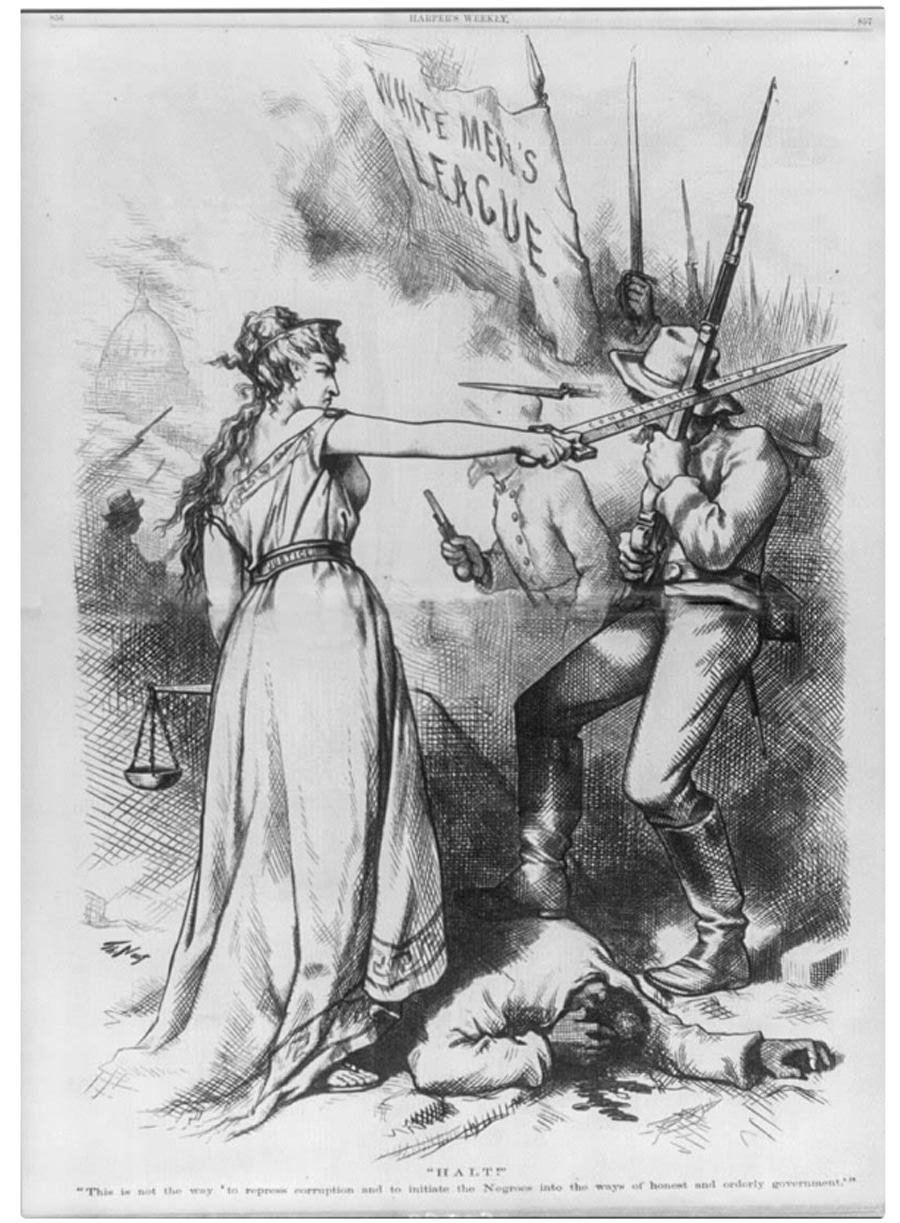
As state governments fell into the hands of the former-Confederate “Redeemers,” white supremacist politicians like former Confederate General Wade Hampton or deposed Confederate Vice President Alexander Stevens took over the public discussion of Reconstruction. They depicted Reconstruction as a Northern-imposed tyranny in which Blacks, who should never have been given the right to vote or hold office, took on the role of racial dictators.
The collapse of Federal monitoring in the mid-1870s leaves a dearth of Black voices analyzing the last phase of Reconstruction before the descent into the Redeemer abyss. However, Black communities in parts of the South started self-help organizations to interview the victims of human rights violations. These were often led by people who took great risks to recruit and organize fellow African Americans who submitted reports to the collective. These leaders would then compile the information into what today we would call a human rights report. While the work was done in secrecy to avoid retaliatory violence, the next steps of the collective would target the leaders. After the reports were authored, the coordinators would leak the reports to the press or submit them to governmental bodies. Then, in some cases, the leaders would be summoned to testify against the local white supremacist structures in their own community.
One of these leaders was Henry Adams.
Adams was born into slavery in Jasper County, Georgia, in 1843. When he was seven years old his enslaver moved Adams’s family to DeSoto Parish, Louisiana. The Adams family was finally emancipated at the end of the Civil War. When he was free from slavery, Adams was not free from harm. For example, in December of 1865 he was confronted by a gang of white men who challenged him for trying to leave the parish where he lived. In 1866, he testified, that “I was met up by about five men, and they asked me who I belonged to. I told them I belonged to nobody. ‘You don’t belong to nobody?’ I said ‘No.’ ‘Well, by God,’ they says, ‘negroes can’t travel through here that don’t belong to somebody, and we will fix you up right here.’ I was on a good horse—a pretty good horse—and I made a break and ran. They tried to kill me but I got off; they shot four or five times at me, but never hit me. I ran and got away.”
Adams saw violent retaliation for emancipation right after the Civil War. He reported that “In the year 1866,” in the parish of Caddo, State of Louisiana, “I seen hanging to a limb of an oak tree, about six miles south from Shreveport, the body of a colored man. He was dead when I seen him. About six miles north from Keachie I saw a wagon belonging to a colored man burning, with all his things; even his mules were burned to death. While on my way to Sunny Grove I seen the head of a colored man lying on the side of the road.”
In September, 1866 Adams enlisted in the United States Colored Troops (USCT). As a soldier, he learned to read and write and he came into contact with other African Americans who came from the wider world. Before he was discharged in 1869, Adams and other soldiers formed a secret committee to report on the conditions of freed people in the South. Its purpose was twofold. First, of course, these USCT veterans wanted to record human rights abuses. Second, they wanted to identify places where freedpeople could move and be treated with respect. They did not find that place in the South.
In 1877, President Ulysses S. Grant sent documents to Congress detailing interference with the election in Louisiana that contained a report from Adams. The veteran wrote that the report was truthful and that it placed his life in danger:
“I did it with honesty, and did it because I thought that such things should be reported to the people at large; but I [missing word] to you, and to you, gentlemen, and to the officers of the military service, if these documents is published to the world at large and my name signed to them, I cannot live no longer in the Southern States, because I would be killed by the white people of the Southern States and never be allowed to travel through the South no more. But if it is necessary for to publish my name at the world at large, publish it, sink or swim, live or die. Yours, truly, HENRY ADAMS.”
In March of 1880, Henry Adams was called to testify before a Congressional committee that was mandated to stop the mass movement of Blacks out of the South to preserve the Southern labor supply. Adams told the story of how he and other United States Colored Troops had formed their committee. He said; “So a parcel of us got together and said that we would organize ourselves into a committee and look into affairs and see the true condition of our race, to see whether it was possible we could stay under a people who had held us under bondage or not. Then we did so and organized a committee.” After the committee was formed, some of its members began to report abuses from areas that they were not from. Adams said “we worked some of us, worked our way from place to place and went from State to State and worked—some of them did—amongst our people in the fields, everywhere, to see what sort of living our people lived; whether we could remain in the South amongst the people who had held us as slaves or not.” The committee collected information from “Nearly all of the States we could get reports from as to how our race was living there,” Adams testified.
One Congressman wanted to know if the committee collected the information to persuade Blacks to move out of the South. Adams responded “we just wanted to see whether there was any State in the South where we could get a living and enjoy our rights.”
The reports from different parts of the South were alarming. Adams said that the observers “cited several things that they saw in their travels; it was very bad.” In spite of slavery having been ended a decade earlier, the reports said “the people was still being whipped, some of them, by the old owners, the men that had owned them as slaves…” When African Americans tried to stand up for themselves, the white Redeemer “will haul out a revolver and strike him on the head, and knock blood out of him, or something of that sort, and maybe, perhaps, shoot him.”
When Blacks tried to exercise the franchise, “where they voted they would be shot.” In Louisiana the movement for Redemption was the White League, led by old Confederate officers. Adams told the Congress that after “the white league sprung up, they organized and said this is a white man’s government, and the colored men should not hold any offices; they were no good but to work in the fields…” This sharp turn towards Jim Crow led the committee to make an appeal to the Grant administration; “We first organized and adopted a plan to appeal to the President of the United States and to Congress to help us out of our distress, or protect us in our rights and privileges,” said Adams.
With the collapse of Reconstruction in the mid-1870s, the committee looked at Blacks getting out of the South and seeking refuge both in the North and West and even going to other countries. Places that Adams said that they got reports from were Kansas, Nebraska, and Colorado where the refugees said “that when they work for a man there he pays them, he has no trouble to get his money whatever. They says there is no such thing as whipping him, there is no such thing as shooting him, there is no such thing as running him off from his club meeting, or any thing of that sort, when he is holding his meetings. They says there is no such thing as an order to close the churches at nine o’clock at night, and there is no such thing as arresting them if they sets up over their dead after nine o’clock, as it has been in some parts of Louisiana,” where he had lived. “They says everybody is free there, and everybody has free intercourse there every way. And they says that wages is—some stated that they got nine dollars a week for their work, and some of them stated—that is the men—and some of them stated that their wives got from three to four dollars a week for work in Kansas, Nebraska, and Colorado,” Adams recalled.
Adams also commented on the advantages for the next generation of young African Americans. As schools were forcibly closed by Redeemers throughout the South, the refugees “said that they had public schools there [in Kansas, Nebraska, and Colorado], and they had the same privilege to send their children as anybody else had that was there before,” he testified.
Some Blacks got help after they left the South. Adams says that he knew of two Turner groups that assisted Blacks coming through St. Louis. The Turners were German clubs, called Turnvereine, which organized education and gymnastics in German immigrant communities and were also mostly Abolitionist. Adams reported that the two St. Louis groups he had been in contact with were the Colored Emigrant Aid Association there, and the Emigrant Relief Association. The “Turner Circular” from St. Louis said that the Germans got involved because of “The frequent and continued arrival of colored emigrants from the South, in a majority of cases utterly destitute, and the information received from credible sources that thousands are assembled at steamboat landings along the Mississippi ready to embark,”
There were also groups set up by African Americans to provide refugee aid. For example, in 1879 the Colored Immigration Association of St. Louis published a statement of its purpose which was to help with the establishment “of colored settlements and to aid the colored immigrants who may reach our city while fleeing from the Southern States.” Blacks were flooding St. Louis because in the South, the group said, “murder, rapine, arson, and most barbarous outlawry have prevailed to persecute the negro, and now that a general exodus of those poor afflicted people is upon us.” The Association reported that “Our streets are crowded almost daily with men, women, and children without sufficient clothing, shelter, or food.” The Association helped the refugees “in establishing homes where he and his family can enjoy in peace and security all the fruits of his labor.” Most of the money expended was to pay for steamship and railroad passage to places further north, as well as provisions for impoverished families.
After the Election of 1876, things had so deteriorated for Black people in the South that a meeting in Shreveport, Louisiana in 1877 of 5,000 African Americans sent a letter to newly elected President Rutherford B. Hayes that said the Constitution “guarantees to us equal civil and political rights and protection in the exercise of those rights, and as we the colored people of the South have been debarred from exercising those rights, the right to vote, hold office, and the privilege of education without molestation, and it being a well-established fact that we have been oppressed, murdered, and disfranchised on account of our race and color, and have not received that protection in the exercise of our rights guaranteed to us by the Constitution…” After Redemption, the letter said, Blacks found “our race in a worse state of slavery than before.”
Sources:
The Testimony of Henry Adams, Freedman: Hope, Terror, and Exodus in the Post-Civil War South by Henry Adams published by Library of America (2026)
Testimony before the Senate Select Committee to Investigate the Causes which have led to the Emigration of Negroes from the Southern to the Northern States, Washington, D.C., March 12–13, 1880
THE COLORED IMMIGRATION ASSOCIATION. SAINT LOUIS, MO., April 22, 1879.
COLORED REFUGEE RELIEF BOARD, OFFICE 903 MORGAN STREET, SAINT LOUIS, MO.
Appeal to President Hayes, Shreveport, Caddo Parish, Louisiana, September 15, 1877
Statement of Outrages Committed in Louisiana during the Years 1865 to 1866 compiled by Henry Adams
Statement of Affairs and Outrages in the South, 1866 compiled by Henry Adams
Statement of Specific Cases of Outrages from 1866 to 1876 compiled by Henry Adams
Affidavits of Colored Men
The White League in Louisiana


Thank you for introducing this invaluable source to us!
Thank for reading it.
Enlightening, but dismaying