Loyalty and Reconciliation: The Tennessee G.A.R. and the Union Soldiers Monument
ECW welcomes back guest author Riley Sullivan.
On October 24, 1901, nearly a thousand spectators gathered for the commemoration of a new monument at the Knoxville National Cemetery. With funds raised primarily by aging veterans in the Grand Army of the Republic’s Tennessee Department, the Union Soldiers Monument stands at sixty feet in height, dominating the cemetery surrounding it. Erected in response to a similar monument commemorating Knoxville’s Confederate dead during the 1890s, the dedication and speeches provide insight into how Tennessee’s Union veterans remembered the late conflict.
The Tennessee Union veterans gathered in Knoxville that morning occupied an interesting space within the historical memory of the Civil War, claimed by neither northern nor southern traditions.[1] Consistently, Tennessee veterans within the G.A.R. had to defend their record of loyalty to demonstrate their contributions to the late conflict.
To prove their loyalty, these veterans frequently reminded their comrades of the hardships experienced in joining the Union army within a Confederate state. In an argument of bringing the national encampment to Nashville in 1883, Comrade A.W. Wills reminded the order that the Tennessee soldier “was cursed by his neighbor, friend, and relative,” thus forced to flee his home on “behalf of his country.”[2] Likewise, former Department Commander A.J. Gahagan in 1904 made his fellow comrades aware that “during the sixties [Tennessee was] surrounded on all sides by the men who wore the grey, yet thirty-one thousand of us came across the line…[to] shed our blood in defense of the flag of our country.”[3] Acknowledging such calls, one E.P. Murdock of Illinois recognized these hardships faced by the Union men of the South as they faced “every social and political influence that could be brought to bear upon him.”[4]
When Judge Newton Hacker—a former officer of the 4th Tennessee Infantry Regiment (Union)—spoke before the crowd gathered in Knoxville, he reflected this long established sentiment. For Hacker, the men of East Tennessee reverberated that “neither persuasion nor force—neither imprisonment nor the threat of death could induce them to forsake the Stars and Stripes.”[5] Hacker continued that “untold indignities and cruelties” were suffered at the hands of the Confederacy, which reminded the audience of what these men endured for their loyalty to the nation.
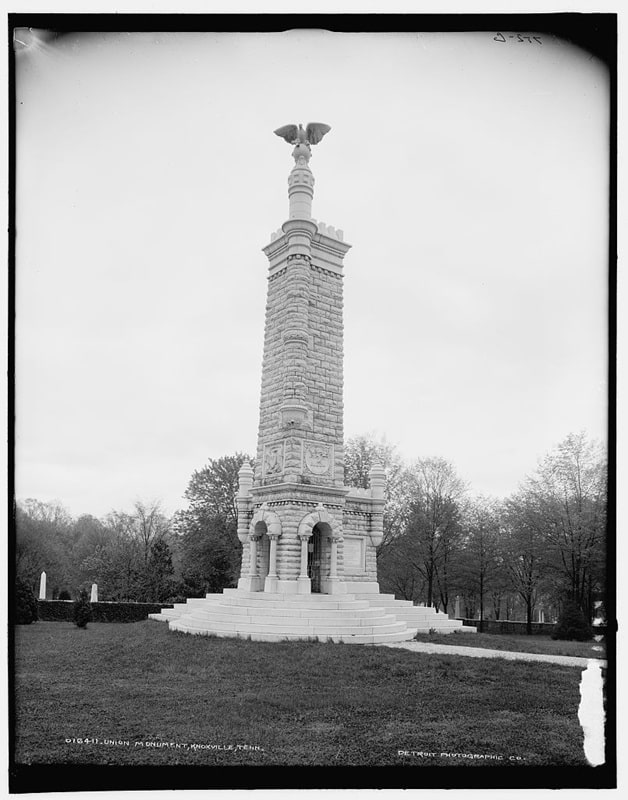
The monument itself reminds posterity of the hardships endured by the men of Tennessee who maintained their loyalty, as the main inscription of the monument reads: “TO THE TENNESSEE MEN / Who laid down their lives as voluntary sacrifice on / FREEDOM’S ALTAR / Who endured with fortitude temporary banishment from their mountain homes, who followed / THE FLAG THEY LOVED / On scores of battlefields, and who fell, valiantly contending for / THIS MONUMENT / Is lovingly erected by their surviving comrades and friends.”
Through this memorialization, Tennessee Union veterans also highlighted their refusal to forget the actions of their former foes by noting that their hardships had been brought on due to their “banishment” from their communities.
As these veterans showcased the hardships they faced, the monument dedication proved an occasion to express opinions on what brought about the deaths of the men buried beneath it. Hacker made clear in his address that the “eternally wrong” institution of slavery ultimately led to the outbreak of the war. Invoking Thomas Jefferson, he recounted to the crowd that the “great Virginia patriot, had penned those immortal words…That all men are created equal.” Therefore ensuring that “this Godlike sentiment and human slavery could not stand together.”[6]
Although making it clear that Tennessee’s Union veterans fought on the right side that promoted the “Godlike sentiment” of the Declaration of Independence, Hacker echoed reconciliation sentiments towards his former foes. He declared that “the scars of the great civil war have well nigh been healed and the waste places have been repaired, and a new era of unsurpassed prosperity has dawned upon our whole nation.”[7]
Reconciliation long abounded within the G.A.R. Department of Tennessee. Throughout the 1880s, Tennessee delegates advocated for the national encampment to be hosted in Nashville, stating that a “lasting good to the Union of our common country must result” by creating “closer social intercommunication” between the sections.[8] When advocating for the G.A.R. to host the national encampment in Chattanooga, Comrade Van Deman implored the G.A.R. to heed the words of the city’s ex-Confederates by stating “let the chasm be buried,” never to reemerge.[9] However, Van Deman did not subscribe to a rendition of reconciliation that abandoned the principles of the G.A.R concerning patriotism and loyalty. Arguing further the case for reconciliation, he contended that ex-Confederates were converted Yankees. Further proclaiming to the encampment “to see what man can do when he is whipped and comes back into the nation, revering and reverencing that old flag.”[10]
In a similar vein, Judge Hacker called to bridge the bloody chasm, contending that former Confederates should “take my flag and make it your flag and teach your children to love it.”[11] By adopting imagery of the flag as a sign of patriotism, Hacker demonstrated that Tennessee’s Union veterans embraced reconciliation if their former antagonists accepted the outcome of the war and accepted their place within the Union.
As the dedication of the Union Soldiers Monument and the Tennessee G.A.R. demonstrate, Tennessee’s Union veterans promoted a unique memory of the conflict that consistently reminded the public of their determined loyalty to the Union and while advocating for reconciliation with their former foes. Their memory of the conflict, therefore, exemplifies how Tennessee Union veterans developed a complicated historical consciousness of the legacy of the war.
Riley Sullivan earned his MA in History at Sam Houston State University and is a Professor of History at San Jacinto College in Pasadena, TX. He has published works on Civil War Memory that have appeared in the Tennessee Historical Quarterly. He is also a doctoral student in the Department of History at the University of Houston.
Endnotes:
[1] When speaking of Arkansas’ Union veterans, historian Rebecca Howard noted they “were always caught between” notions defining who was Northern and Southern. Rebecca Howard, “Lost to the Lost Cause: Arkansas’s Union Veterans,” in The War Went On: Reconsidering the Lives of Civil War Veterans, Brian Matthew Jordan and Evan C. Rothera, eds., (Baton Rouge, LA: Louisiana State University Press, 2020), 263.
[2] Journal of the Seventeenth Annual Session of the National Encampment of the Grand Army of the Republic, Denver, Col., July 25th, 1883, (Omaha, NE: Republican Book and Job Printing House, 1883), 157-158.
[3] Journal of the Thirty-Eighth National Encampment of the Grand Army of the Republic, Boston, Massachusetts, August 17th and 18th, 1904, (Chicago, IL: M. Umbdenstock & Co., 1904), 184.
[4] Journal of the Thirty-Second National Encampment of the Grand Army of the Republic, Cincinnati, Ohio, September 8th and 9th, 1898, (Philadelphia, PA: Town Printing Company, 1898), 250.
[5] “Federal Monument Dedicated Today,” Knoxville Sentinel, Knoxville, TN, October 24th, 1901, 2.
[6] Ibid, 2.
[7] Ibid, 2.
[8] Journal of the Nineteenth Annual Session of the National Encampment, Grand Army of the Republic, Portland Maine, June 24th and 25th, 1885, (Toledo, OH: Montgomery & Vrooman, Printers, 1885), 135.
[9] Journal of the Twenty-First Annual Session of the National Encampment Grand Army of the Republic, St. Louis, Missouri, September 28th, 29th, and 30th, 1887, (Milwaukee, WI: Burdick & Armitage, Printers, 1887), 192.
[10] Ibid, 192.
[11] Knoxville Sentinel, October 24th, 1901, 2.


Great article! Beautiful fin de siècle, Union soldiers monument in the South.