The Everlasting Patient: Pvt. James Luman’s Donated Skull
In 2023, I was introduced to Brent Reidenbach in order to help him piece together his ancestor’s story. Private Martin Swick of the 126th Ohio died at the former Civil War hospital where I was employed as its lead historian (you can read about Martin in our earlier article here). Brent, an Ohioan and veteran himself, works tirelessly to trace the life and military service of other Ohio soldiers. Our research collided at the Alexandria National Cemetery, where Brent spends his free time telling the stories of Ohioans buried at this hallowed ground. One of those interments is Pvt. James Luman of the 122nd Ohio, who died of an egregious head wound at the same hospital and lives on at the National Museum of Health and Medicine.
James’s demise in Alexandria, Virginia began with Brent contacting the descendants of James Luman’s family. He discovered that not many knew of this particular Luman cousin, least of not his tragic wartime death. It is always an honor and privilege to inform the current generation of their ancestors’ military services and sacrifices. Brent and I both have experienced the wide range of emotions that come with learning of a long lost soldier on the family tree. We did learn that the Lumans were a tall bunch for the era, nearing six feet and with pervasive blue eyes throughout the tree branches. Born in 1836, James married Mary Wells in December 1858. The couple had one son, John, who sadly died before his first birthday.
James enlisted at Philo, Harrison Township in Muskingum County on September 8, 1862 and mustered into Co. A of the 122nd Ohio Volunteer Infantry at Camp Zanesville on September 30th. James is listed as a farmer from a town just south of Philo, standing 5’9” with a light complexion, black eyes, and dark hair. His childhood home surprisingly survived until the 1980s when burned to the ground after a lightning strike. James’s first major encounter with Confederate forces was on June 13-15, 1863 at the battle of Second Winchester. Despite the approximate 170 prisoners of the 122nd Ohio that day, he evaded capture. Although not actively engaged, he witnessed the battles of Auburn (October 13, 1863), Bristoe Station (October 15, 1863), and Kelly’s Ford (November 7, 1863).
In November 1863, James saw active combat at the battle of Payne’s Farm during the Mine Run Campaign. He was shot in the head during this engagement and removed from the battlefield. Although it was unclear at the time if he would ever recover, James was taken to Brandy Station, where he was placed in a hospital railcar en route to Alexandria, Virginia.
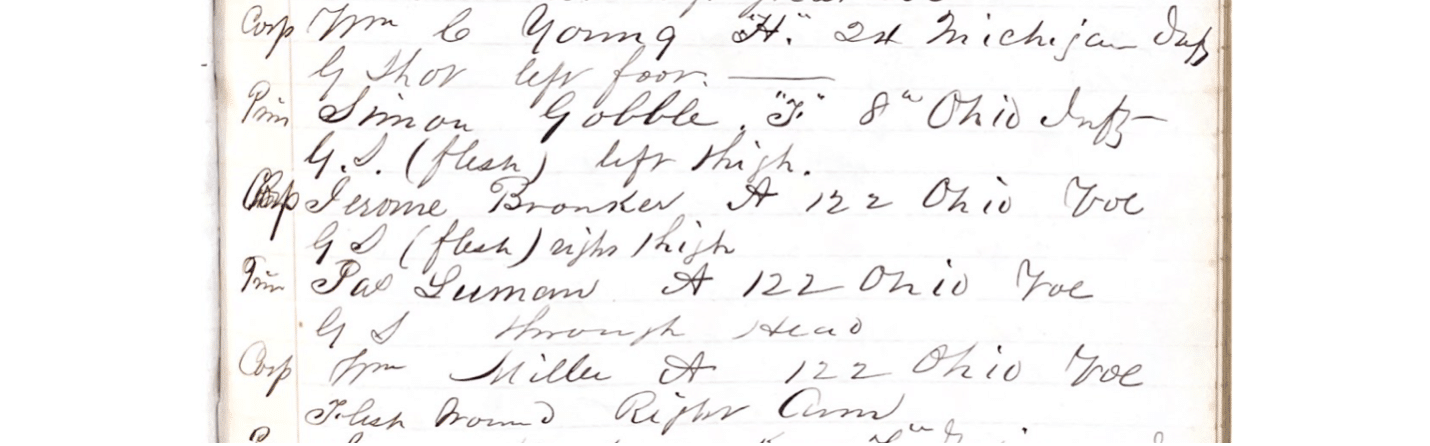
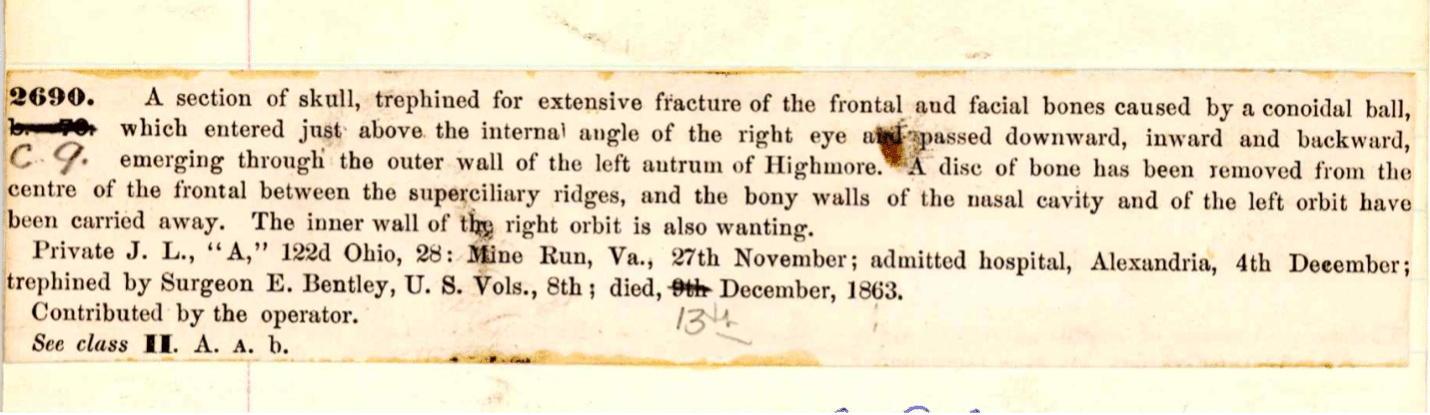
Dr. Edwin Bentley, head surgeon of Alexandria’s Third Division hospitals, administered aid to Pvt. Luman upon his December 6 admission to the Grosvenor Branch Hospital– nine days after receiving the injury. Over fifty soldiers were admitted on that same day, covering several pages within the medical ledger. James’s entry simply lists “G[un] S[hot] wound head” among dozens of other battlefield injuries from Mine Run. The hospital was now overcrowded and attempting to triage immense carnage.
Alexandria became the first stop for many injured and diseased soldiers coming off the Virginia battlefields, due to its central location along the border of the Union and Confederacy. Under strict martial law, the military government managed an average of thirty hospital across three divisional “neighborhoods,” each with a larger general hospital and several branch campuses. Grosvenor Branch Hospital, the site of the modern Lee-Fendall House Museum, opened in April 1863 due to overcapacity at Grosvenor House across the street. The two hospitals are often interchanged or confused with one another, but remain in the record books as distinct locations.
James Luman convalesced on the first floor that was designated for private rank (the second level was reserved for officers and the third for staff). Dr. Bentley, who went on to become the superintendent for all of Alexandria’s medical care the following summer, resided at Grosvenor Branch in his first year as head surgeon. This Lee family estate-turned Civil War hospital was not designed to house the nearly 200 soldiers now recovering on its 1785 floorboards. The two parlors, which once hosted George Washington and John Quincy Adams, now were home to a myriad of illness, disorder, and chaos. While we do not know if James was conscious on arrival or how much sensory input he managed, he lingered for seven more days before succumbing to his wounds on December 13.
James was buried in the Alexandria National Cemetery shortly thereafter, alongside close to 4,000 other Union casualties from the city’s hospitals. His family did not have the funds or ability to relocate his body back home in Ohio, so he is solemnly buried away from his infant son. Last month, Brent journeyed to the National Museum of Health and Medicine outside of Washington, D.C. after making a remarkable discovery: James’s own skull. Dr. Edwin Bentley was a renowned surgeon and had impeccable bedside manner. However, Bentley was in the habit of shipping amputated limbs back to his private office in Connecticut for later dissection and study. He also “donated” several unclaimed corpses of former soldier-patients, including James’s severed head. All the name of advancing science, Bentley practiced one of the surgical spoils of war.
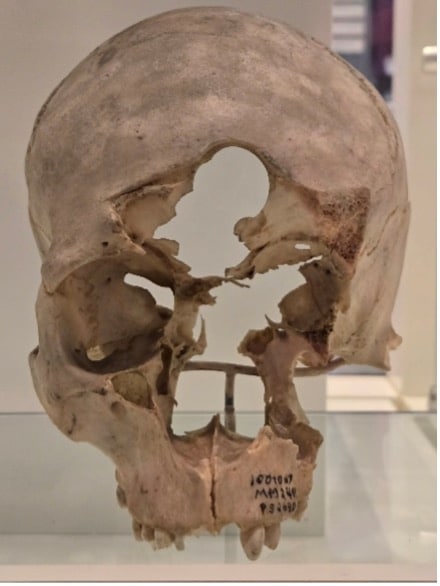
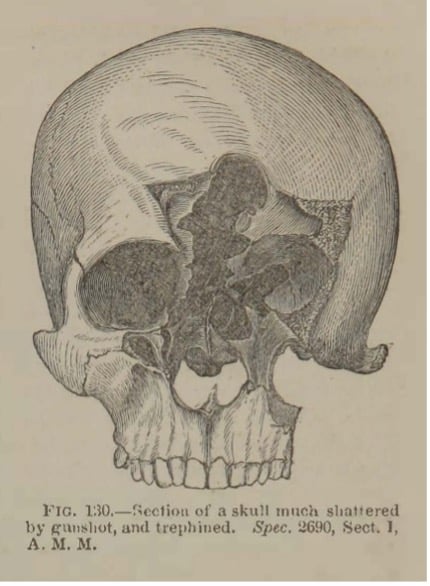
The National Museum of Health and Medicine, established during the Civil War by Dr. William Hammond as the Army Medical Museum, is a center for the collection of specimens and artifacts for research related to trauma and pathology. Part of Dr. Bentley’s treatment of James’s injuries was performing a procedure called trephination, a surgical intervention in which a hole is drilled or scraped in the human skull with the intent to release pressured blood buildup from an injury. It is unknown if James was the only patient that Dr. Bentley performed trephination on, however, it is obvious that James’s case made an impact. Dr. Bentley conducted an autopsy with the goal of removing James’ skull for further study, afterward donating all associated materials to the Army Medical Museum. After reaching out to staff at the museum, Brent was informed that James’s skull is on display as an example of the procedure of trephination. The staff at the museum was very welcoming, helpful, and knowledgeable as they discussed James’s service and his received wound. I’m currently working on my second book, a biography of Lt. Col. Bentley, which will feature the everlasting story of James Luman.
Thank you to Brent for co-writing this article with me.
Madeline Feierstein is an Alexandria, VA historian and founder of the educational & historical consulting company Rooted in Place, LLC. A native of Washington, D.C., her work has been showcased across the Capital Region. Madeline is a member of Emerging Civil War and has written for Emerging Revolutionary War, Civil War Monitor, and the National Museum of Civil War Medicine. She leads significant projects on the history of hospitals, prisons, and wartime America. She is the author of Occupied Alexandria: How the Civil War Transformed a Southern City (History Press, 2026). Madeline holds a Bachelor of Science in Criminology from George Mason University and a Master’s in American History from Southern New Hampshire University. Explore her research, schedule a meeting, and book a guided tour at www.madelinefeierstein.com.
Brent Reidenbach, a native of Delphos, Ohio and U.S. Army veteran, has been interested in the Civil War for almost 45 years. Since returning from Germany in 2001, Brent has been conducting research on all Ohio units that served in the Eastern Theater, specifically the 126th Ohio Volunteer Infantry Regiment – a regiment his cousin served in.


I enjoyed this article immensely as it added unknown information on James Luman, who was in my genealogical tree. I am descended from his wife, Mary Wells Luman Perdew, her second marriage.