What Was So Wrong About the Dred Scott Decision? [Part I]
The Unites States Supreme Court’s 1857 Dred Scott decision[1] is typically considered the Court’s “worst decision.”[2]Undisputedly racist—the Court stating, for example, that blacks were considered “so far inferior that they had no rights which the white man was bound to respect”[3]—the Court not only ruled that African Americans could never be U.S. citizens, but that Congress was Constitutionally prohibited from excluding slavery in federal territories. The decision was a political bombshell. Indeed, rather than settling the divisive national slavery question (the Court’s goal), the decision sparked outraged resistance in much of the North. This response in turn angered the slave-holding states, who insisted that the law must be honored, the New York Herald declaring that “Disobedience is rebellion, treason, and revolution.” The Court’s decision is seen as a contributing factor towards the outbreak of the Civil War.[4]
Thus, the decision obviously must be the Court’s “worst” decision, correct? Such certainly is the modern conventional wisdom. Yet conventional wisdom is not a substitute for objective analysis. Every pre-Thirteenth Amendment Court decision that upheld the institution of slavery today is seen (rightly) as morally repugnant. Yet no reasonable person could deny that the Constitution as originally drafted protected slavery to some extent.[5] Hence, a pro-slavery decision should not, per se, be considered “wrong” in the sense of being incorrectly decided under then-controlling law. Moreover, one Constitutional scholar has gone as far as to argue that the conclusions reached by the Court were “just as plausible as the contrary views detailed in the dissents.”[6] A closer look at the opinion issued in Dred Scott is warranted to determine if it truly warrants the ignominy assigned by posterity.

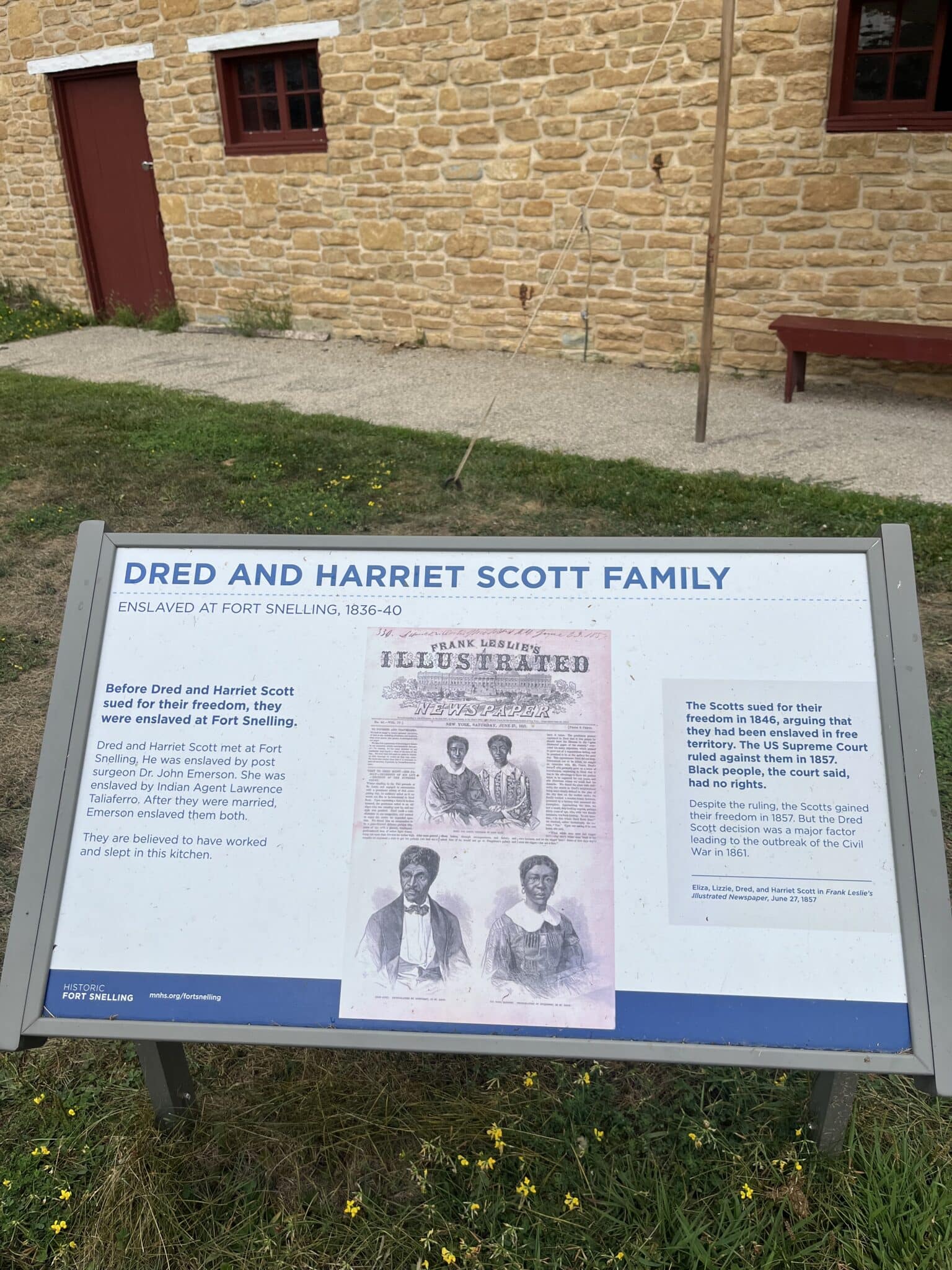
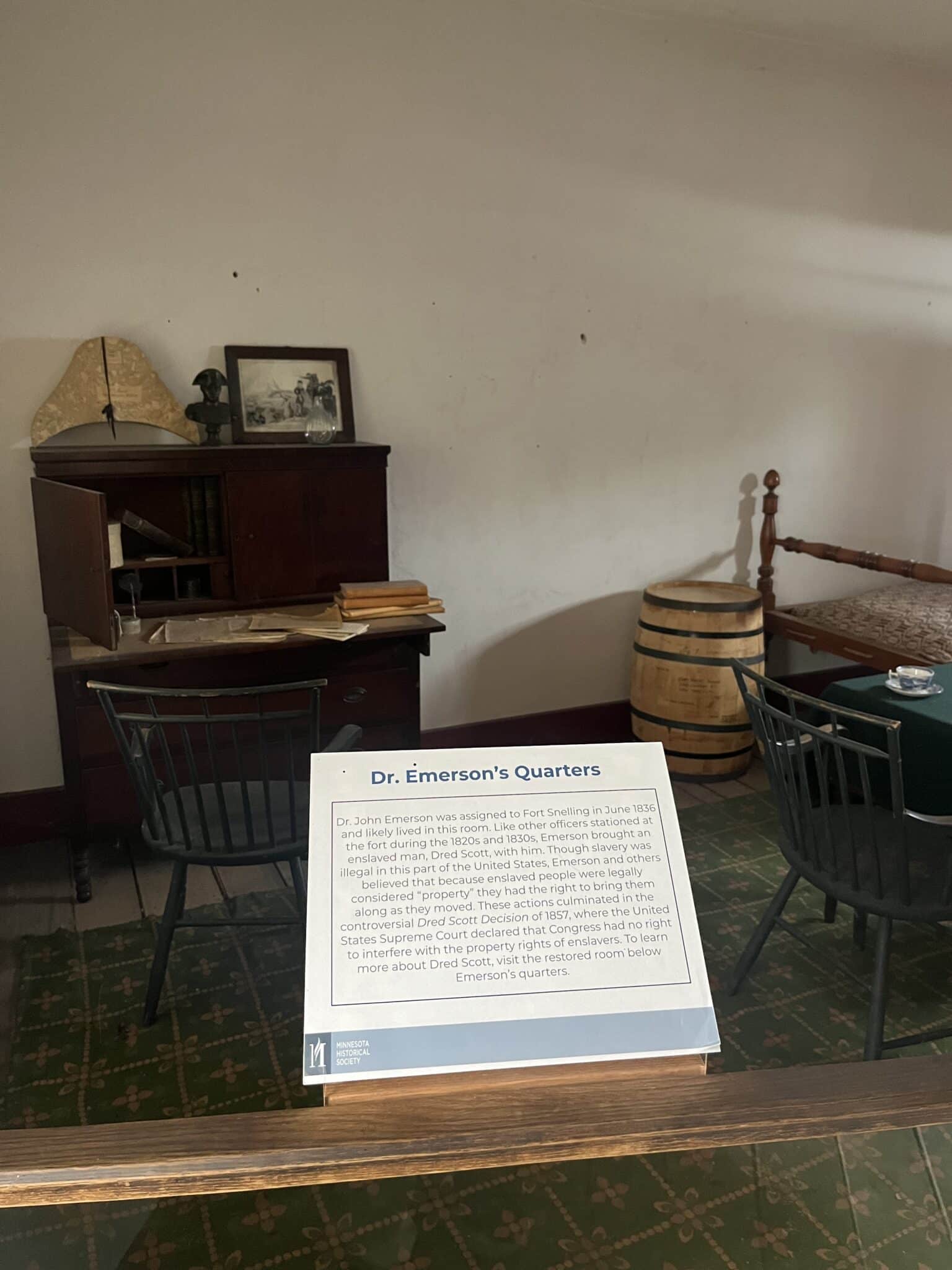
The facts of the case were straightforward. The petitioner to the Court, Dred Scott, was an enslaved man once owned by Dr. John Emerson, a surgeon in the U.S Army. From May 1836 until April 1838 Scott was held at Emerson’s post at Fort Snelling, located in today’s St. Paul, Minnesota.
That was land in which Congress had expressly prohibited slavery by, inter alia, the Missouri Compromise of 1820. Relying upon precedent cases, including almost a dozen decided in Missouri—where Scott then was residing—that held that residence in a free state emancipated an enslaved person, Scott filed suit in 1846 claiming he had become free at Fort Snelling. Scott won his freedom in 1850 after a trial. However, the Missouri supreme court decided to overturn twenty-eight years of state precedents and held that Scott remained enslaved under Missouri state law.[7]
Scott then turned to federal court. The federal trial court rejected an argument raised by Scott’s then-current owner, John F.A. Sanford,[8] that no black man descended from African slaves could ever be considered a “citizen” possessing the right to sue in federal court. But the judge instructed the jury that Scott’s status was governed by Missouri law. Since that state’s supreme court already had decided that question, Scott lost. He then appealed to the U.S. Supreme Court, which heard initial arguments in February 1856.[9] It was at this point that matters became squirrely.
The Supreme Court’s decision should have been simple, narrow and uncontroversial. Only five years before the Court had decided, in Strader v. Graham, 51 U.S. 82 (1851), that each state had the right to decide the status (free or enslaved) of persons within its borders.[10] Again, the Missouri supreme court already had established Scott’s status as enslaved. All the Supreme Court had to do was ratify that state court decision.
There was, though, a relatively minor fly in the judicial ointment. There was that question of whether Scott had the right to sue at all. Federal courts then, as now, are courts of limited jurisdiction, i.e., the authority even to entertain a case. They may hear certain cases of plaintiffs versus defendants who are citizens of different states (called “diversity jurisdiction”).[11] But if Scott were not a “citizen” in the first place, the Court did not have jurisdiction to hear his appeal. And it was well-established—then, as now—that confirming jurisdiction is a fundamental preliminary task of any federal court.[12]For if the court cannot entertain the case before it due to a lack of jurisdiction, then it cannot issue an opinion deciding any issues raised by that case.
The Dred Scott court thus had two potential avenues to dispose of Scott’s case without any major national political repercussions. First, the Court could avoid the citizenship issue and simply rule, based upon its own recent Strader v. Graham case, that the prior Missouri supreme court decision governed Scott’s status. Second, the Court could instead rule that Scott was not a “citizen” within the meaning of the Constitution, and thus not entitled to pursue a case in federal court. Either way, Scott would remain enslaved. Yet the Supreme Court would not further significantly inflame the existing passions surrounding the slavery debate.
Neither of these uninflammatory available courses was taken by the Supreme Court. Instead, the Court, in an expansive 55-page majority opinion authored by Chief Justice Roger B. Taney, held that: (1) Scott, as an African American, never could constitute a citizen of the United States, even if a particular state endowed him with its citizenship;[13] (2) despite the Constitution’s mandate that each state must grant citizens of other states the same “privileges and immunities” afforded its own citizens, African Americans—even if free—were never entitled to such protection in slave states;[14] (3) Congress was without authority to ban slavery in any federal territory not held at the time the Constitution was adopted, and consequently, the Missouri Compromise of 1820 was unconstitutional;[15] and (4) moreover, even no legislature of a territory could prohibit slavery within its limits.[16] This last holding swept aside the doctrine of “popular sovereignty,” that is, permitting the residents of a territory themselves to decide if their territory/state would permit slavery.[17]
It would be difficult to overemphasize the significance of the Court’s ruling to the struggle between freedom and slavery. In one fell swoop, all legal obstacles to the admission of new slave states were deemed unconstitutional. Congressional debate over the issue of new territories as free or slave states, and any political compromises that might be sought, were all for naught. Slavery must prevail. The Constitution so held. At least that is what the Supreme Court ruled.
Such a remarkable Court decision—effectively revoking the authority of Congress to deal with the divisive slavery issue while simultaneously depriving all African Americans of any right to civic participation in the national body politic —should of necessity have to be supported by powerful legal authority, one would surely have thought. One would have been disappointed in any such expectation. And here is where the Court’s Dred Scott decision starts to earn its “worst decision” moniker. Exactly how this happened will be addressed in Part II of this post.

[1] Scott v. Sandford, 60 U.S. 393 (1856), https://supreme.justia.com/cases/federal/us/60/393/.
[2] E.g., Donald Scarinci, Editor, “The Dred Scott Decision: Slavery And The U.S. Supreme Court,” Constitutional Law Reporter (“Legal scholars overwhelmingly agree that it is the U.S. Supreme Court’s worst decision.”), https://constitutionallawreporter.com/2015/07/07/the-dred-scott-decision/; Charles Evans Hughes, The Supreme Court of the United States: Its Foundation, Methods and Achievements, an Interpretation (Columbia University Press, New York, NY, 1928), 50 (referring to the case as one of the Court’s “self-inflicted wounds”), https://archive.org/details/supremecourtofun0000hugh/page/n5/mode/2up.
[3] 60 U.S. at 407.
[4] Paul Finkelman, Dred Scott v. Sandford: A Brief History With Documents (Bedford/St. Martin’s, Boston, MA, 2017), describes both the case and the heated controversy it generated, “which certainly pushed the nation far closer to…war.” See also Allen Carden, Freedom’s Delay: America’s Struggle for Emancipation (The University of Tennessee Press, Knoxville, TN, 2014), 205, 218, 241-242.
[5] See e.g., U.S. Constitution, Article IV, Section 2 (the “Fugitive Slave Clause,” mandating the return of fugitives from slavery).
[6] Mark A. Graber, Dred Scott and the Problem of Constitutional Evil (Cambridge University Press, 2006), 4, quoted inArthur T. Downey, Civil War Lawyers: Constitutional Questions, Courtroom Dramas, and the Men Behind Them (ABA Publishing, Chicago, IL, 2010), 39.
[7] Finkelman, 12-19.
[8] Sanford’s last name was misspelled by the Supreme Court clerk as “Sandford.” Finkelman, 19.
[9] Finkelman, 19-23.
[10] The only exception was that free states could not declare the freedom of fugitive slaves, as the Constitution required the return of such fugitives. Finkelman, 27 & n. 56.
[11] There are other sources of Supreme Court jurisdiction, but none were relevant to Scott’s case.
[12] Indeed, the question of whether the Supreme Court had jurisdiction was the determinative question in the famous case of Marbury v. Madison, 5 U.S. 137 (1803), the only case prior to Dred Scott in which the Court had held an act of Congress unconstitutional. Finkelman, 7, 30.
[13] Scott, 60 U.S. at 404-427, 454.
[14] Scott, 60 U.S. at 405-407, 422-427.
[15] Scott, 60 U.S. at 432-452.
[16] Scott, 60 U.S. at 450-451.
[17] Popular sovereignty had successfully been employed as part of the Compromise of 1850 and later championed by Illinois Senator Stephen A. Douglas in his 1854 Kansas-Nebraska Act. Carden, 192-193.


If a person was born in the United States after American Independence was declared, how did he become an American citizen?
Let’s use as an example….a person born in Schenectady, New York, in 1800 was considered a U.S. citizen under the common-law doctrine of birthright citizenship (jus soli, or the right of the soil), which the United States inherited from English common law. That is a fact. Under traditional English and early American common law, anyone born within the territory and allegiance of the sovereign power (in this case, the United States ) automatically acquired citizenship at birth. Early U.S. courts, such as the Supreme Court, routinely operated on the assumption that individuals born on American soil after the Declaration of Independence were natural-born citizens.
Now Dred Scott was born in Alabama around 1799. He should have had citizenship given to him under the common law doctrine of birthright.
Now, it is correct that the US Constitution was a slave friendly document. The 3/5th rule gave slave states more representation in Congress than they were entitled to. It gave the slave states more votes in the Electoral College, and the person who was President nominated Supreme Court justices. So, slavery was protected in all 3 branches of the US Government.
The decision was a bad decision because it was not based on law, but only on the interpretation of one man, but also because it was based on extreme racial bias, historical falsehoods (such as claiming the U.S. was founded on structural racism), and judicial activism that overreached instead of resolving sectional strife.
The worst US Supreme Court decisions were based on racism.
Dred Scott v. Sandford (1857):
Plessy v. Ferguson (1896)
Korematsu v. United States (1944)
Shelby County v. Holder (2013)
Brnovich v. Democratic National Committee (2021)
Louisiana v. Callais(2026)