Book Review: How Lincoln Won: The 1860 Presidential Election and the Origins of the Civil War

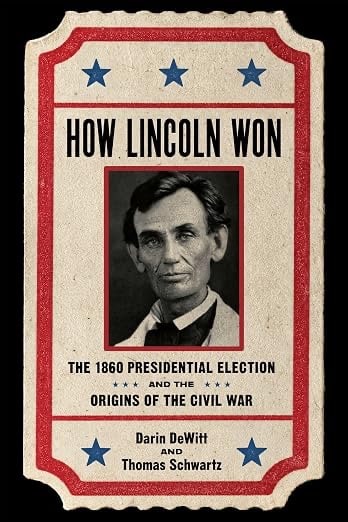
How Lincoln Won: The 1860 Presidential Election and the Origins of the Civil War. By Darin DeWitt and Thomas Schwartz. Baton Rouge: Louisiana State University Press, 2026. Hardcover, 278 pp. $45.00.
Reviewed by Robin Friedman
In 1858, Republican Abraham Lincoln challenged the Democratic incumbent Stephen A. Douglas for the U.S. Senate seat in Illinois. The candidates held a series of debates. During the debate in Freeport on August 27, Lincoln posed the following question to Douglas: “Can the people of a United States territory, in any lawful way, against the wish of any citizen of the United States, exclude slavery from its limits prior to the formation of a state constitution?” (3) This question was a trap. It was meant to expose the inconsistency between Douglas’ advocacy of popular sovereignty as the means to decide whether slavery would be allowed in a new territory on the one hand and the Supreme Court’s decision in Dred Scott, which held that slavery could not be prohibited in the new territories on the other hand. Douglas fell into the trap. His response to Lincoln became known as the Freeport Doctrine: “The people of a territory can, by lawful means, exclude slavery from their limits prior to the formation of a state constitution. If the people are opposed to slavery they will by unfriendly legislation effectually prevent the introduction of it into their midst.” (3-4) Douglas’ response suggested that territorial legislatures had the right to undercut the Supreme Court language in Dred Scott allowing slavery in the territories. The Freeport Doctrine cost Douglas the support of the southern wing of the Democratic party and its allies in the north.
The history of the Lincoln-Douglas debates and of the Freeport Doctrine have been told many times, but it is at the heart of this new book, How Lincoln Won, by Darin DeWitt, professor of political science at California State University, Long Beach, and the late Thomas Schwartz, (1943 – 2024), Distinguished Research Professor of Political Science at the University of California, Los Angeles. They offer a new analysis of the Freeport Doctrine and its significance which focuses on Lincoln’s aggressive strategy in dividing the Democratic party. This strategy had a pivotal role both in 1858 and in Lincoln’s election to the presidency in 1860.
The story of the Freeport Doctrine was first told in the earliest biography of Lincoln written by John Locke Scripps for the 1860 presidential campaign with material provided by Lincoln himself.[1] Scripps found that by entrapping Douglas, Lincoln lost the 1858 senate election but put himself in position to win the presidential election in 1860. DeWitt and Schwartz describe this as the “folklore” view of the Freeport Doctrine. Many recent scholars, in contrast, question the significance of the Freeport Doctrine on grounds that the debates and the Doctrine simply rehashed positions already well-known and that, in 1858, Lincoln had no realistic hope of running for president in 1860.
DeWitt and Schwartz reject the contemporary position and modify the “folklore” position. They argue that Lincoln’s actions in and subsequent to the 1858 debates reflected a strategy of dividing the Democratic party on slavery, the issue of virtually exclusive concern to the electorate. They point out that Lincoln won the popular vote in the 1858 senate election and lost the race due to the malapportionment of the Illinois State Legislature. The 1858 election and its aftermath catapulted Lincoln into national prominence. He was able to expand his appeal as an opponent of the spread of slavery to the territories to include less committed voters who might otherwise have voted democratic by, among other positions, Lincoln’s lack of support for full civil equality for Black people. Lincoln’s 1858 campaign exacerbated the tensions in the Democratic party, resulting in two additional candidates, John Breckenridge and John Bell, in addition to Lincoln and Douglas. Lincoln received less than 40 percent of the popular vote but won overwhelmingly with the electoral college votes of the North. The population in the northern states had increased to such an extent that the northern votes were more than sufficient to carry the election.
Although the focus of the book is on the 1858 and 1860 elections, DeWitt and Schwartz provide context by studying the 1820 and 1850 attempted compromises on slavery, the multi-party presidential campaigns of 1844, 1848, and 1856, the Kansas-Nebraska Act of 1854, the Dred Scott decision, and Lincoln’s Cooper Union address of February 27, 1860. The book shows how slavery, its existence and expansion to the territories, had become the consuming issue in American politics by the 1850s. Although the book emphasizes Lincoln’s skill as a tactician, it also rightly emphasizes the role of morality in politics. While Douglas’ position was close to that of Lincoln in 1860, Lincoln stressed that the difference between the two was a matter of moral principle. Douglas was willing to defer to popular sovereignty while, for Lincoln, popular sovereignty in the spread of slavery to new territories had to yield to morals and to the wrong of slavery. DeWitt and Schwartz write: “Whether democracy and justice were in conflict depended on who the demos was: different populations might vote for or against slavery by majorities. Douglas’ majoritarianism was tantamount to moral neutrality. On fundamental questions of justice, neutrality can be politically irresistible but it implies that injustice is permissible.” (202)
“How Lincoln Won” is a thoughtful, provocative study, well-documented with extensive endnotes and references. It will increase the reader’s understanding of how and why Lincoln was elected president.
Robin Friedman retired from a career as an attorney with the United States Department of the Interior in 2010. In retirement, he pursues his passion for American studies, including literature, history, philosophy, and the Civil War.
[1] John Locke Scripps, The First Published Life of Abraham Lincoln (1860) (Detroit, MI, Cranbrook Press 1900).


