From the Mule Shoe to the Hitching Post: A Horse Theft, a Sentry, and a Court-Martial
ECW welcomes guest author David C. Moore.
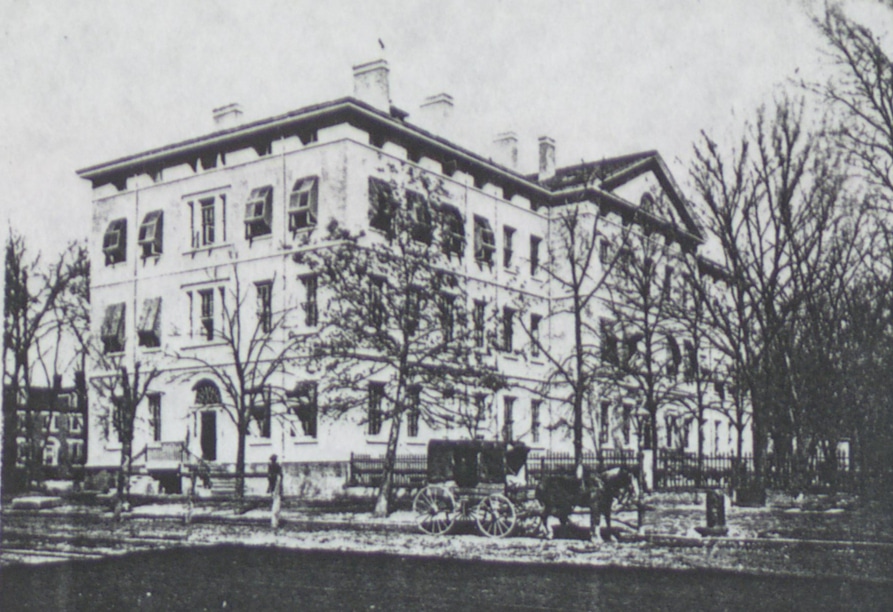
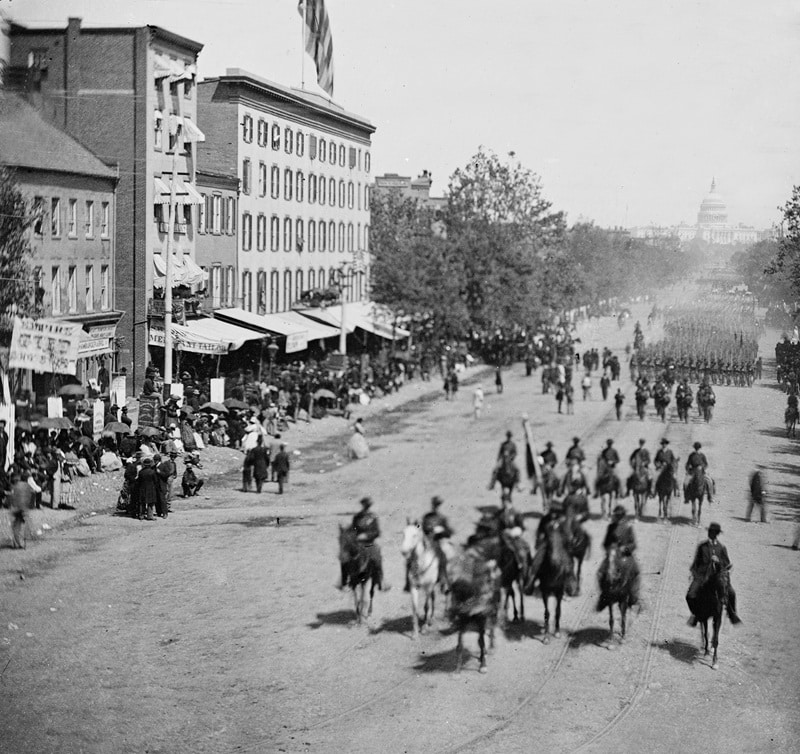
On the sweltering morning of July 3, 1865, Caspar Nauman, a Regular Army cavalryman serving as a messenger, hitched his mount to the rack outside the War Department building in Washington, D.C. Less than an hour later, he was informed that a stranger was riding his horse up Pennsylvania Avenue. Nauman’s reaction was swift. He ran into the street, commandeered another horse, and galloped after the thief. He overtook the culprit, recovered his animal, and hauled the man before the authorities.[1]
Ten days later, a different man stood trial relating to the incident. A tribunal of seven officers turned its attention not to the thief, but to the man who had been assigned to guard the hitching post. Private George Henhoeffer Jr., pronounced “Hen-heff-er,” was a sentinel from the Veteran Reserve Corps (VRC), and this was not his first court-martial.
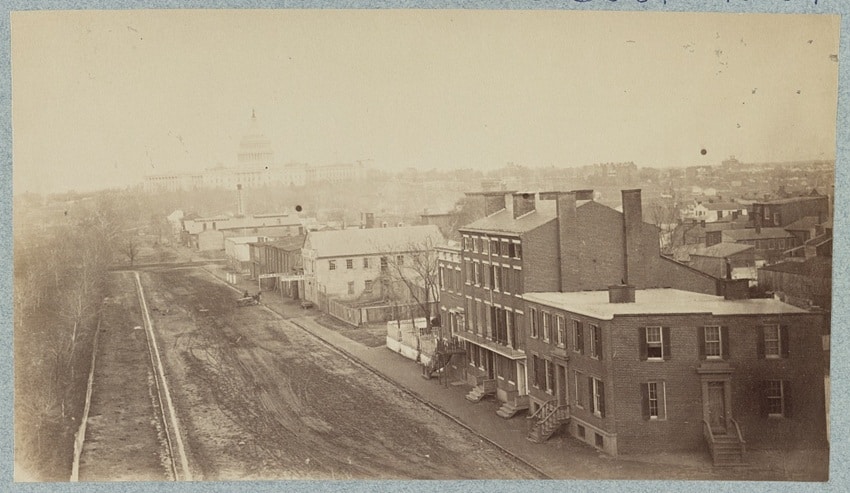
Although the major Confederate armies had surrendered, Washington remained tense, crowded, and militarized. The city was suffocating under a 97-degree heatwave, alternating with violent rainstorms that flooded the muddy streets.[2] While the military was slowly transferring authority back to civil officials, Washington remained under extraordinary military oversight during the trial and execution of the Lincoln assassination conspirators.[3] Petty crime remained a visible concern, as pickpockets and “sneak thieves” preyed on the transitional chaos of demobilizing soldiers.[4]
In this case, the stolen property was not trivial. A horse in 1865 was transportation, military property, and an essential tool of communication. Quartermaster-General Montgomery C. Meigs once wrote that a horse in the wrong hands could be “more injurious” than “a barrel of gunpowder.”[5] A War Department messenger, such as Nauman, understood that a horse was critical to his ability to move and support the military’s daily operations.
Although the theft itself was limited in scale, it brought Henhoeffer before a formal military tribunal presided over by Capt. William R. Morse of the 7th Regiment, VRC.[6] The VRC was composed largely of soldiers no longer fit for combat service but still capable of guard, clerical, or other military duties.[7] Morse was a former captain in the 2nd Michigan Infantry and a combat veteran who had been severely wounded at the battle of Williamsburg in May 1862.[8] He understood combat, discipline, and military service firsthand.
The accused was no stranger to combat either. Henhoeffer was a twenty-year-old silversmith from Philadelphia who enlisted in the 98th Pennsylvania in February 1864.[9] His father, a German immigrant, had joined the 98th Pennsylvania when it was organized in August 1861 and had mustered out of it in August 1864.[10]
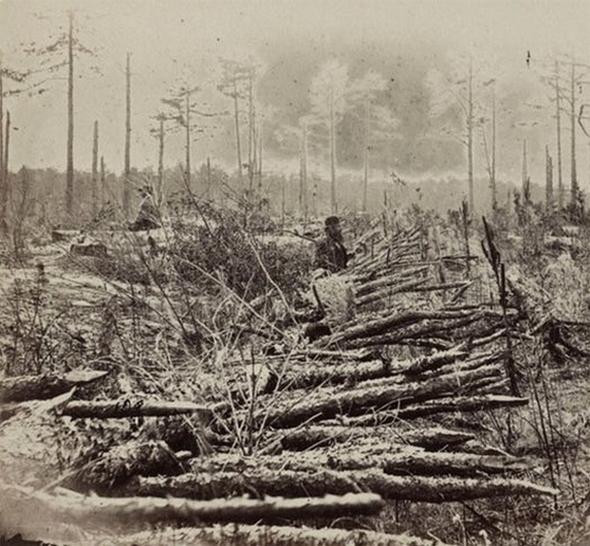
Henhoeffer Jr. marched into the brutal fighting of the Overland Campaign and was severely wounded on May 12, 1864, at the battle of Spotsylvania Court House when the 98th assaulted the Mule Shoe salient, resulting in the amputation of his right index finger.[11] Deemed unfit for frontline combat, he was transferred to the VRC.
Despite being a combat veteran, his record in the VRC was not spotless before his July court-martial. In January 1865, Henhoeffer was court-martialed for a dereliction of duty: he was ordered to escort a prisoner to the latrine. Instead, he took the man to a “house of bad repute” to obtain civilian clothes for the prisoner’s desertion attempt.[12] He was found guilty and sentenced to hard labor and forfeiture of a month’s pay.[13]
When Henhoeffer stood before a court for a second time in July 1865, the charge was not larceny of a horse, but “neglect of duty to the prejudice of good order and military discipline.”[14] The question was whether Henhoeffer had failed to perform a duty he was reasonably capable of carrying out. The prosecution’s case rested on the instructions given to the sentries. Private L. Blanchard, whom Henhoeffer relieved, testified that his orders were, “When a man came there with a horse, to take notice and see that no one else came and took the horse away.”[15]

Henhoeffer’s defense was equally simple. He declined to call witnesses, instead highlighting the logical limitations of his orders. He stated to the court that there were six or seven horses hitched at the rack when he assumed his post. Because he had not seen the riders arrive and hitch them, he argued that it was “impossible to judge who was the proper person to take them away.”[16] It was also his first assignment to that post. The case turned less on whether the horse had been stolen than on whether Henhoeffer could reasonably have carried out the orders he had been given.
Henhoeffer had been ordered to prevent unauthorized removals without a reliable way to identify the authorized riders. On that narrow, but important point, the prosecution failed to offer a counterargument. Henhoeffer was acquitted of the charge, released from confinement, and returned to duty.[17] He was honorably discharged from the service on July 22, 1865.[18]
Even in the shadow of the Lincoln conspirators’ execution and the demobilization of Union armies, the military still had to manage the ordinary routines of service, including protecting government property and performing sentry duty. Henhoeffer’s case shows that military discipline did not simply disappear when the fighting ended. It continued to shape the lives of soldiers even as the armies were shrinking and thousands of volunteers prepared to return home.
It is tempting to imagine that, after the loss of a finger and months of routine duty in Washington, Henhoeffer regarded watching horses as a poor remnant of the soldiering he had once known. Perhaps, with his father already out of the army and armies demobilizing around him, he had grown less invested in the routines of military life. That remains speculation. What the record does show is that the Army continued to expect discipline from its soldiers even as their service was ending. As George’s second-great-grandnephew, I may be inclined to give him the benefit of the doubt. In this case, at least, so did the court.
David C. Moore is a lieutenant colonel in the United States Air Force and a graduate of Gettysburg College. He holds a Master of Public Administration from Rutgers University and is pursuing a Master of Science in International Relations at Troy University. A Civil War living historian, he reenacts with Company B of the 28th Massachusetts Volunteer Infantry.
Endnotes:
[1] Proceedings of a General court-martial for Private George Henhoffer, Co. C, 7th Regiment Veteran Reserve Corps, July 1865; Records of the Office of the Judge Advocate General (Army); Record Group 153; National Archives Building, Washington, D.C.
[2] “The National Holiday,” Evening Star (Washington, DC), July 3, 1865; “Heavy Rain,” Evening Star, July 12, 1865.
[3] “The Execution,” Evening Star, July 7, 1865; U.S. War Department, Adjutant-General’s Office, “General Court-Martial Orders, No. 356,” July 5, 1865.
[4] “A New Way to Show Them Up,” Evening Star, July 24, 1865.
[5] U.S. War Department, The War of the Rebellion: A Compilation of the Official Records of the Union and Confederate Armies, ser. 1, vol. 25, pt. 2 (Washington, DC: Government Printing Office, 1889), 544.
[6] Court-Martial Case Files, 1809–1894, Entry PC-29 15; Records of the Office of the Judge Advocate General (Army), Record Group 153.
[7] National Archives and Records Administration, Veteran Reserve Corps (VRC), 1863–1865, Reference Report no. 920, revised December 2010, accessed July 1, 2026, https://www.archives.gov/files/research/military/civil-war/veteran-reserve-corps.pdf.
[8] “Maj. Morse Dead: A Gallant Soldier and a Beloved Citizen,” Detroit Free Press, March 10, 1907.
[9] Compiled Military Service Records of Volunteer Union Soldiers Who Served in Organizations from the State of Pennsylvania, Record Group 94, National Archives Building.
[10] Pennsylvania State Archives, Register of Pennsylvania Volunteers, 1861–1865, Record Group 19, Series 19.65, 98th Pennsylvania Volunteers, p. 55, Pennsylvania Historical and Museum Commission, accessed July 1, 2026, https://www.phmc.state.pa.us/bah/dam/rg/di/r19-65RegisterPaVolunteers/r19-65Regt098/r19-65Regt098%20pg%2055.pdf.
[11] Carded Medical Records for U.S. Volunteers, Mexican War and Civil War, Entry PI-17 534, Record Group 94, National Archives Building.
[12] General Orders, No. 17, Headquarters 1st Brigade, Veteran Reserve Corps, February 22, 1865, in Compiled Military Service Record of George Henhoffer, Private, Company C, 7th Regiment Veteran Reserve Corps; Records of the Adjutant General’s Office, 1780s–1917, Record Group 94; National Archives, Washington, DC.
[13] Ibid.
[14] Henhoffer court-martial, July 1865, Case OO 1180.
[15] Ibid.
[16] Ibid.
[17] Ibid.
[18] Pension File of George Henhoeffer (Private, Co. F, 98th Pennsylvania Infantry and Co. C, 7th Veteran Reserve Corps), Invalid Application No. 165,352, Certificate No. 116,086, and Widow Application No. 669,817, Certificate No. 465,203; Civil War and Later Pension Files; Record Group 15; National Archives Building, Washington, D.C.


