Book Review: A Desperate Fight: The Lives of Louisiana’s Confederate Soldiers

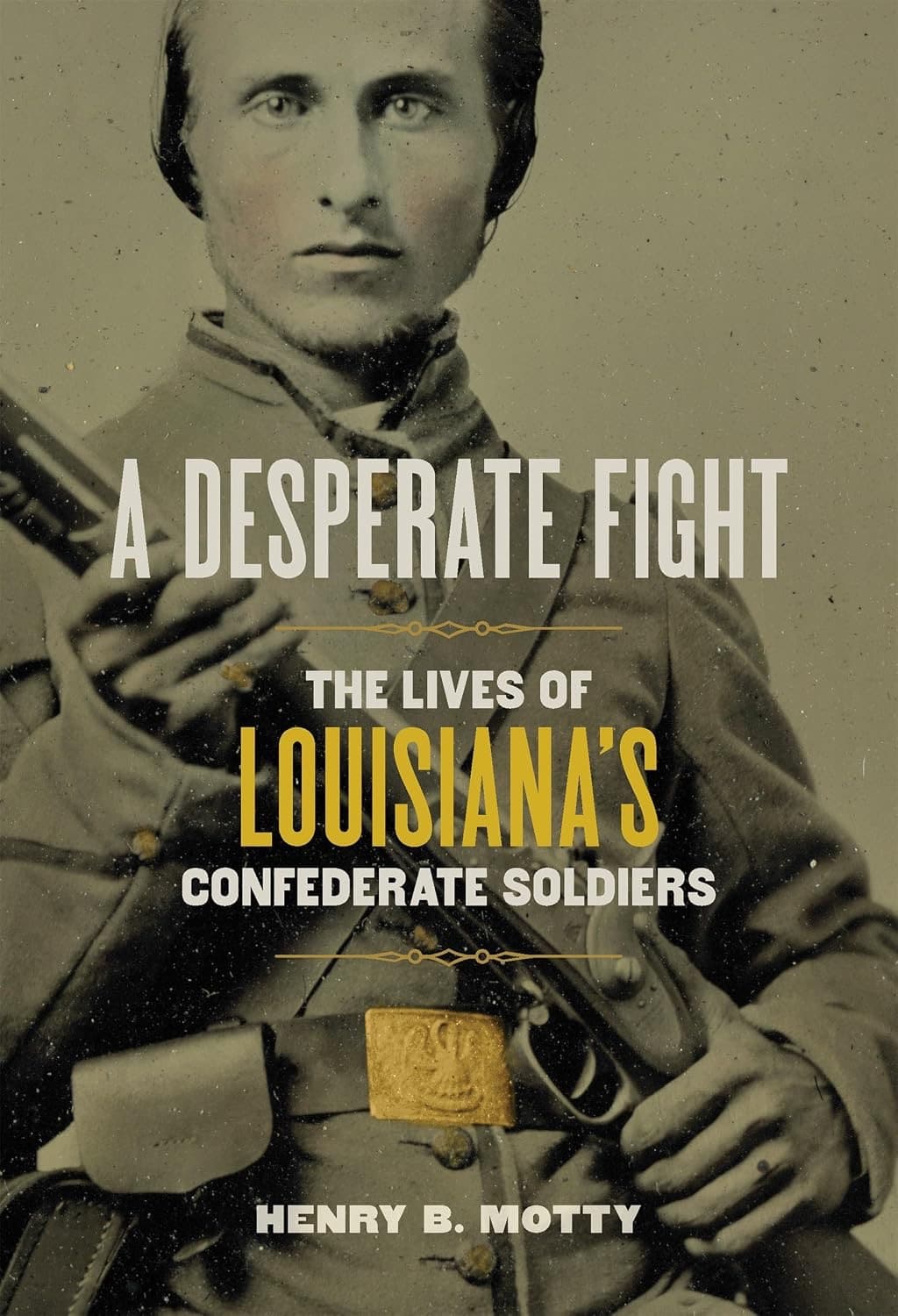
A Desperate Fight: The Lives of Louisiana’s Confederate Soldiers. By Henry B. Motty. Baton Rouge: Louisiana State University Press, 2026. Hardcover, 280 pp. $50.00.
Reviewed by Darryl R. Smith
Henry B. Motty’s A Desperate Fight: The Lives of Louisiana’s Confederate Soldiers, provides a focused historical analysis of the American Civil War by isolating its scope to Louisiana. Motty, a native of southwest Louisiana with a PhD in American history from LSU, structures the text around a central thesis: the military persistence of Louisiana’s Confederate forces relied on deep, sustaining interdependence between soldiers and the civilian population.
Rather than relying on traditional top-down military narratives that emphasize battlefield tactics or abstract nationalistic fervor, Motty views the conflict through the soldiers’ localized experiences and continuous social bonds with the home front. The book operates on the premise that these two groups did not endure the hardships of the conflict in isolation. Motty argues that communal attachments forged between the fighting forces and the civilians they left behind served as the primary mechanism that kept the state’s soldiers in the ranks throughout the war.
To establish the scale of this interdependence, the book details a critical demographic baseline. Louisiana fielded approximately sixty thousand men for the Confederate military, representing nearly 18 percent of the state’s total white population. The removal of this demographic from the civilian labor force and local economy constituted a massive structural disruption.
Motty highlights that the vast majority of these troops came directly from civilian life, carrying their local identities and community ties into military encampments. They viewed themselves fundamentally as citizen-soldiers who required continuous civilian support to maintain morale. In turn, civilians sympathetic to the Confederate cause expected these local soldiers to protect their specific communities from federal incursions, forming a binding social contract that dictated the behavior of Louisiana regiments.
This soldier-civilian interdependence was heavily amplified by the rapid strategic collapse of Louisiana’s formal defensive posture. A Desperate Fight traces how swift military defeats fundamentally altered the nature of the war within the state. In April 1862, Union land and naval forces successfully seized New Orleans, the largest city in the Confederacy. The following month, federal forces captured the state capital of Baton Rouge.
These rapid operational losses meant that the economic and political heart of Louisiana fell into Union hands for the remainder of the war. The strategic situation deteriorated further the following year with the fall of Port Hudson, securing complete Union control over the Mississippi River in the state.
By detailing this timeline, Motty establishes the environmental conditions that forced soldiers and civilians into total reliance upon one another. The loss of primary economic centers effectively dismantled standard Confederate supply lines and centralized administrative control. Furthermore, Union control of the Mississippi River geographically severed the Trans-Mississippi theater from the Confederate government in Virginia. In this administrative void, localized communal ties replaced formal government infrastructure. The conventional concept of an isolated home front ceased to exist, blurring the distinction between civilian and military spheres across large sections of the state.
With physical boundaries erased, Motty details how the wartime experiences of both groups became intertwined through shared trauma. Active military campaigns systematically dismantled the region’s rural economy and accelerated the destruction of the slavery-based agricultural system.
Civilians were forced to deal with the immediate physical destruction left in the wake of combat operations. Motty outlines a shared economy of suffering where soldiers and civilians contended with the constant threat of injury, extensive property damage, and severe shortages of basic necessities. This shared proximity to violence forged a resilient communal framework capable of sustaining the Confederate war effort in Louisiana despite increasingly insurmountable operational odds.
Motty addresses the shifting forces that drove Louisianians to support the war effort, noting that motivations evolved as conditions degraded. While abstract ideology and overarching Confederate nationalism served as catalysts for initial enlistment in 1861, Motty asserts these concepts were insufficient to maintain long-term combat endurance.
As formal Confederate authority waned, localized civilian relationships provided soldiers with a tangible connection to their sacrifices. As the conflict dragged on, many Louisiana soldiers believed they were no longer fighting for a distant nation-state, but to protect their immediate families and defend specific, local conceptions of civilian freedom. The immediate physical proximity of their homes provided a highly motivating rationale to remain in the ranks.
Henry B. Motty’s A Desperate Fight: The Lives of Louisiana’s Confederate Soldiers provides a focused, rigorous examination of the localized social mechanics that sustain military operations during a prolonged conflict. By restricting its analysis to Louisiana, the text documents the transition from abstract, nationalistic enlistment to a desperate, locally focused defense mechanism driven by familial bonds. The book demonstrates that the complete disruption of standard governmental infrastructure following early Union occupation forced a profound reliance on local civilian networks. Motty successfully argues that the endurance of Louisiana’s citizen-soldiers was inextricably tied to the survival and support of the communities they fought to protect.
Darryl Smith is the owner and operator of Walking With History LLC. Darryl is an avid hiker and backpacker, who also is a Civil War and American military history enthusiast. Darryl serves as the chair of the Buffington Island Battlefield Preservation Foundation. Darryl also was the founder of the Miami Rivers Chapter of the Buckeye Trail Association, served as the Activities Chair for the Cincinnati Civil War Round Table, served as the Communication Coordinator for the Military Heritage Chapter of the League of World War One Aviation Historians, and was a board of trustees member for the Buckeye Trail Association. He served as membership chair for the Cynthiana Battlefields Foundation. In addition, Darryl serves as blog writer and co-administrator for the Western Theater in the Civil War website. He has always believed that the most effective way to understand our history is to walk the ground where history took place.


