Book Review: A Desperate Fight: The Lives of Louisiana’s Confederate Soldiers

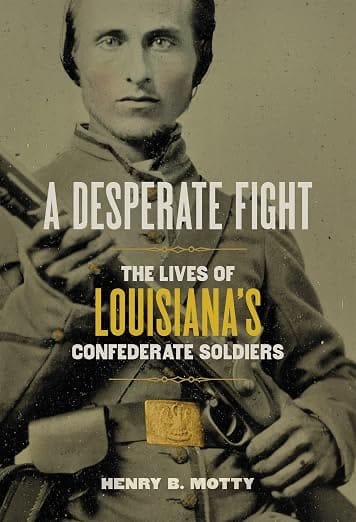
A Desperate Fight: The Lives of Louisiana’s Confederate Soldiers. By Henry B. Motty. Baton Rouge: Louisiana State University Press, 2026. Hardcover, 272 pp. $49.95.
Reviewed by Sean Michael Chick
Of all the Confederate states, Louisiana produced the most diverse units and, debatably, the most colorful ones. This has led to numerous unit studies, with Lee’s Tigers by Terry L. Jones being a classic. Many regimental books have been written and self-published by Michael Dan Jones.
The state is worthy of such attention. For one, Louisiana units served in all major theaters. For another, Louisiana itself had a unique experience. The state was devastated by war and became particularly lawless as the war dragged on. Louisiana regiments were noted often for hard fighting but also high desertion rates, leading to many questions. Henry B. Motty’s A Desperate Fight: The Lives of Louisiana’s Confederate Soldiers is the latest work on the Pelican State’s soldiers.
A Desperate Fight concentrates on the communal and familial forces that sustained Louisiana’s Confederates. These, of course, were buttressed by both more ideological and tangible goals. Slavery, after all, was not merely an economic factor in Southern life but determined much of the political and social world in an era of emerging scientific racism. There was also the initial rush to battle that happens every few generations when those who remember the last major bloodletting are gone. Indeed, Motty finds that at least in the initial cohort, Louisiana’s foreign-born population was just as eager as the rest of them.
A Desperate Fight is a highly personalized account. Soldiers are quoted often and within the broad range of experiences and backgrounds. Some of it is funny, touching, or, in other cases, quite searing. The author does not hide away the most unpleasant aspects. At one point Motty quotes Edwin Fay of the Minden Rangers, who was upset one slave was not pregnant, saying, “when I come home that I’ll either whip her most to death or sell her to the meanest man I can find on Red River…I bought her to breed her.” (137)
Motty pays close attention to how women fostered Confederate nationalism. Their support, material and emotional, was key to sustaining a war effort anywhere, but particularly in Confederate society, which lacked the national resources of their foes. At the same time, the early war brought the classes together. However, the strain of war seared these short-lived bonds, and privations mounted over time. Once the South suffered battlefield defeats, morale at home cracked, and so did the soldiers. However, like many contemporary studies, Motty downplays this erosion, at least before the late summer of 1864. Even as Louisiana was ravaged, Motty sees her soldiers staying in the field longer than usual.
One unique aspect of the book is something of a move away from a dependence on letters. Such documents are key to understanding the conflict, but they can be relied upon too much, as such documents were meant for a particular audience. Instead, there is much here on the day-to-day experience of the war, often but not always gleaned from letters. Indeed, the book is less about fighting. It is there, but in dealing with the fighting, much is about the lure of battle, irregular warfare, and the psychology of the experience. In that regard, Motty forges a more total picture of the experience. A particularly good chapter is on camp life.
Motty’s A Desperate Fight is a good first effort. It is not the usual work in its scope. Motty was doubly shrewd to use Louisiana given its place in the war. Most of all, the diversity of topics makes for an interesting read.
Editor’s note: This is one of two reviews that Emerging Civil Was has posted for A Desperate Fight. The other can be found here.


Did the author say anything about how the early capture of New Orleans affected their morale or the ability for these units to keep fighting?
Great question, M. A.! I have a copy of this book, but have only read about ten pages of it. Nevertheless, I went ahead and looked up what I could on how the early capture of New Orleans affected their morale or the ability for these units to keep fighting.
1. On Morale – nothing is really said about the fall of New Orleans and its affect on morale.
2. On the ability of these units to keep fighting – there is a lot of discussion on this subject, especially around conscription and the shrinking pool of men who could be conscripted once New Orleans and much of south Louisiana was occupied. The author mentions Louisiana state officials asking if troops in Virginia could be sent back to Louisiana, but understood they were needed for national defense in Virginia. The author also provides evidence for Union conscription driving some men in Union controlled areas to enlist in Confederate units to avoid being conscripted into a U.S. Louisiana unit, which is interesting.
I’ve read Terry Jones’ book that Sean Chick references and he also doesn’t say anything about the fall of New Orleans affecting morale other than it was used as a rallying cry during battle, especially after Butler became publicly reviled for his administration of New Orleans. I’ve read one account of a New Orleans militiaman who fled the city immediately before it was occupied by Butler, and he wrote about being willing to fight for the defense of New Orleans itself, but didn’t really want to leave the city and fight elsewhere.
Some officers and men did go back to Louisiana after the fall of New Orleans to serve in defense of Louisiana. Two such examples of officers were Brigadier General Richard Taylor and Colonel Theodore G. Hunt. Taylor was ordered to western Louisiana as Union regiments started to be placed on the west bank of the Mississippi by Butler (and the same side of the river as Taylor’s plantation, which was eventually sacked by U.S. troops). Hunt, the original colonel of the 5th Louisiana, resigned in August 1862 and went back to Louisiana to serve as the state adjutant general and as a militia officer. Hunt was from New Orleans and apparently decided to go back as soon as he heard New Orleans had fallen, but remained with his regiment during the Peninsula and Seven Days campaign. Dreux’s Battalion’s, which was made up of mostly of New Orleans men, enlistment time was up around the time Yorktown fell in 1862. They were allowed to disband and leave Virginia, but most of the men that returned to Louisiana reconstituted as an artillery battery (Fenner’s) that fought in the western theater.
Thanks, Lyle, I appreciate your reply. Just seems like such a big thing to omit. Wasn’t New Orleans the largest city in the South? A major trading port and probably had some of their few manufacturers. Its capture had to have some repercussions in terms of recruiting, morale, and the ability to sustain the fight. I know the population was more balanced between rural and urban back then, so maybe it didn’t have such a large impact?
The fact that both books say very little about it… may mean it didn’t affect their morale in the negative as much as we might think it should have. Think about rebel Bostonians, New Yorkers, Philadelphians, and Charlestonians in the Revolution… they fought on. We’re talking about, I think, the most ardent Louisiana rebels and secessionists who were the first to volunteer in 1861 (excluding those men in the prisons or along the wharves shanghaied into service ). White, male Louisianians voted in about a 60-40% split for secession. Motty’s book actually gives a good voice to a number of Louisianians who didn’t think secession was the best course for the state or their livelihoods, from the mercantile to the planter class. So once New Orleans fell a lot of these folks either came out as Unionists or they remained behind enemy lines to mind their businesses and plantations, as that is what mattered to them. They never signed up to fight in the first place. Motty even makes note of how the free black plantation mostly flip flopped in allegiances depending on who was in charge. The loss of New Orleans was a tremendous blow of course, but clearly the Louisiana regiments in Confederate service remained committed and fought well. I mean Jackson’s Shenandoah campaign with Taylor’s Tiger Brigade involved doesn’t kick off until after the fall of New Orleans. Same for most of the Peninsula campaign and all the campaigns beyond in Virginia where the Louisiana units fought year after year until Appomattox.
Also, Louisiana was not that highly populated a state even with New Orleans being the largest city by population in the South. The 1860 census counted 357,456 whites in Louisiana, which means Louisiana only had more white people, from least to most, Florida, South Carolina, Arkansas, and Mississippi.
Your point about the balance between rural and urban companies is a good point. There were a goodly number of north Louisiana companies in the ANVA and they would have been personally less affected than the New Orleans men. Many of the New Orleans men were also foreign born and who knows what they thought of it. There were Greek sailors dutifully serving and dying at places like Antietam while fighting in Louisiana units. Why?
Very interesting
Losing New Orleans did cause a large loss for the Confederacy, since so many men of military age were still there. In fact, due to the Northern blockade, those men were largely out of work until many months after the Union army occupied New Orleans. But, not sure how losing a large pool of possible soldiers would affect morale for those already serving. New Orleans had a large pre-war population of Northern immigrants who came to make money. The port was booming before the war. The population almost doubled from 1850 to 1860. They were less interested in secession. But, Butler managed to unite the city against him.
Tom