The Last Desert Duel: Peralta and the New Mexico Campaign
ECW welcomes guest author Paul Duerr.
The Trans-Mississippi Theater of the American Civil War is one of the most overlooked and under-researched aspects of the conflict, yet crucial to the preservation of the Union. Far from the Virginia meadows and farms where titanic clashes tore the earth asunder, far from the sea lanes subject to constant harassment by Confederate commerce raiders, and even far from the swamps and marshes of the Western Theater where the Federals so desperately fought to split the Confederacy in two. Part of the Trans-Mississippi Theater featured action in the far West deserts of Arizona, the valleys of New Mexico, the Rocky Mountains of Colorado and the plains of west Texas. The battles of this theater were not nearly as colossal as Antietam or Gettysburg, but their impact sent shockwaves to the east. At Peralta the Union forces, unrelenting in their pursuit of the Confederates, finally expelled them from the New Mexico Territory, and any Rebel hope of accessing gold in Colorado or ports in California was finally crushed.
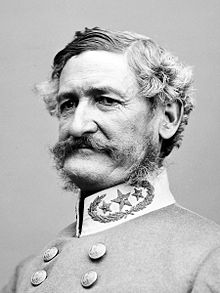
In the immediate aftermath of the action at Valverde, fought on February 20-21, 1862, the Confederate Army of New Mexico under the command of Brig. Gen. Henry Hopkins Sibley withdrew from the battlefield surrounding Fort Craig and advanced toward Albuquerque and Santa Fe.[1] Sibley’s forces had successfully cleared the field of Union troops, but not without cost. A significant number of his horses had been killed. which rendered the rebel cavalry, specifically the 4th Texas Cavalry, unable to continue on horseback, carrying their wounded. This slowed their column significantly. Their slow advance limited the amount of supplies they had attempted to seize in Federal towns and depots along the route.
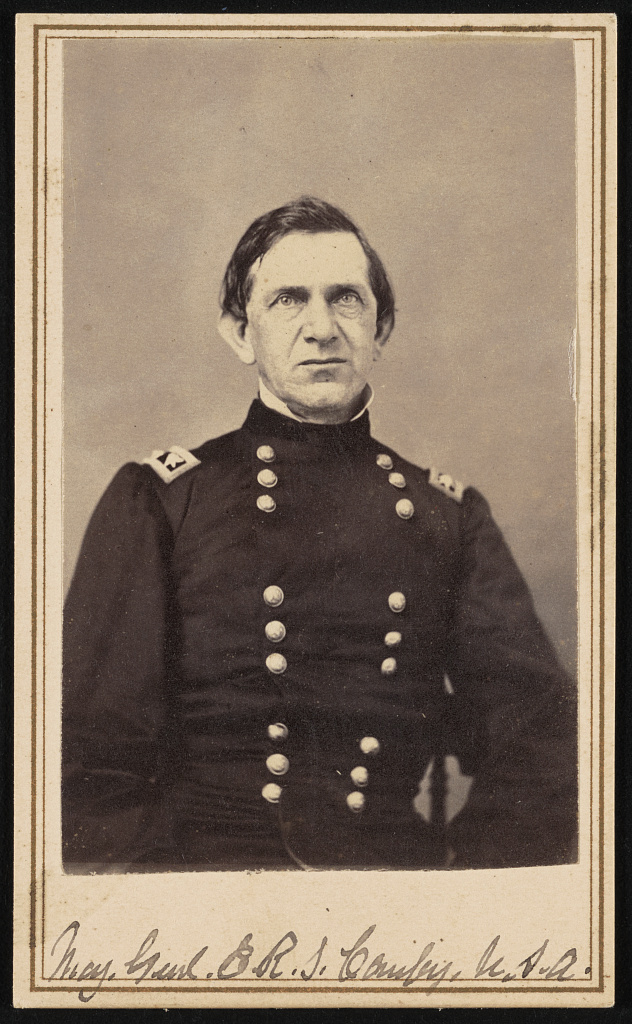
Union cavalry had caught up to Sibley’s column and had been periodically harassing them, but their slow advance meant that Union forces under Col. Edward Richard Sprigg Canby could sally out from nearby Fort Union and Fort Craig in order to destroy the Confederate column. When the two sides fought at Glorieta Pass—the prelude to the battle of Peralta—in late March 1862, the Confederate forces had successfully beaten the Union forces through the pass itself, but were forced into a full retreat following the destruction of their wagon train. Following the retreat, Sibley was forced to await reinforcements from Texas north of Albuquerque, near the town of Peralta.
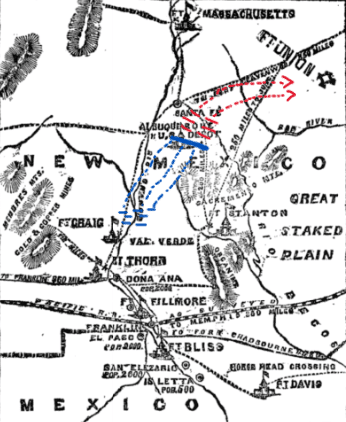
Union cavalry had continued to harass the Confederate column as they neared Peralta, capturing several wagons. Once the Confederate forces had entered the town on April 14, they took up defensive positions around the walls and the low adobe houses. The Union forces had deployed their artillery around the town on three sides, trapping the rebels inside. Once they were in position, artillery fire rained down on the walls of Peralta. The walls of the town had been described as “adobe walls of which form almost as good bulwarks as a fortress.”[2] The rebels were firmly trapped inside the town, with smaller elements securing the rearguard of their position where an escape route on the other end of town began to look appealing. Most of the rebel force, however, had been caught and were effectively under siege.
Continuous Union artillery fire, some from guns as large as 24-pounders, had relatively little effect on the town’s walls as “a ball penetrating them does no more damage than to make a hole the size of the ball.”[3] The rebels trapped inside were forced to endure under these conditions throughout the entire day, giving both sides sufficient time to strategize. The Union force was still entering the battlefield piecemeal, one small element at a time.
On April 15, the rebels had withdrawn to the outskirts of the town through the back of town out of sight of Union forces, with some elements making it across the Rio Grande itself. The rest of the Union Department of New Mexico had been alerted, and the remaining elements had arrived to pursue them, including the 2nd New Mexico Infantry and the 1st Colorado Infantry. Colonel Canby had engaged the Confederate rearguard, destroying yet more of the Confederate supplies over the course of the day.
Both sides had taken defensive positions north of the town, including the deployment of sharpshooters and their respective artillery batteries. Sporadic artillery fire had been exchanged over the river, and sharpshooters had attempted to pick off officers on either side.
Soon the rest of the Confederates had attempted to escape across the river, but had been caught in another fight with the Union cavalry, destroying the remaining few wagons the Confederates had. Suddenly, just as the rest of the Union forces were being readied for a final assault on the beleaguered Confederates, a sandstorm had covered the field, allowing the 4th and 7th Texas Cavalry to continue their retreat towards Texas.
The battle of Peralta had marked the final notable engagement in the 1862 New Mexico Campaign. If not for a sandstorm, the Confederate Army of New Mexico might have been destroyed at Peralta, making it a much more significant engagement. The relentless pursuit of the Confederates after their tactical victories had not allowed them to capitalize and capture a Union fort in the west, which may have altered the course of the war. While Canby was not a strategic mastermind, his actions prevented the Confederacy from seizing gold mines in Colorado or gaining access to the ports in California.
Paul Duerr is currently a 21-year-old author based in Hawthorne, New Jersey, as well as a historian and presenter. He has written and self-published a total of eight books, including seven historical fiction titles and one political science title. He holds a BA in History and Political Science from Rutgers University – New Brunswick, currently serves on Passaic County, New Jersey’s Open Space, Farmland, and Historic Preservation Trust Fund Advisory Committee as an Open Space Commissioner and Vice-Chair, and actively works in New Jersey politics.
Endnotes:
[1] “From New Mexico. Resume Of Events From The Invasion To The Expulsion Of The Texans.” Albany Evening Journal (Albany, New York), May 23, 1862.
[2] “From New Mexico.” Daily Colorado Republican and Rocky Mountain Herald (Denver, Colorado) 3, no. 7, May 22, 1862.
[3] “From New Mexico.” Daily Colorado Republican and Rocky Mountain Herald (Denver, Colorado) 3, no. 7, May 22, 1862.


