Private Ware and the Expedition to Forsyth
ECW welcomes back guest author William M. Koch.
In mid-1861, Pvt. Eugene F. Ware was a member of the “Burlington Zouaves,” Co. E of the 1st Iowa Infantry Regiment.[1] On June 13, Ware’s regiment left Iowa and reached Hannibal, Missouri early the next morning. The Iowans rode the rails and then marched further into Missouri, joining Brig. Gen. Nathaniel Lyon’s small force at Boonville on June 20.[2] Just days earlier, Lyon had driven the pro-Confederate Missouri State Guard (a state militia organization) out of Boonville. Pushing south after the State Guard, Lyon’s column (which had been reinforced along the way) reached Springfield in mid-July, meeting an additional column that Lyon had previously sent into southwestern Missouri.[3]
Exaggerated reports reached Lyon of pro-Confederate activities south of Springfield near the Arkansas line, including at Forsyth, the seat of Taney County.[4] “[B]right and early” on July 20, Ware and his comrades of the Burlington Zouaves left their camp and marched into Springfield, thinking they were going to be mustered out. Ware took the opportunity to consume “all kinds of soda-water” and purchase (among other things) a new shirt and a quantity of candy.
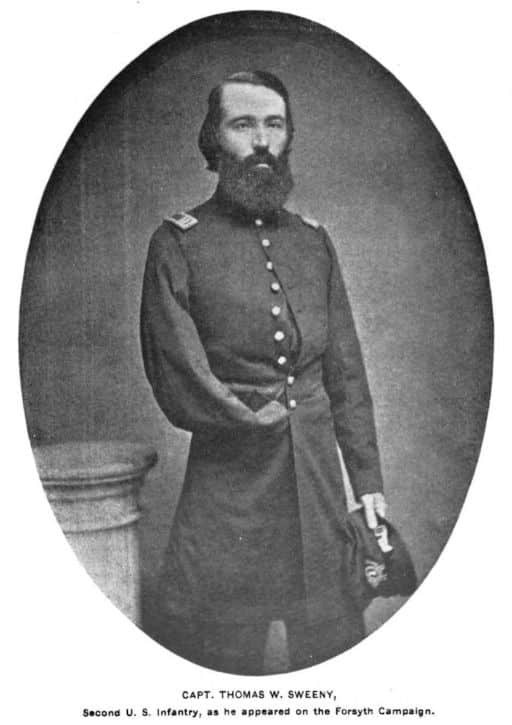
Instead of returning to Iowa, the Zouaves were sent on the march, going further south.[5] Ware’s company was one of six companies of the 1st Iowa sent on an expedition to Forsyth. Joining the Iowans were the 2nd Kansas Infantry (a company of which was mounted on captured horses), two companies of U.S. Regular cavalry, and a section of artillery. The expedition was commanded by Thomas W. Sweeny, a Regular Army captain who was functioning as an acting brigadier general under an appointment from Lyon.[6] Joining Sweeny was a group of Unionist local citizens.[7]
The march crossed the James River on July 20 and reached the town of Ozark the next day. At Ozark, the men encountered a secessionist shopkeeper who was in the process of attempting to remove his cache of whiskey before the soldiers could get to it. When his wagon bogged down in the mud, he was relieved of his goods, which Sweeny ordered distributed to his soldiers in an orderly manner.
The chosen distribution method was for sergeants to confiscate containers and then dish out the liquor with tin cups. Some of the sergeants selected chamber pots for this purpose, which Ware referred to as “very inappropriate earthen jars.” Now “good-natured and happy” despite being rained on, the men marched three and a half miles further before camping for the night. Ware’s company drew picket duty that night.[8]
Experienced students of the Civil War have doubtless read many anecdotes of soldiers throwing away their playing cards before battle, so that they would not be killed while carrying the instruments of sin. When Sweeny informed the column on the morning of July 22 to expect possible action, Ware’s mess destroyed their shared pack of playing cards for a much less solemn reason. Rather, the cards were “sadly consigned to the fire” for the more mundane reason of water damage; the rain had also claimed an astronomy book carried by Ware.[9] Sweeny’s column reached Forsyth after a long march; Ware estimated that he crossed the same creek twenty times and reported that he marched twenty-nine miles, three of which were at the double quick. Sweeny’s report placed the distance marched at 28 miles, but increased the double quick distance to four miles.[10]
Sweeny sent the mounted portion of the 2nd Kansas ahead of his column, and the Kansans captured most of the men guarding a State Guard outpost. Intelligence gleaned from the prisoners indicated that 150 Guardsmen held Forsyth (the true number was half that), and Sweeny sent the mounted Kansans and his Regular cavalry to the town under Capt. David S. Stanley of the Regulars. When another one of the prisoners claimed that Forsyth was really held by 1,000 men, Sweeny brought up the rest of the column. Stanley’s men took possession of the town, but continued to be engaged in a low-intensity firefight with some scattered State Guards who had been driven into the surrounding hills.[11]
Ware watched one of the Union guns unlimber and then marveled as its “beautiful hit” struck the courthouse.[12] Apparently unknown to him was the fact that the area around the building at time was occupied by some of Stanley’s cavalry and some Union civilian newspaper correspondents, one of whom was injured by debris. Forsyth was quickly under Union control, with minimal losses on either side.[13] Ware, evidently quite hungry after the day’s exertions, consumed “about four pounds of beef” for his evening meal before again going on picket duty.[14]
After drinking his morning coffee, Ware wandered into Forsyth on the morning of July 23. Upon reaching the outskirts, he encountered his regiment’s chaplain (who was apparently “really a private soldier of Co. “I” and whom Ware depicts as a rather dubious character) with a large quantity of purloined handkerchiefs. The chaplain shared some of his handkerchiefs with Ware, who never saw him again.[15]
Entering the town, Ware found that “[e]verything worth taking was gone”, but managed to acquire a canteen’s worth of molasses. Wandering into the town drug store, Ware again found “everything that a man in good health would want was taken,” and all that remained was a box of Jaynes’ Carminative Balsam. Seeing that the box instructed the user to “take” the medication, Ware interpreted it as a call to pilfer the box. Finding that he disliked the taste of the drug, he hoped that its claim to cure “[a]fflictions off the skin” would help his sore feet and poured some of the medicine down each shoe.[16]
Later that day, Sweeny started the column on the march back to Springfield, which was reached on July 25.[17] On August 6, the men of the 1st Iowa learned that Lyon calculated the effective date of their enlistment as being later than when they had previously believed it was, meaning that they had to spend another week in the service.[18] The regiment fought at Wilson’s Creek on August 10, suffering 154 casualties, and was finally discharged on August 23.[19] Ware eventually rose to the rank of captain, and became a noteworthy poet.[20] The patent medicine he had “taken” at Forsyth was (at least in its 1909 formulation) 25% alcohol, with 9-10 grains of opium per fluid ounce.[21]
William M. Koch has been interested in the Civil War since a childhood visit to Wilson’s Creek National Battlefield. He is a certified public accountant and resides in southwestern Missouri.
Endnotes:
[1] William Garrett Piston and Richard W. Hatcher III. Wilson’s Creek: The Second Battle of the Civil War and the Men Who Fought It (Chapel Hill, NC: University of North Carolina Press, 2000), 51; Hans Christian Adamson. Rebellion in Missouri: 1861. Nathaniel Lyon and His Army of the West (Philadelphia, PA: Chilton Company, 1961), 214-215.
[2] Piston and Hatcher, 57-59.
[3] Louis S. Gerteis, The Civil War in Missouri: A Military History (Columbia, MO: University of Missouri Press, 2015), 37-39, 43-49.
[4] Elmo Ingenthron. Borderland Rebellion: A History of the Civil War on the Missouri-Arkansas Border (Forsyth, MO: The Ozarks Mountaineer, 1980), 62.
[5] Eugene F. Ware. The Lyon Campaign in Missouri, Being a History of the First Iowa Infantry (Topeka, KS: Crane & Company, 1907), 228-230.
[6] Piston and Hatcher, 125-126; Adamson, 100.
[7] Ware, 231.
[8]Piston and Hatcher, 126-127; Ware, 230-234.
[9] Ware, 235.
[10] Ware, 237; The War of the Rebellion: The Official Records of the Union and Confederates Armies, Series I, Volume III, 45-46.
[11] Piston and Hatcher, 128-129.
[12] Ware, 237-238.
[13] Piston and Hatcher, 129-130.
[14] Ware, 238-239.
[15] Ware, 227-228, 240.
[16] Ware, 240-242.
[17] Piston and Hatcher, 131.
[18] Piston and Hatcher, 171.
[19] Piston and Hatcher, 324, 338.
[20] William E. Connelly. A Standard History of Kansas and Kansans. Volume II (Chicago, IL: Lewis Publishing Company, 1919), 1175.
[21] Renick W. Dunlap. Patent or Proprietary Medicines (Springfield, OH: Springfield Publishing Company, 1909), 31.


