Calculated Risk: Decision-Making and Operational Pressure in America’s Defining War
ECW welcomes back guest author Kyle R. Hallowell.
As a lifelong student of the Civil War, I am always seeking new ways to understand America’s defining conflict. I have found that sometimes the best way to do that is to engage with it differently. I was fortunate to have three opportunities over the summer that helped me better understand strategic decisions made during the war. The first of these new perspectives came from an unlikely place: a book about poker.
Nate Silver is a poker enthusiast, statistician, and best-selling author who gained notoriety for developing an algorithm that successfully predicted the outcomes of the 2008 presidential election in 49 of 50 states. His book, On the Edge, helped me to understand Robert E. Lee’s decision to invade Pennsylvania. On the Edge compellingly weaves together poker, game theory, and statistics to offer crucial lessons on decision-making. One of the most important concepts Silver introduces is Expected Value (EV).[1]
EV is defined as the long-term average of a random variable. Put differently, it is the expected average outcome of a decision if repeated over many iterations. A random variable is a mathematical formalization of a quantity that depends on random events, has a defined set of possible outcomes in a sample space, and a corresponding range of measurements associated with those outcomes.
When applied to Lee’s decision-making, the random variable being considered is battle, which has a defined set of outcomes. Those battles have a measurable range of corresponding range of measurements, such as casualties taken or inflicted, supplies captured, territory captured, and popular support for the war.
Throughout the book, Silver discusses how various poker players used EV in their decision-making process to determine their best action to take in a particular situation. However, in a war where the outcomes of a campaign are unknown and contingent upon so many variables, the best decision to make is the one that provides you with the greatest number of future options. This is termed “optionality”, and in the context of the Civil War, EV and optionality help explain and contextualize Lee’s decision to invade Pennsylvania, and the subsequent disagreements with James Longstreet over the execution of that invasion.[2]
Before the Gettysburg campaign, Lee’s sample space consisted of the battles fought during the Seven Days, Second Manassas, Antietam, Fredericksburg, and Chancellorsville campaigns, of which Lee won 80 percent or more.[3] However, the measurable range of these battles posed a compelling problem for Lee by exposing the true cost of battle. These victories cost him dearly in manpower, which was already strained across the entire Confederacy.[4]
Chancellorsville is considered Lee’s greatest victory, but the price of victory was 13,000 casualties, the loss of Stonewall Jackson, a failure to reduce the burden on Virginia’s farmers for feeding both armies, and, crucially, no commensurate reduction in the Northern public’s support for the war.[5] These problems continued to compound and exert considerable influence on Confederate leadership in subsequent years.
At the outset of his invasion, it was probabilistically more likely than not that Lee would win the next battle he fought against the Army of the Potomac. Therefore, Lee’s expected value was victory. Additionally, Lee was also more likely than not to achieve another objective, such as reducing the Northern population’s support for the war and the Lincoln administration or reducing the burden on Virginia’s farmers by moving the war north of the Potomac River. Even if Lee sustained high casualties, the political value gained from winning a battle on Northern territory would outweigh his losses. Thus, Lee’s decision to invade Pennsylvania seems less of a risky venture and more of a probabilistically likely way to maximize EV and help solve the Confederacy’s strategic problems.[6]
The prospect of EV maximization helps explain why Lee persisted in attacking the Army of the Potomac on July 2 and 3, even though it violated the contemporary military doctrine that attacking an enemy in a defensive position on favorable terrain typically fails to achieve victory.[7] In contrast, Longstreet wanted to interpose the Army of Northern Virginia between the Army of the Potomac and Washington and fight a defensive battle that it was likely to win.[8] Viewed through the lens of EV, the Confederates may have maximized their EV even further if they suffered fewer casualties and achieved their other objectives by winning a defensive battle.
Pennsylvania and Louisiana are closer than you think
The second experience was playing a recently released Civil War game called And the War Came, designed by Larry Pinkerton. When I started playing, I surveyed the map and was struck by the realization that Pittsburgh and New Orleans are connected by water, specifically by the Ohio and Mississippi rivers, which meet in Cairo, Illinois. I was already aware of this, but the full gravity of the realization didn’t occur to me until I saw the rivers depicted on the game map.
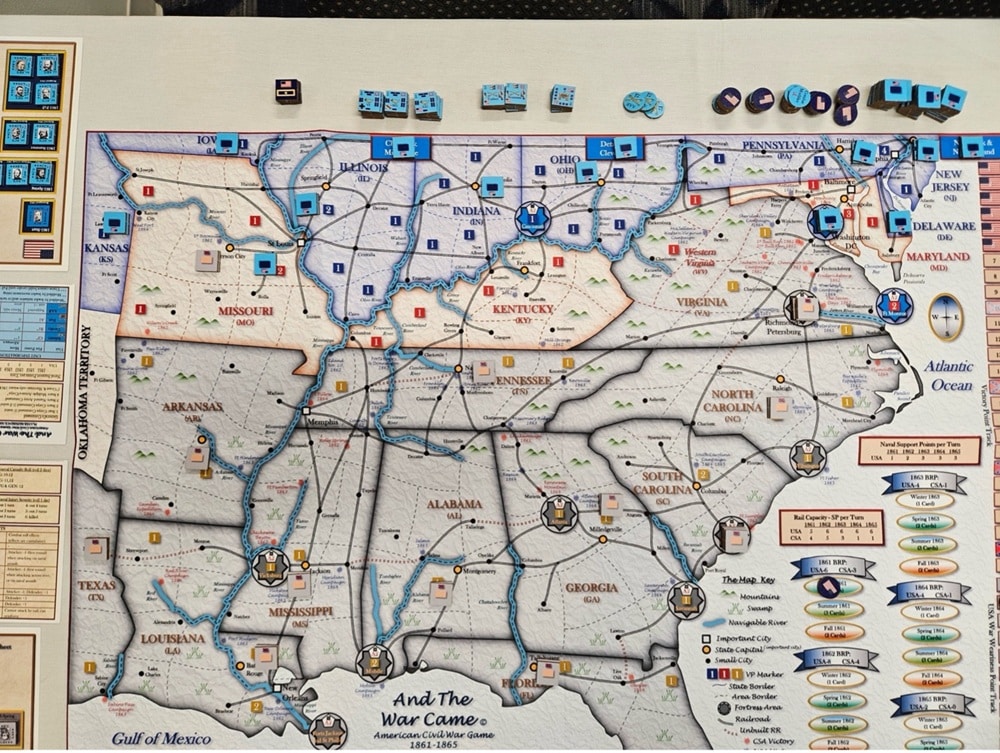
After seeing this effluvial network and the linked rail lines, it became clear that whatever side had sufficient naval and land power, and the ability to coordinate its movements, could penetrate the interior of its opponent’s territory. Thus, I found myself in a position I couldn’t find in a book; I felt like Winfield Scott, standing over a map and developing the now-infamous “Anaconda Plan.” The objective of Scott’s plan was to raise and train an army of 80,000 men, sail them down the Mississippi River, capture New Orleans, and simultaneously isolate and blockade the Confederacy.[9]
If you look at a map of the United States in 1861 and remove the space north and west of the Ohio and Mississippi rivers, it becomes clear that the Confederacy was ringed with water and therefore vulnerable to isolation, blockade, and infiltration via combined naval and land military operations. [10]The only gap in this “ring of water” is between Pittsburgh and Harrisburg, which is divided by the Appalachian Mountains.
This perspective reinforced for me the importance of the U.S. Navy during the war and the severity of the strategic problem the Confederacy faced. Bringing probability back into this discussion, if you were Jefferson Davis and faced with a decision about where to allocate scarce troops, it is equally likely that coastal and inland Confederate states would be attacked by Union forces, therefore requiring soldiers present for defense. In some instances, vital Confederate infrastructure was vulnerable in those areas, and quality troops were needed to defend them. Every soldier defending Confederate coastline or inland infrastructure was one fewer available for a major campaign.[11]
Use it before you lose it
The third experience was playing Mark Greenwald’s soon-to-be-released wargame, Chevauchee, in the Levy and Campaign series, which made me feel the same pressure Lincoln and McDowell felt when faced with the prospect of their army being disbanded before it could be employed.
Levy & Campaign explores the dynamics and challenges of Medieval warfare at the operational level. Players take on the role of kings and lords and muster their vassals to conduct military campaigns. The mustered lords and vassals bring troops and capabilities, but only for a limited number of turns before they disband. Players are incentivized to plan how best to employ their massive host but frequently have to make suboptimal decisions about its employment before it disbands.
In June of 1861, the Union army commanded by Brig. Gen. Irvin McDowell was about to lose 75,000 men due to the expiration of ninety-day enlistments. The looming disbandment of the Army strained Abraham Lincoln, who in turn pressured McDowell to strike the Confederates in Northern Virginia before his army disbanded. McDowell protested and cited his troops’ inexperience as a reason to delay. Lincoln responded with his now- infamous quip that “You are both green alike.”[12]
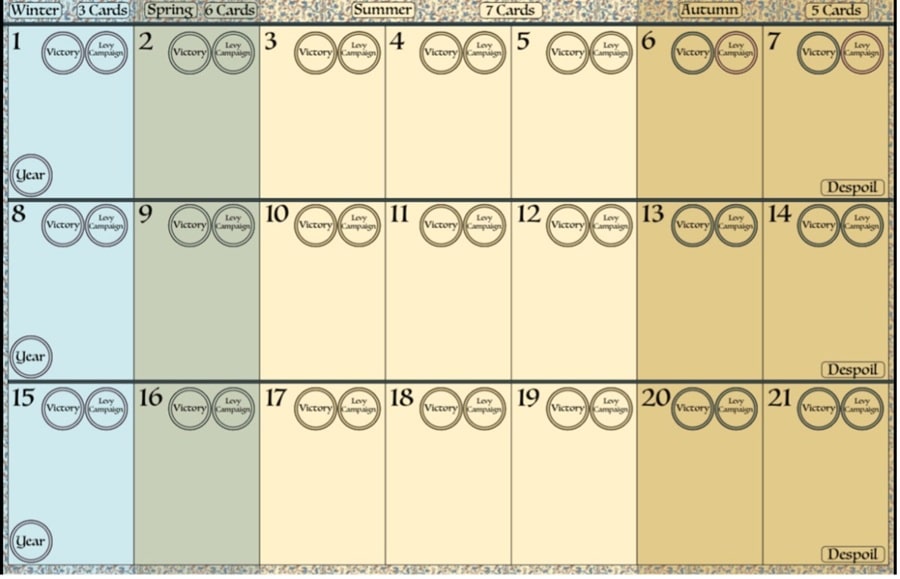
Shown here is the game turn track, which has spaces to display the current turn, turn phase, and when the mustered vassals’ service expires. For example, during a game, the track would show that you are currently in turn 4 and that a portion of your force will disband on turn 6. This looming disbandment pressures you to use your military force while you still can. This pressure typically forces the player to make suboptimal decisions and avoid long-term operations that are more likely to succeed the longer they endure, such as a siege.
Feeling this pressure helps modern players understand the decision-making pressure Civil War leaders faced about how to use an Army of ninety-day or nine-month regiments. The temptation to do something, regardless of strategic value, is compelling. When we analyze the actions and inactions of the Civil War’s participants, we need to remember that they were human, prone to emotion, and tried their best in stressful situations.
Kyle R. Hallowell is an active-duty U.S. Army Strategist assigned to the Headquarters, Department of the Army in the Pentagon. He holds a master’s in International Policy from Texas A&M University and a BA in History from Norwich University. He has been passionate about the Civil War since childhood and lives in Northern Virginia with his wife and sons.
Endnotes:
[1] Nate Silver, On the Edge: The Art of Risking Everything (New York: Penguin Press, 2024), 484.
[2] Silver, On the Edge: The Art of Risking Everything, 491.
[3] I am counting Antietam as a Union victory. This is opinion is not solely mine and is shared by many historians, such as James M. Mcpherson in Crossroads of Freedom and Daniel J. Vermilya in That Field of Blood. This percentage does not include time before Lee assumed command of the Army of Northern Virginia.
[4] Stephen W. Sears, Gettysburg (New York, New York: Houghton Mifflin Company, 2003), 1-17. Robert E. Lee, The Wartime Papers of Robert E. Lee, De Capo Press paperback ed., ed. Clifford Dowdey; Louis H. Manarin (New York, NY: De Capo Press Inc, 1987, 1961), 508.
[5] Robert W. Krick, Chancellorsville: Lee’s Greatest Victory (Civil War Preservation Trust, 2010), 7-10.
[6] Noah Andre Trudeau, Gettysburg: A Testing of Courage (New York, New York: HarperCollins Publishers Inc., 2002), 6; Edwin B Coddington, The Gettysburg Campaign: A Study in Command, First Paperback Edition ed. (New York: Charles Scribner’s Sons, 1968), 9.
[7] Carl von Clausewitz, On War, trans. Michael Howard, ed. Michael Howard; Peter Paret (Princeton, NJ: Princeton University Press, 1976), 370-1.
[8] Sears, Gettysburg, 9.
[9] Herman Hattaway; Archer Jones, How the North Won: a military history of the civil war, Illini Books ed. (Urbana and Chicago, IL: University of Illinois Press, 1991; repr., 1991), 127; Ethan S. Rafuse, A Single Grand Victory: the First Campaign and Battle of Manassas ed. Steven E. Woodworth, 26 vols., The American Crisis Series (Wilmington, Delaware: Scholarly Resources Inc., 2002), 34-5.
[10] Craig L. Symonds, The Civil War at Sea (Oxford University Press, 2012).
[11] Lee, The Wartime Papers of Robert E. Lee, 498.
[12] Rafuse, A Single Grand Victory: the First Campaign and Battle of Manassas 46, 74.


It is always refreshing to experience a thoughtful ‘alternative’ re-analysis of ‘accepted wisdom.’ And when that re-analysis involves Poker, so much the better.
During the Civil War it could be argued that Euchre was the most popular card game: entertaining, with luck and a bit of skill required… but no real application to military strategy. It was a favorite pastime of the enlisted ranks.
Chess was the accepted game of logic and strategy, requiring experience and skill… with the only bit of Luck inserting itself at the start of the game: who was White, who was Black. Set moves, established opening strategies, anticipated outcomes… two players engaging in a convoluted dance, each attempting to establish dominance, until ONE makes a mistake… The beauty [and flaw] of Chess: it ALL takes place out in the open. There are no hidden moves.
Poker was not encouraged during the Civil War. And cadets were prohibited from playing Poker at West Point. Considered to be ‘the Devil’s Game,’ Poker was not a part of polite society in America: growing up in Rock Island County, Illinois during the 1970s our family gatherings included 5-card draw Poker that restricted bets to abysmally small wagers and required “openers must be shown at the end of the hand.” These restrictions precluded practice of the most important element of Poker… the ability to overcome the bad Luck of bad cards: the Bluff.
Was Robert E. Lee a good Poker player? I would venture to say… Thank You for an informative, engaging article!