We’ll Keep the Light On for You: A Tale of Two Lighthouse Keepers
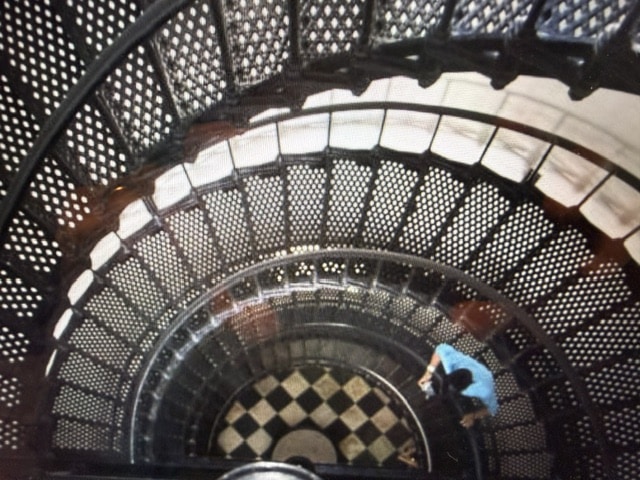
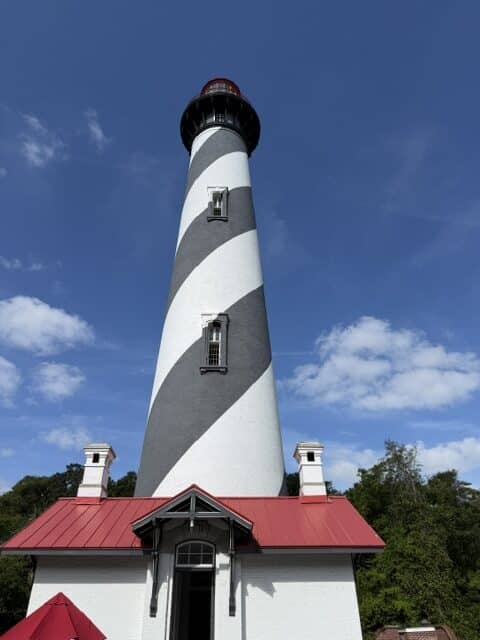
Up and up, I climbed those circular steps. . .216, 217, 218. . . 219 (finally) and out onto the observation platform of the black and white striped St. Augustine lighthouse, 165 feet tall. While I was taking in the marvelous view, the docent explained that construction of the lighthouse began in 1871 and finished in 1874 when it activated its Fresnel lens and sent out its beacon over the harbor and out to the Atlantic Ocean.[1]
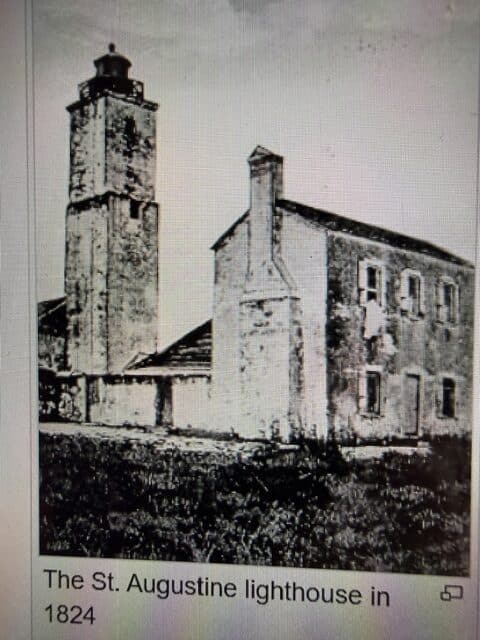
This was not the first lighthouse in St. Augustine, he explained, pointing out to a channel to the east where the old lighthouse, erected before the Civil War, once stood. Over time, due to steady erosion and encroachment from the sea, both the old lighthouse and keeper’s home crumbled, and today they lie beneath the waters of the channel.
At the outbreak of the Civil War, the Confederates commandeered and operated the lighthouse. Due to the tightening of the Union blockade of the east coast, the Confederates darkened the light so the Yankees could not use it as a guide to invade St. Augustine. Unfortunately, the darkened beacon did not help either Confederate privateers or blockade runners.
On August 18, 1861, the Confederate privateer Jefferson Davis encountered severe weather off the coast of St. Augustine. Unable to safely enter the inlet and being pursued by Union ships, the Jefferson Davis struck and grounded on the sandbar at 7:30 a.m. Firing her guns for assistance, the townspeople came, rescuing all hands and landing them safely at St. Augustine.
The history of the brig Jefferson Davis is an interesting one. Built in Baltimore in 1845, she had originally been named Putnam. Operating first out of Philadelphia for five years, she had a series of owners and operated out of Providence, Boston and New York before ending up in New Orleans in 1857. There her new owners altered the ship for the illegal slave trade and renamed her Echo.
A year later, the U.S.S. Dolphin captured the Echo and her cargo of 318 African slaves and brought them into Charleston, South Carolina. A young soldier from Fort Moultrie, Sgt. William Harn, was assigned to guard the ship as the slaves were shipped to Liberia. The prize court renamed the ship Putnam and sold her.
The new owners had a new purpose in mind for her. After Fort Sumter fell, the owners re-christened the brig Jefferson Davis and operated her as a Confederate privateer sailing out of Charleston. She preyed on Union shipping, collecting nine merchant ships, which made her one of the most successful privateers, until she was chased and grounded at St. Augustine.[2]
On March 11, 1862, the city of St. Augustine surrendered without violence to United States naval forces under Commander C.R.P. Rodgers. Union infantry commanded by Col. Louis Bell of the 4th New Hampshire Infantry soon occupied the town and fort.[3]
Before the Union forces came ashore, the Confederate harbor master, Paul Arnau, removed the lighthouse lens and other instruments and hid them. Arnau was captured and when asked where the lens and instruments were, refused to answer. He was held in solitary confinement off shore on one of the Yankee ships, until he was forced to reveal the location of the pilfered implements.[4]
Once the lens was recovered, the United States government continued to operate the lighthouse through the war and after. In October 1874, the construction of the new lighthouse was completed, and the new lighthouse keeper arrived with his family. His name was William Harn, the same man who, as a soldier in Charleston Harbor, guarded the Echo.
William Alexander Harn was a veteran of the Civil War. Born in Philadelphia, Pennsylvania in 1834, little is known of his early years. In 1864, Harn, At the age of 19, enlisted in the U.S. Army and served in Company E, 1st U.S. Artillery.[5]
Harn was a sergeant when the 80 officers and men of Companies E and H were stationed at Fort Moultrie on Sullivan’s Island in Charleston harbor. One of Harn’s best friends was the 42-year-old Irishman, ordnance sergeant James Skillin. Skillin, along with his wife Ruby and 16-year-old daughter Katherine (Katie) Harriett Skillin, was posted to Castle Pickney. He was the lone soldier stationed there. His major duty was the lighthouse keeper and chief of maintenance of the cannons and the ammunition of the fort. Harn would regularly row his bateau, Katy, across the harbor to visit Skillin. Eventually, Harn fell in love with pretty Katie Skillin and enjoyed spending time with her on his increasingly frequent visits.[6]
With the election of Abraham Lincoln as the 16th President of the United States, sectional tensions in Charleston reached a boiling point. Kentucky-born Maj. Robert Anderson was sent by the War Department to command the U.S. troops at Fort Moultrie. It was hoped that the assignment of Anderson to this role would help to relieve some tension, since he was a Southerner, but this was not to be. On December 20, 1860, South Carolina seceded from the Union.
The new commander saw Castle Pinckney as a key to any Federal defense. “The brave ordnance-sergeant Skillin begged hard that we would send him a few artillerists,” remembered Capt. Abner Doubleday. Being within a mile of Charleston, Castle Pinckney “could easily control the city by means of its mortars and heavy artillery. . . [Skillin] could not bear the thought of surrendering the work to the enemies.”[7]
Anderson also realized he could not defend Fort Moultrie and, on the night of December 26, he secretly moved his troops to unfinished Fort Sumter instead of Castle Pinckney. Thinking he could not spare the soldiers to man both forts, Anderson sent only Lt. Richard K. Meade and a few workers from Sumter to reinforce Castle Pinckney.[8]
On December 27, Lt. Meade sent Sgt. Skillin into Charleston to test the tenor of the Charlestonians. Skillin was a native of Westbrook, Maine and a 21-year veteran with experience in the Mexican-American War. He observed the Southerners like bees around a disturbed hive angry about Anderson’s clandestine maneuver, and he also noted the local militia units rapidly forming with knapsacks and guns on the Citadel’s green. He hurriedly slipped back to report.[9]
Later that day, three companies of Charleston militia under the command of Col. James J. Pettigrew and under orders from the governor, seized Castle Pinckney without a fight, there being only being Lt. Meade and James Skillin and his family facing 150 men. (The workers in Castle Pinckney refused to get involved.) Despite being a native Virginian and West Point-trained, 25-year-old Meade found himself grossly outnumbered and with little he could do to prevent the fort’s seizure. With arms folded across his chest, he defiantly protested their presence, saying he did not recognize the authority of the South Carolina governor’s orders to seize Castle Pinckney. Meade further declared that he and would not formally surrender the U.S. fort. As for Skillin, he was furious with these uninvited intruders declaring, “Damn it! This is a pretty thing to happen to a U.S. fort.”[10]
The American flag was pulled down and replaced with a red flag emblazoned with a single white star. Katie Skillin was seen crying nearby a militia officer. The officer tried to comfort her, assuring her that she and her family would not be harmed. “That’s not why I’m crying,” Katie answered. “Then what is it?” asked the officer. “I am crying because you have put that miserable rag up there.” She mockingly added that it certainly took a lot of very brave fellows to capture a fort occupied by only two soldiers and a girl.[11]
Meade, along with Skillin and his family, were transported to Charleston, where Meade asked his captors for considerate treatment of Skillin and his family. On February 3, Ruby and Katie joined 40 other women and children who had been at Fort Sumter. They boarded the steamer Marion and departed Charleston for Ft. Hamilton, New York. Meade and Skillin were released and allowed to re-join the garrison at Fort Sumter.[12]
Harn and Skillin, once more united, faced the grueling 34 hours of bombardment on April 12-13, 1861 and were surrendered with the rest of Anderson’s command. Anderson’s men were allowed to salute their colors before boarding the steamer Baltic and steaming for New York. Arriving on April 18, the “two companies, E & H, settled for some weeks at Fort Hamilton where they were reunited with their families.”[13]
When Lincoln called for troops to put down the rebellion, most of the men and officers of the two companies became scattered as they were assigned or volunteered to various regiments. Harn’s and Skillin’s service records were quite different.
William Harn enlisted as a lieutenant in the 1st New York Light Artillery, Battery E. He transferred to Battery G before being again transferred to the 3rd New York Independent Light Artillery, of which he took command after the battle of Antietam in September 1862.
Harn’s battery joined others on Stafford Heights across the Rappahannock River from Fredericksburg in December and participated in the bombardment of that city. During the Chancellorsville campaign, Harn saw action in the VI Corps’ storming of Marye’s Heights and its follow-up to Salem Church, where the guns of the 3rd New York successfully repulsed a Confederate charge before being ordered to withdraw across the Rappahannock River.
On June 4, 1863, Harn was commissioned captain and marched to Gettysburg as part of Gen. Sedgwick’s VI Corps. On July 3, Harn’s battery supported Alexander Hays’ division in repulsing the Pickett-Pettigrew charge. Harn’s battery was active during the Bristoe campaign as well as at Rappahannock Station and Mine Run before going into winter quarters at Brandy Station.[14]
With the battery’s term of service about to expire, Harn and most of the men in the battery re-enlisted and were granted a “veteran furlough,” returning to New York City for thirty days. From there, Harn traveled to Maine where he married 19-year-old Katherine Skillin.[15]
Returning to the Army of the Potomac, Harn was dismissed from military service with the 3rd New York Independent Battery on April 5, 1864, but was reinstated 15 days later on April 20, 1864. The reason for this dismissal and reinstatement is unclear. Harn served in the bloody battles of the Overland Campaign and received a brevet major appointment for gallant and meritorious services for his actions at Spotsylvania Court House. He continued serving through the Petersburg and Appomattox Campaigns, and mustered out at the end of the war on June 24, 1865.[16]
James Skillin’s Civil War record is not easy to discern. In fact, it is murky. Brian Swartz, Maine Civil War Historian, and author of the Maine at War blog, referred to Skillin as a “slippery character.” Using information from soldiers’ files in the Maine State Archives, the state census records and cemetery records, Swartz found a James R. Skillin enlisting as a private in Company C, 2nd Maine Regiment on April 27, 1861 who was discharged at Willets Point, New York on June 9, 1861. The reason was “Dis[charged] for Dis[ease].” Unfortunately, the age in the file states Skillin was 26 years old at the time of enlistment. For a man born on December 25, 1821, according to Skillin’s burial records, this is more than 14 years off. He might have falsified his age or perhaps the clerk made an error.
A second file for James P. Skillin in the archives shows a 40-year-old who enlisted in the 10th Maine Infantry Regiment on August 5, 1862 and was “discharged by order” on February 19, 1863. In this instance the age is more appropriate. Some records show Skillin supposedly re-enlisting a number of times, the sixth and last time at the Rome Arsenal in New York in 1864. Each time he was discharged as an invalid.[17]
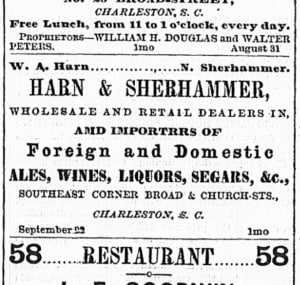
Whatever Sgt. Skillin’s record, he survived the war. On October 11, 1865, Skillin and his wife Ruby returned to Charleston and to his post as lighthouse keeper at Castle Pinckney. William and Katie Harn followed her parents to Charleston, where William became a partner with N. Sherhammer establishing a wholesale and retail bar/liquor store at the southeast corner of Broad and Church Streets. In addition, through Skillin’s patronage, William on occasion helped at the Morris Island Lighthouse.[18]
In August of 1869, Skillin’s assistant, a Private Johnson, returned to Castle Pinckney at noon in a highly intoxicated state. Wishing to go back to Charleston to continue his revelry, Johnson requested to be relieved of his duty so he could return to the city, but Skillin denied his request. A petulant Johnson then refused to obey Skillin’s order to resume work around the fort. Words flew and the confrontation became heated with Johnson’s declaration that he would kill Skillin. Johnson raced up the stairs to the parapet to grab a rifle. Skillin followed and was met at the top of the stairs by Johnson holding a loaded rifle aimed at the sergeant. A startled Skillin raised his left hand in defense, but before a word was spoken Johnson pulled the trigger. The bullet, cut off Skillin’s left forefinger, then plowed through his left breast, and ultimately exited through his shattered shoulder blade.
Ruby, hearing the altercation and then a gunshot, rushed to her husband’s aid. Johnson, suddenly sobered by his actions and realizing the gravity of what he had done, jumped into a small boat and raced to Charleston, not to escape, but to bring help. He brought back a Dr. Bailey. Skillin’s severe wound was at first thought to be fatal. Johnson was arrested by a squad of soldiers who arrived from the Citadel.
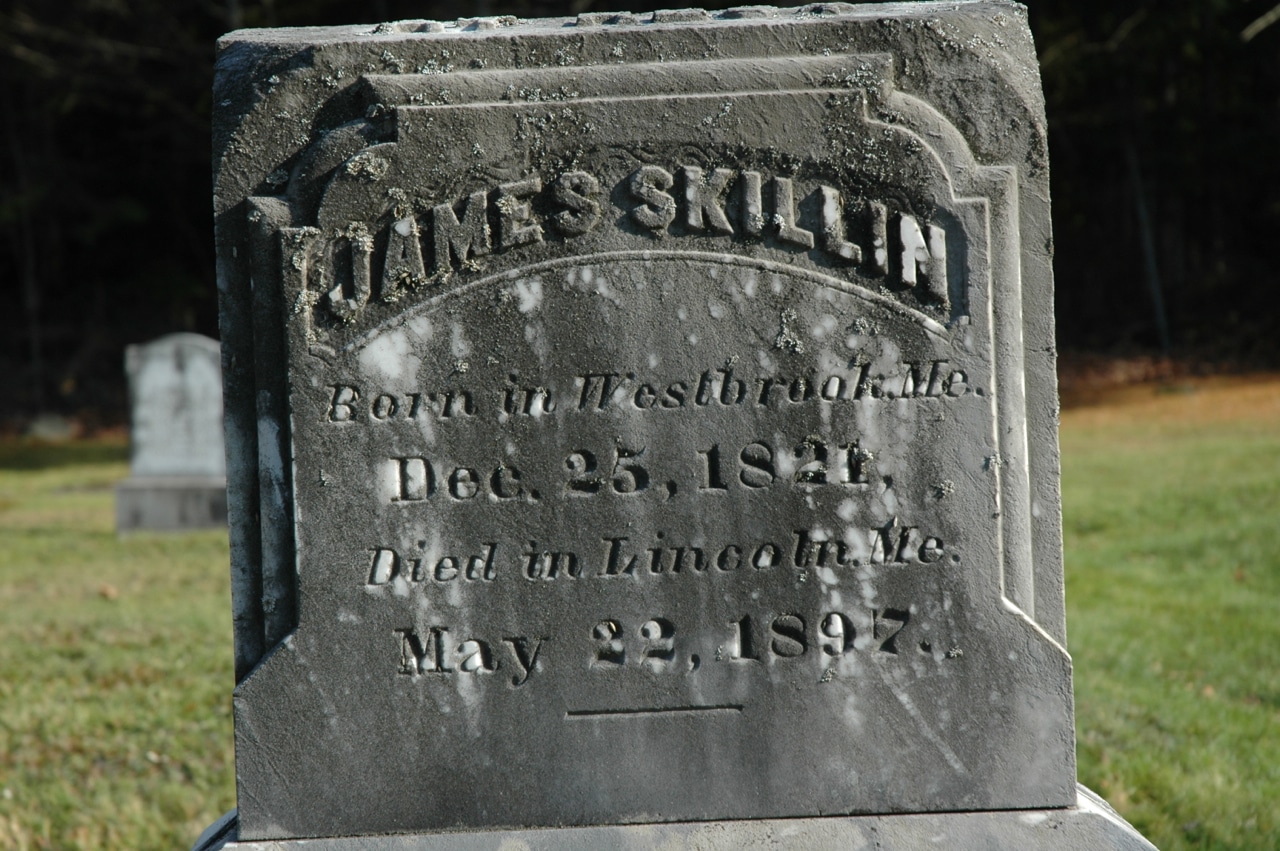
James Skillin miraculously survived his wound. During his lengthy recovery between 1870-1875, William helped run the lighthouse for his disabled friend and father-in-law. Through political patronage and Skillin’s recommendation, William joined the U.S. Lighthouse Service. In 1875, as an invalid, James Skillin, along with Ruby, returned to Maine where James received a government pension and became a farmer, dying in 1897.[19]
The U.S. Lighthouse Service began constructing a new 165-foot, brick lighthouse tower in St. Augustine, Florida to replace the old one that was doomed to fall into the ocean. Started in 1871 it was completed in 1874.[20]
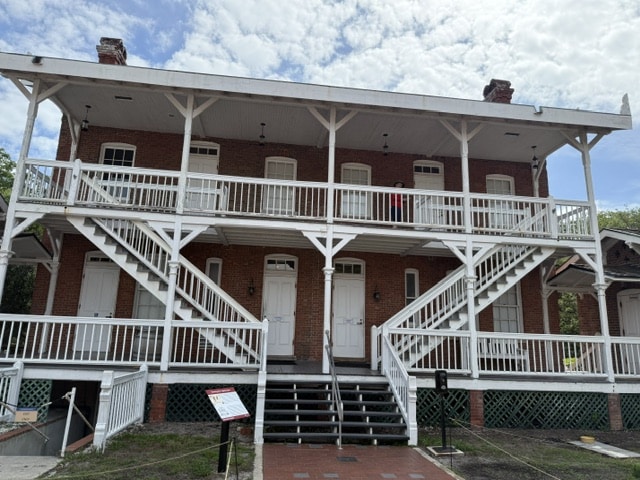
In October 1875, William was appointed the Head Lighthouse Keeper in St. Augustine. William, Katie, and their five daughters moved to Florida, residing for a year in the old lighthouse keeper’s home until a new one was finished in 1876. They were the first family to live in the new home, and their sixth daughter was born there. Harn was the lighthouse keeper for the next 14 years and witnessed the destruction of both the old lighthouse and the old keeper’s house, as well as two earthquakes and hurricanes. The Harns were welcomed into the St. Augustine community and earned a reputation for hospitality, including serving lemonade to visitors.
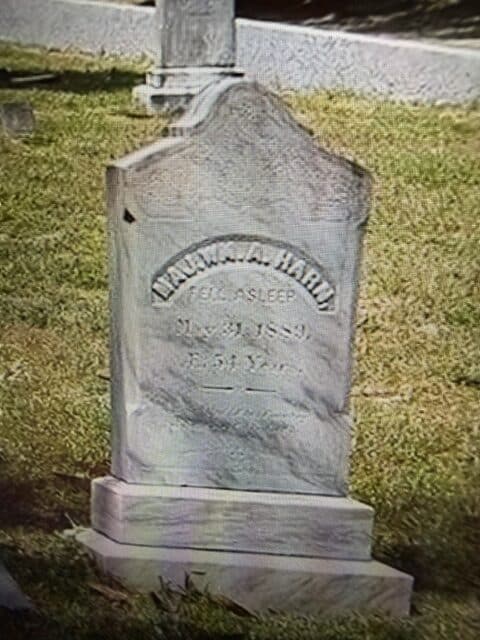
In 1887, William, now 53-years-old, began to suffer from the effects of tuberculosis. He had probably contracted the disease during his Civil War service. The disease progressed, and two years later he died on May 31, 1889 at 1:00 a.m. He was buried in Evergreen Cemetery in St. Augustine.[21]
By June 4, the community of St. Augustine petitioned the government to appoint Katie Harn as lighthouse keeper to replace her husband so she could support her family. Due to this effort, Katie became 2nd Assistant and served for six months before she secured William’s military pension. She then moved her family into town for a few years, before moving back to her home state of Maine.[22]
Katie Harn was reunited with her mother and father in Enfield, Maine where her parents had their farm. On May 22, 1897, James Skillin died and was buried in Enfield Village Cemetery. He lived six years longer than William Harn.[23]
James Killin and William A. Harn were two soldiers who became friends. They both served in the American Civil War and became related by marriage. As lighthouse keepers at St. Augustine and Castle Pinckney respectively, both faithfully served in keeping the lights on as essential guardians of maritime trade.
[1] “Frequently Asked Questions by Lighthouse Visitors,” St. Augustine Lighthouse & Maritime Museum, accessed 9/2/2026. Frequently Asked Questions by Lighthouse Visitors – St Augustine Lighthouse & Maritime Museum
[2]Zielinski, Paul, Director of Interpretation, St. Augustine Lighthouse & Maritime Museum, January 21, 2015. Logbook of the Jefferson Davis, August 18, 1861.
[3] King, Tom, “In War Between the States, St. Augustine Surrendered Hundred Years Ago,” St. Augustine Record, St. Augustine, Florida, March 11, 1962. Redd, Robert, St. Augustine and the Civil War, Charleston, SC: History Press, 2014. Covert, Robert, “Occupation and Reconstruction: St. Augustine After the Civil War,” St. Augustine Historical Society, Special Collections Occupation and Reconstruction: St. Augustine After the Civil War – St Augustine Historical Society
[4] Redd, St. Augustine and the Civil War, p. 24. Zielinski, Paul, “Keepers of the Light,” St. Augustine Lighthouse & Maritime Museum, March 29, 2017. Keepers of the Light – St Augustine Lighthouse & Maritime Museum
[5] Historical Data Systems, Inc., U.S. Civil War Soldier Records and Profiles, 1861-1865, U.S., Civil War Soldier Records and Profiles, 1861-1865 – Ancestry.com
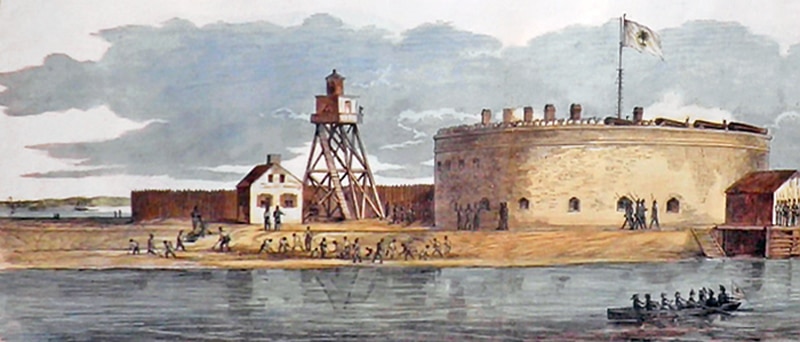
[6] Doubleday, Abner, Reminiscences of Forts Moultrie and Sumter in 1860-1861, New York, NY: Harper & Brothers, 1876, p. 15. The Project Gutenberg eBook of Reminiscences of Forts Sumter and Moultrie in 1860–’61, by Abner Doubleday. Roberts, Clifford W., Jr., and Locke, Matthew A.M., Holding Charleston by the Bridle: Castle Pickney and the Civil War, El Dorado Hills, CA: Savas Beatie, 2005, p. 54. Carr, Jo Ann Daly, “The Families of Fort Sumter and the Crib Left Behind,” Battlefield Photographer: Journal of the Center for Civil War Photography, Vol. XXII, Issue 3, December 2024, p. 9. Reed, Jan, “Kate Harn for Jo Ann Carr.” Unpublished Document, 2019. Charleston Dailey Courier, May 20, 1856. Register of Officers & Agents, Civil, Military, and Naval in the Service of the United States on September 30, 1857, Washington, A.O.P. Nicholson Publishers & Printers, 1857, p. 33. 10055573A Lights, beacons and buoys were all needed to help navigation in Charleston harbor. Lighthouses were erected at Fort Sumter and Castle Pinckney. Pinckney’s light was a red-beaconed Fresnel lens placed atop a yellow-painted, open wood tower that stood 50 feet above the low water mark.
[7] Doubleday, Reminiscences, p. 53.
[8] Ibid.
[9] Military files of James Skillin, National Park Service, Fort Moultrie Visitor’s Center, Sullivan’s Island, South Carolina. Roberts & Locke, Holding Charleston, p. 60.
[10] Doubleday, Reminiscences, p. 73. Detzer, David, Allegiance: Fort Sumter, Charleston, and the Beginning of the Civil War, New York, NY: Harcourt, Inc., 2001, p. 134.
[11] Doubleday, Reminiscences, p. 73. Detzer, Allegiance, pp. 134-135.
[12] Swanberg, W.A., First Blood: The Story of Fort Sumter, New York, NY: Charles Scribner’s Sons, 1957, pp. 107-108. Carr, “Families of Fort Sumter,” p. 13. Shortly after the fall of Fort Sumter, Lt. Richard K. Meade resigned his commission and joined the Confederate States Army as a Major of Engineers. He contracted an illness and died in 1862 at the age of 26 years-old.
[13] Detzer, Allegiance, pp. 311-313. Doubleday, Reminiscences, pp. 174-175.
[14] Phisterer, Frederick, New York in the War of the Rebellion, vol. 2, Albany, NY: J.B. Lyon Co., 1912, pp 1215, 1225, 1566. “3rd Independent Battery Light Artillery (Veteran),” New York State Military Museum and Veterans Research Center. 3rd Independent Battery Light Artillery (Veteran) :: New York State Military Museum and Veterans Research Center
[15] Maine Marriage Records, 1713-1922, Augusta, Maine, Maine State Archives Cultural Building
[16] Phisterer, New York in the War, pp. 1566, 393. The reason for his dismissal is not preserved in the general public historical overviews. It might be found in his compiled service records in the National Archives. A rapid reversal of dismissal during the Civil War typically stemmed from common bureaucratic mistakes such as administrative clerical errors due to mixed up names or ranks; or absence overages (which could have been Harn’s transgression in view of his recent marriage in Maine) or due to minor technical disagreements with senior ordnance or artillery commanders.
[17] Soldiers file for James R. Skillin from the Maine State Archives. Soldier’s file for James P. Skillin from the Maine State Archives, accessed by Brian Swartz September 15, 2026. Roberts & Locke, Holding Charleston, p. 164. Skillin’s headstone does not list a middle initial.
[18] Roberts & Locke, Holding Charleston, pp. 164-165. Zielinski, Paul, “Lighthouse History 1874-1894 (Part II),” St. Augustine Lighthouse & Maritime Museum, St. Augustine, Florida, January 21, 2015. Lighthouse History 1874 – 1894 (Part II) – St Augustine Lighthouse & Maritime Museum Skillin returning in 1865 and serving until 1875 would be the longest-serving lighthouse keeper in the station’s history.
[19] Roberts & Locke, Holding Charleston, p. 172. “Shooting Affray at Castle Pinckney,” Charleston [SC] Courier, August 2, 1869, p. 1. Skillin pension, U.S. Civil War Pension Index, 1861-1900, NARA, Record Group 15, T289, Washington, D.C.
[20] St. Augustine Lighthouse & Maritime Museum, History – St Augustine Lighthouse & Maritime Museum
[21] William A. Harn, Find a Grave. William A. Harn (1834-1889) – Find a Grave Memorial
[22] Zielinski, “Lighthouse History,” Lighthouse History 1874 – 1894 (Part II) – St Augustine Lighthouse & Maritime Museum and “Keepers of the Light,” Keepers of the Light – St Augustine Lighthouse & Maritime Museum
[23] James Skillin Find a Grave. James Skillin (1821-1897) – Find a Grave Memorial


