How did Dewey get his job as XO on USS Mississippi?
Just as many Civil War leaders first saw combat in Mexico in the 1840s, many career officers from the late nineteenth century first saw combat in the Civil War. One of the best-known of these late century officers was George Dewey. In the Spanish-American War, Dewey earned national fame for his victory at the battle of Manila Bay, crushing a Spanish fleet with little loss of his own and helping pave the way for a military landing there which ultimately resulted in Spain abandoning the islands and a ten-year war being fought by Filipinos for their independence from the United States–a war they ultimately lost. For that action, the special rank of Admiral of the Navy was created for Dewey.

Turn the clock back to the 1860s however, and Dewey was a young up-and-coming junior officer. He served on numerous ships, including USS Colorado in the Fort Fisher bombardments, and on USS Mississippi on the Mississippi River. It was his time on Mississippi that was most well-known of his wartime service, with Dewey capably serving on that vessel as the executive officer when it ran aground at Port Hudson and was destroyed. It was his performance there that brought him to prominence, a prominence that ended up with him as the highest-ranking admiral in the navy.
Dewey was only 25 years old when Mississippi was lost and the question quickly arises about how such a young and junior officer ended up as the second-in-command of a 3,200-ton steam frigate. Oddly enough, his appointment to that position was simply the result of a proverbial game of musical chairs, where officers were swapped from one ship to another.
This swapping of officers was something that Dewey himself acknowledged in his autobiography, though in a limited way. He merely noted that “before the advance on New Orleans” by David Farragut’s West Gulf Blockading Squadron, “the six officers who were senior to me had all gone to other ships. With their departure I ranked next to the captain and became executive officer.”[1] From the sound of it, Dewey simply inherited his role because of standard transfers to other ships as they arrived on the scene of action. This is true regarding some officers, but that did not result in him becoming executive officer, merely moving Dewey up in the ship’s seniority. The real reason for his final elevation was because of far different circumstances.
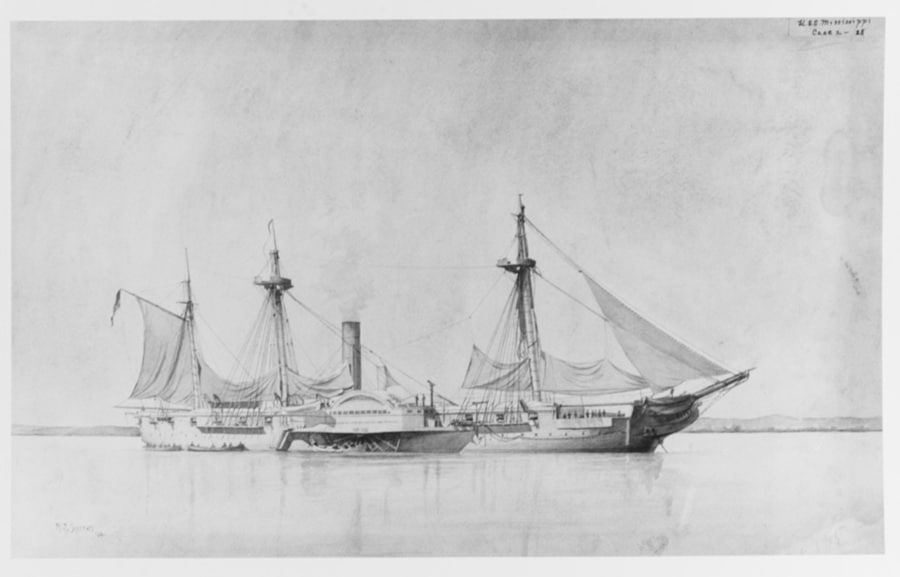
Dewey’s elevation to Mississippi’s executive officer ultimately occurred because of fallout on other ships following the October 12, 1861, battle of the Head of Passes. In that fight, the Federal flotilla was embarrassed when Confederate forces launched a surprise attack that drove blockaders out of the Head of Passes, where the Mississippi River splits into several entrance channels. Following that fight, numerous captains of Federal blockaders involved were relieved of their commands.
The Federal flotilla commander at the Head of Passes, Capt. John Pope, was relieved from commanding USS Richmond. This was in part because of his conduct in the battle, but also because he was on the verge of a mental collapse. That set off a chain reaction of swapping captains from ship to ship, one that was not altogether uncommon in the Civil War, but certainly was rare in the numbers of officers involved.
As Pope left Richmond to return north, Capt. Francis B. Ellison, skipper of USS R.R. Cuyler, was ordered to take his place. This left a command gap on that vessel, and Lt. Francis Winslow, skipper of USS Water Witch, was swapped to command Cuyler. Lieutenant Aaron K. Hughes, executive officer of USS Mississippi, then transferred to command Water Witch. That left Dewey, the senior lieutenant on Mississippi, to assume the duties of second-in-command on that war steamer, but only after an exhaustive swapping of skippers from one ship to the next.[2]
Reorganizing orders of battle with leadership was not uncommon in the Civil War, but this particular example put Dewey in the right place to gain prominence under enemy fire, pushing him to the forefront in the eyes of more senior officers to watch.
Endnotes:
[1] George Dewey, Autobiography of George Dewey: Admiral of the Navy (New York, Charles Scribner’s Sons, 1913), 50.
[2]McKean to Welles, October 24, 1861, ORN, Series 1, Vol. 16, 748; Joseph Warren Shively Journal, Oct. 31, 1861, Journal of Surgeon Joseph Warren Shively Spared & Shared, https://sparedshared22.wordpress.com/2021/10/11/the-civil-war-journal-of-dr-joseph-warren-shively/, Accessed June 3, 2022.


