A Day Among the Indians
ECW welcomes back guest author James Marten.
Cornelius Doxtator was in many ways a typical recruit—although at age 47, older than most—when he received a $60 bounty for a one-year enlistment in the Fourteenth Wisconsin Infantry in February 1864. His sons George and Paul also enlisted in the regiment. All three survived the brutal fighting of the Atlanta campaign during the summer and fall of 1864.
But Cornelius was seriously injured by a fallen tree branch that plunged into his groin while he was running an errand in the dark. He was apparently given a furlough to return to Wisconsin to recuperate, but while there he came down with smallpox, and he never returned to the army. Although listed for a time as a deserter, his status was corrected after the war.[1]
Cornelius received a pension in 1885 for disabilities related to his military service: headaches, increasing deafness, a hernia, and respiratory problems. He was unable to support himself through manual labor—the basis of eligibility for a veteran’s pension—and relied on family members and neighbors. Despite his various maladies, Cornelius lived well into the 20th century, dying in 1911 at the age of 94. His obituary obscured the grim reality of Doxtator’s last years, which were plagued by increasingly poor health and poverty.[2]
In many ways, Cornelius was a typical late-war Union soldier. But there was one significant difference: Cornelius was a full-blooded Oneida Indian. When he enlisted, he was already a deeply respected leader among his people on the Oneida reservation near Green Bay in northeastern Wisconsin.
Doxtator had come to Wisconsin with his parents during the migration of the Oneida from New York to Wisconsin around 1820. He had served as a scout for the U. S. Army during the Black Hawk War in the 1830s, often acted as a translator, and represented the tribe in meetings at the state capital in Madison and in Washington, DC. So it was natural that he would lead a group of mostly younger Oneida men into the army. Several dozen were assigned to the Fourteenth’s Company F.
The Oneida were among the two hundred Native Americans who served in Wisconsin regiments, although it is difficult to establish an exact number. Most enlistment documents do not record race—although they did note the not particularly useful “complexion” of every recruit—and by the 1860s many had converted to Christianity and taken or been given English or French names. Moreover, many were of mixed-race parentage. Not eligible for the draft (as wards of the state), virtually all of them enlisted in 1863 and 1864, when they could receive bounties of up to $400 for three years’ service, but less for shorter enlistments.[3]
A number were hired as substitutes by white draftees. A Wisconsin newspaper reported in early 1864 of “thirty large, young fine looking” Oneida and Menomonee Indians who had enlisted as substitutes. “They speak the English language, and are very proud of their new and warm uniforms, and seem delighted at the prospect of being soldiers.” An experienced officer declared that they were “among the best soldiers in the field!”[4]
In fact, the Oneida did, by and large, perform well while campaigning with the Fourteenth in the western theater. Two died of wounds received in battle, while eleven died of disease and three were discharged for disability, for an effective casualty rate of about 30 percent.[5]
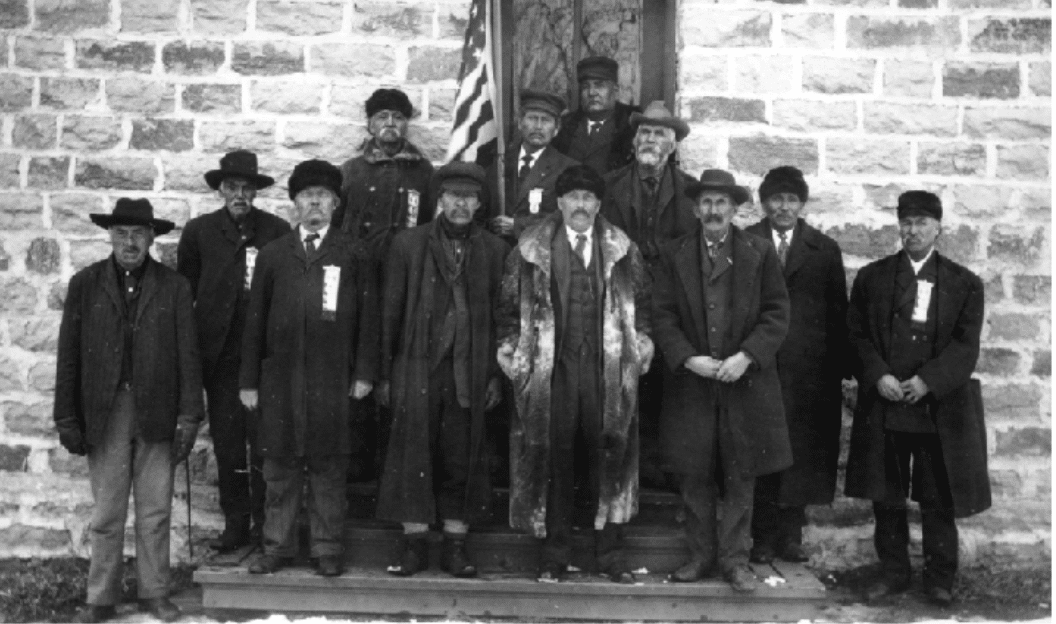
The war ended, and the men returned home. Like hundreds of thousands of Union veterans, in 1899 some of the Oneida formed a Grand Army of the Republic post. All the members were Native Americans; they met in the parish hall of a local church. The post never had more than twenty-eight members, but the steadily shrinking number of old soldiers continued to meet until 1925.[6]
A few years after its founding, the post invited a prominent member of the G.A.R. to speak at a picnic for friends and family members. Hosea W. Rood—himself a veteran of the Twelfth Wisconsin who had been slightly wounded at Atlanta—was custodian of the Memorial Hall in Madison, home to hundreds of artifacts and documents related to the Civil War. A prolific writer and speaker, he authored a biweekly column called the “Grand Army Corner” that appeared in a number of newspapers around the state. He was also the G.A.R.’s state “Patriotic Instructor”—the liaison between the veterans and the schools.
Rood was, for his time, progressive in many ways—he supported civil rights for African Americans and suffrage for women—but he didn’t quite know what to make of the Oneida. His column, “A Day Among the Indians,” although reflecting his instinctive sympathy for Native Americans, still read like an amateur anthropology paper.[7]
“I had heard much of the Oneidas and was glad of the opportunity to meet and get acquainted with some of them.” Rood often described in his column the towns he visited in his GAR travels, offering details about their appearance, economic health, and school systems. In that sense, his day on the reservation was no different. Walking onto the small reservation (just eight miles by twelve miles), he noted the “crooked and rough” road and the “blackened pine stumps” that betrayed the clear-cut logging that had scarred the reservation, although in some areas a second growth of poplar and birch trees “is now springing up.”
He saw some farms and some “rickety” farm machinery, a few good teams of horses, and “decently dresse[d]” Indians driving into town, “looking much the same as their white neighbors.” Yet the “primitive conditions” that prevailed seemed to him a throwback to the pioneer days he remembered from his 1850s childhood. The members of the post and their guests had gathered in a park recently cleared in a poplar grove. It had a dancing floor, a few seats among the trees, board tables, and a booth at which entrepreneurial attendees could sell refreshments. It “was a pretty good imitation of such picnic grounds as may be found in many country neighborhoods.”
Here, and elsewhere, Rood seemed to be encouraging his mostly white readership to understand that this particular community of veterans and their families might not be so different from their own.
In a section called “Some Things I Learned,” Rood related a conversation he had struck up with one of the G. A. R. men, a three-year veteran of the Eleventh Wisconsin. He learned that the Native American men were just now receiving citizenship and that the reservation was being divided up among the Indian families. “There is a great stir among real estate agents to get white men to buy.” The younger Indians, the older man complained, tended to sell their land cheaply and buy alcohol or fancy buggies and horses; the older men with families tended not to sell. After offering a couple of examples of young men drinking and spending away their profits, Rood warned that despite these “extreme cases . . . we must not say that the Indian is foolish above all other fools.”
Rood had a long talk with Henry Powless, another Grand Army veteran and a senior member of one of the most prominent families among the Native American community. He had “the appearance of a prosperous business man—well dressed and intelligent.” Rood asked him about the transformations regarding land and citizenship. Powless admitted that it had caused some disruptions and problems, but believed that it generally was a good thing.
Indians had for too long relied on the government for their basic needs of food and even clothing. “This took from him the necessary discipline of self-help [and] independence,” and if nothing changed they “will continue to be dependent, something like a child.” Of course, most of the men he talked to were among the older generation, and they all agreed that “drunkenness is increasing” among younger men and even the women. “It is, indeed, a pity,” wrote Rood, himself a dedicated Prohibitionist. “Saloon men take liquor to the reservation and give it away to create a taste for it among the young.” Rood made no overt judgments, but clearly liked what he was hearing from the elders.
But there was a “Brighter Side.” Powless took Rood for a drive where there were “many fine farms and some good houses.” Some farmers were “thrifty and well-to-do.” The two-hundred member Methodist church featured a large meeting house, a hall for church festivals and lectures, and a school. “I greatly enjoyed the ride and the opportunity afforded me to get information.”
After a huge meal characterized by quiet conversations among couples and small groups—“it was the stillest picnic I ever saw”—he gave his talk, probably on the history of the United States flag or one of the other talks he often gave to schoolchildren and community organizations. Another man named Powless interpreted the address for those who could not understand English. “During all this time I did not hear a word spoken by any one else. There was silent and most respectful attention. We highly civilized people are apt to talk all we please when near a speaker at a picnic, and whisper at lecturers—some times in church. I really think we might learn something from the ‘noble red man.’”
The highlight for Rood—aside from satisfying his curiosity—was the performance of a band comprised of Oneida dressed in neat brown uniforms. It was a rather famous group; Rood had heard them play over thirty years earlier at a state educational convention (he had been a teacher for thirty years after the war). There was some dancing of the square dance variety on the dance floor, with the occasional chuckling whenever a dancer made a particularly outrageous move. Lemonade, bananas, crackerjacks, and stomach bitters—apparently a mildly alcoholic drink—were served.
Rood noted that although there was a wide range of mixed-race attendees—from full-blooded to those who had no obvious Indian features—all spoke the Oneida language among themselves. Here and in his other encounters with Indians who, in the vernacular of the day, could “pass” for white, Rood was somewhat surprised to learn that most such people were proud of their heritage and would rather stay within their Indian community. “There is something in his blood that holds him to his traditions. They are submissive to the present order of things, yet are not at all unconscious of the wrongs inflicted upon them by white Christians.”
All in all, Rood left with a positive feeling about his day among the Oneida, especially his conversations with the older veterans. “I was never treated with a finer courtesy than at the Oneida picnic.”
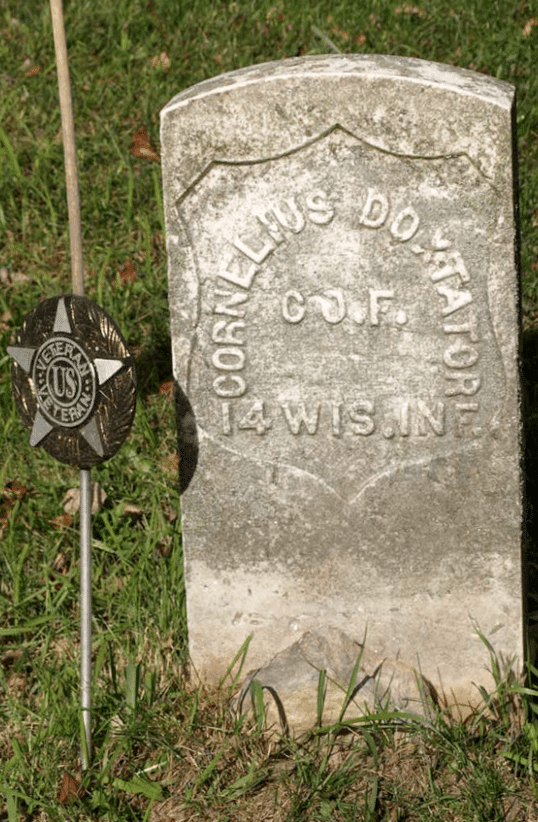
Perhaps Cornelius Doxtator was among the polite, well-dressed Oneida listening intently to their white G. A. R. comrade. In any event, Cornelius died three years later. His obituary appeared on the front page of an Appleton newspaper with the headline “Old Oneida Chief Was War Veteran.” The obituary related his long and storied career as a leader and patriot and ended with a condescending and wildly inaccurate assessment of the tribe’s history over the previous few decades. “This old sachem lived to see his tribe metamorphosed practically from savages into prosperous farmers.” Historians have not seen it that way. Laurence Hauptman concludes that the Civil War era—with smallpox epidemics, the breaking up of reservation lands, and the casualties caused by the war itself—was “a disaster . . . for the Wisconsin Oneidas.”[8]
Whatever prejudices—however sympathetic—Rood brought to his visit with the Oneida, his description of a few hours among G. A. R. comrades and their families captured a moment in the early 20th century transition of Native American tribes across the nation. Despite Rood’s generally positive portrayal of the state of affairs on this tiny reservation in northeastern Wisconsin, his description of a “Day among the Indians” nevertheless reveals the challenges and hardships facing even those Native Americans who had served and sacrificed for the Union.
James Marten is professor emeritus of history at Marquette University and a former president of the Society of Civil War Historians. His most recent book is The Sixth Wisconsin and the Long Civil War: The Biography of a Regiment (Chapel Hill: University of North Carolina Press, 2025).
Endnotes:
[1] Laurence M. Hauptman and L. Gordon McLester, “Cornelius Doxtator: An Oneida Veteran of the Civil War,” in Hauptman and McLester, eds., The Oneida Indians in the Age of Allotment, 1860-1920 (Norman: University of Oklahoma Press, 2006), 15-32.
[2] Appleton Post-Crescent, November 2, 1911.
[3] Laurence M. Hauptman, The Iroquois in the Civil War: From Battlefield to Reservation (Syracuse, NY: Syracuse University Press, 1993), 67-83; Russell Horton, “Unwanted in a White Man’s War: The Civil War Service of the Green Bay Tribes,” Wisconsin Magazine of History 88 (Winter 2004-2005): 18–26.
[4] Semi-Weekly Wisconsin, January 16, 1864.
[5] From a spreadsheet produced from the Roster of Wisconsin Volunteers, War of the Rebellion, Vol. 1 (Madison: Democrat Printing Co., 1886), 770-804, and the Fourteenth Wisconsin Regimental Muster and Descriptive Rolls, Series 1144, Wisconsin Historical Society.
[6] Thomas J. McCrory, Grand Army of the Republic: Department of Wisconsin (Black Earth, WI: Trails Books, 2005), 286.
[7] Baraboo News Republic, September 1, 1908.
[8] Hauptman, The Iroquois in the Civil War, 67.


Not a perspective you hear very often, professor, thank you for you this.