The Legacy of the “Noble Iowa First” from Wilson’s Creek to Shiloh
As August 1861 drew to a close, Iowa prepared for a celebration. The men of the 1st Iowa Infantry Regiment were coming home. Having concluded their three-month enlistments, the men returned directly from the Wilson’s Creek battlefield, where over 150 of their number fell in battle. Communities across the state vied to deliver the pomp and circumstance befitting their triumphant hometown heroes.
An enormous crowd of spectators swelled the Mississippi River levee at Burlington on August 25, anticipating the regiment’s arrival.[1] Towns throughout the state spared no expense in organizing parades, public banquets, picnics and other festivities to honor the returnees.[2] No matter that Wilson’s Creek was a Confederate victory; the volunteers proved their valor beyond reproach and honoured the state’s steadfast commitment to the Union cause.[3] Proud Iowans lionized the gritty determination of these hardscrabble westerners, contrasting it with the rout at Bull Run in Virginia the month prior. It was more than enough in these heady, early days of the war.

In addition to being the toast of the state, their hard-earned reputation made the newly-demobilized veterans a valuable commodity. They possessed something in great demand that summer: recent battlefield experience. The growing number of new regiments forming throughout the state needed experienced men to train, discipline and lead them into battle. Three months of hard service offered many opportunities for advancement.
The veterans carefully positioned themselves. They knew the value of their service in the “noble Iowa first”. One such veteran advised the editor of the Davenport Morning Democrat that “many young men who were in the Iowa First,” among them “an officer who distinguished himself at Wilson’s Creek … will not enter the service again without knowing who is to command them.”[4]
Seven of the 1st Iowa’s nine surviving company commanders obtained commissions in three-year regiments. Five assumed the rank of lieutenant-colonel, second-in-command of their regiment. With it they assumed the critical responsibility of translating their experience, as short as it was, to the raw officers and recruits under their tutelage. Most of the remaining company grade officers and many of the non-commissioned officers and enlisted men also joined new regiments in short order. Young privates, having “seen the elephant” at Wilson’s Creek, became sergeants and corporals. Several secured officer’s commissions.[5]
Nearly every Iowa regiment soon found Wilson’s Creek veterans in their ranks. The largest concentration of these soldiers were spread across five infantry regiments: the 11th, 12th, 14th, 16th and 22nd Iowas. By a twist of fate, four of these regiments came to be heavily engaged in another battle that forever changed the character of the Civil War: Shiloh.
The untested 11th Iowa was the first of the four to meet the enemy on the unseasonably warm morning of Sunday, April 6, 1862. The inexperienced Col. Abraham Hare, while personally fearless and well-liked by the men under his command, owed his commission principally to his reputation as a wealthy and charismatic resident of Muscatine.[6] To complicate matters further, Hare was now in brigade command, with the regiment led into the fight by its equally untested lieutenant colonel, Harvard-educated lawyer William Hall.[7]
At 8 a.m., the Federal division of Maj. Gen. John A. McClernand began to form its first defensive position north of the crossroads of the Corinth Road and the Hamburg-Purdy Road. Hare detached a single regiment from his brigade to support Battery D, 2nd Illinois Light Artillery near the center of McClernand’s battle line. Hare selected the 11th Iowa for this responsibility.[8] Any relief at being placed in reserve was brief. There were few safe positions at Pittsburg Landing that day.
A reservoir of resolve for the raw 11th Iowa came from the Wilson’s Creek veterans interspersed in its ranks. Its second-in-command that day, Maj. John C. Abercrombie, fought in the 1st Iowa as the first lieutenant of Company E. Four of the regiment’s company commanders – Benjamin Beach, Charles E. Compton, William Grant and John C. Marven – had also fought at Wilson’s Creek as junior officers or senior non-commissioned officers. Fourteen other lieutenants, sergeants or senior corporals, comrades from the old 1st Iowa, buttressed the 11th Iowa’s inexperienced soldiers.[9]
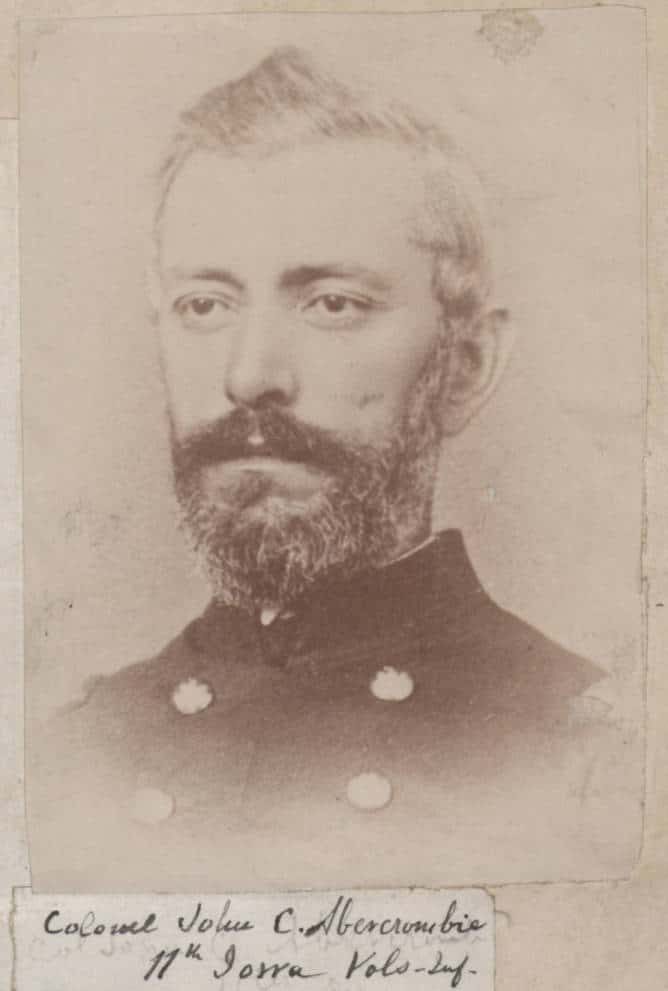
North of the crossroads, the 11th Iowa faced a powerful, relentless attack from Tennesseans and Arkansans under Brig. Gen. S.A.M. Wood and Col. Robert G. Shaver. The two sides maintained a sustained firefight for about two hours. The regiment’s loss in killed and wounded in this stand-up fight was, “very severe”, and included the “most gallant,” Maj. Abercrombie who, through his conspicuous presence remained in the thick of the fight until severely wounded in the head. As the Federals to its front and right began to retreat, the 11th Iowa did as well, with some companies retreating in disarray under heavy musket and artillery fire.[10]
The regiment rallied a short distance to the rear and continued to trade fire with the advancing Confederates. At around noon, McClernand ordered a counterattack by his division, advancing from their new position in Jones Field. While most of Hare’s brigade did not advance, the detached 11th Iowa joined the counterattack, driving back a brigade of Tennesseans under Col. Preston Smith. Confederate reinforcements ultimately overlapped the flanks of the Federal attackers and pressed the Iowans and their comrades back.
The 11th Iowa remained until 1 p.m., when they exhausted their supply of ammunition. After withdrawing back nearly to Pittsburg Landing in search of more bullets, the army commander, Maj. Gen Ulysses S. Grant ordered the Iowans to deploy skirmishers to help protect the final defensive line.[11] To execute this delicate assignment in the deepening dusk, Lt. Col. Hall turned to one of his Wilson’s Creek veterans, Capt. William Grant, who led his company on to the skirmish line in the woods as the balance of the regiment remained in support of Grant’s batteries.[12]
Shiloh was a deadly baptism of fire for the 11th Iowa. The regiment incurred 194 casualties, including 33 killed.[13] One member of the regiment, upon visiting their positions in Jones Field two days later, recorded that “the dead lay so close that one could walk on dead bodies for some distance without touching the ground.”[14] Among the slain were two of the regiment’s Wilson’s Creek veterans: Sgt. George E. Daniels and Sgt. Henry Seibert.[15]
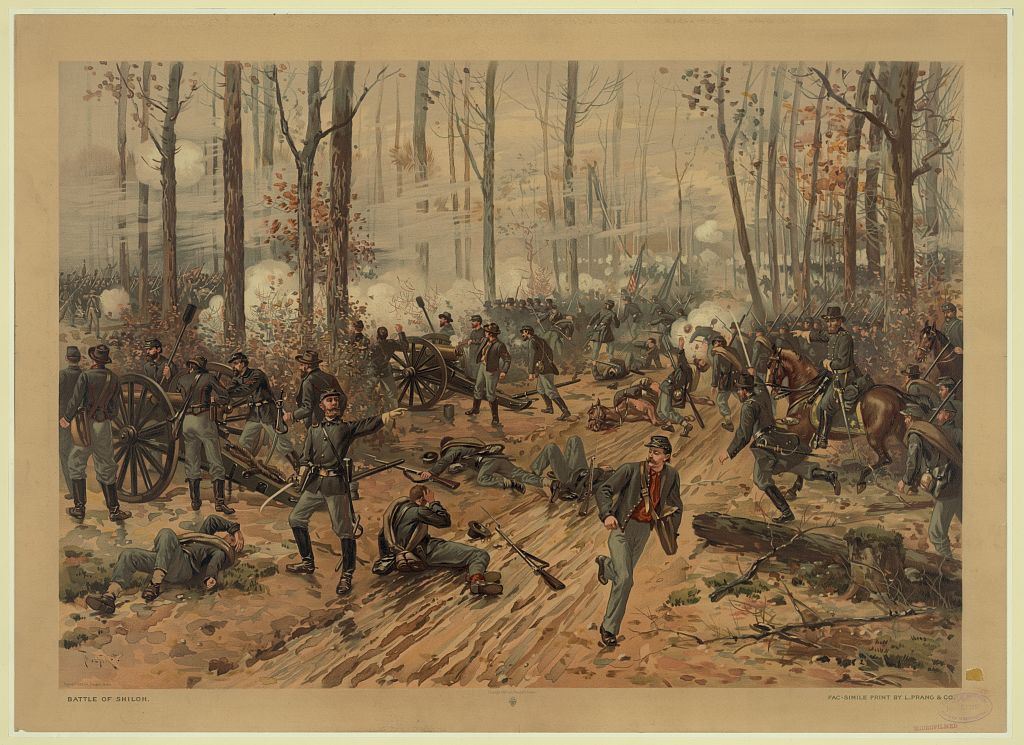
In the counterattack from Jones’ Field, the 11th Iowa was joined by the 16th Iowa, another regiment with a sizable complement of Wilson’s Creek veterans. Their commanding officer, Col. Alexander Chambers, a West Point graduate and regular officer, served as mustering officer in Iowa during much of 1861. Despite a professional military education, Chambers last fought in battle against the Seminoles in Florida.[16] The regimental major, William Purcell, was a 1st Iowa veteran wounded at Wilson’s Creek. At least one company commander served alongside Purcell at the earlier battle, and half a dozen neophyte company commanders could rely on lieutenants who’d fought in Missouri the previous summer. Wilson’s Creek veterans made up nearly all the company officers and senior non-commissioned officers of Company G, drawn from the large German community of Davenport, Iowa.[17]
The 16th Iowa experienced one of the most jarring introductions to war of any regiment that fought at Shiloh. The regiment arrived at Pittsburg Landing the previous evening and spent the night encamped near the river, expecting to proceed and report to the division of Brig. Gen. Benjamin Prentiss the next morning.[18] The regiment arrived on steamboats directly from St. Louis, “without any training, without any experience.” Among the men, “some of them had never loaded a musket,” prior to that morning, with all their instruction consisting of “firing a half a dozen rounds Sunday morning before they were marched into battle”.[19] They needed the Wilson’s Creek veterans – especially the junior officers – to guide them for what lay ahead.
Departing from the landing around 9:30 a.m., the regiment encountered the human detritus of the chaotic morning fighting. Confused squads of wounded and unwounded men, leaderless cavalry and the remains of batteries descended on Pittsburg Landing.[20] Arriving near McClernand’s position along the eastern edge of Jones Field, they were ordered to lie down and shelter from the bullets that passed overhead.[21] They soon joined in the noon counterattack, holding their position for nearly an hour in a deadly firefight before retreating to the cover of the Federal batteries.
The 16th Iowa suffered 131 casualties among its officers and men in its dearly bought baptism of fire.[22] Company G’s Wilson’s Creek veterans were hard hit. Lieutenant Henry Meyer and Sgt. Nicholas Eichmann were among the wounded; Sgt. Rudolph Mohrmann and privates Jacob Rein and Martin Zimmerman were killed. Among the other companies, the wounded included Capt. Edwin M. Newcomb of Company H and Lt. Jesse Lucas of Company C.[23] Lucas was wounded twice in the right leg and chest but remained in command of his company for the duration of the battle.[24]
Elsewhere, Wilson’s Creek veterans faced every manner of trial on April 6. Many among the 12th and 14th Iowa were captured during the collapse of the Hornet’s Nest position. Some, like Capt. Henry Benson of the 8th Iowa and Lt. Smith Thompson of the 14th Iowa, fell prisoner when overcome by wounds.[25]
At least one disgraced their reputation. Lieutenant Colonel Markoe Cummins, who had commanded a company in the 1st Iowa at Wilson’s Creek and was said to have “distinguished himself in that sanguinary engagement,” struggled to command the 6th Iowa in its first major battle.[26] When the brigade commander, Col. John McDowell, asked for an explanation for Cummins’ strange behaviour, he was informed, “It means, sir, that the Colonel is drunk.”[27] McDowell immediately relieved Cummins and placed him under arrest. Cummins sobered up later that day and returned to the field to fight in the ranks of the 15th Iowa as a private, but he was soon cashiered for his conduct.[28]
Endnotes
[1] “Another Welcome to the Volunteers,” Burlington Weekly Hawk-Eye (Burlington, IA: August 31, 1861), 1.
[2] “The Reception of the Returned Volunteers,” Dubuque Weekly Times (Dubuque, IA: August 29, 1861), 2; “Return Home of the Gallant Iowa First,” Davenport Daily Democrat & News (Davenport, IA: August 27, 1861), 1.
[3] William Garrett Piston and Richard W. Hatcher III. Wilson’s Creek: the Second Battle of the Civil War and the Men Who Fought It. (Chapel Hill, NC: The University of North Carolina Press, 2000), 319-320.
[4] Davenport Morning Democrat (Davenport, IA: December 6, 1861), 1.
[5] Roster and Record of Iowa Soldiers in the War of the Rebellion, Together with Historical Sketches of Volunteer Organizations, 1861-1866. Vol 1-3. (Des Moines, IA: 1908).
[6] A.A. Stuart. Iowa Colonels and Regiments: Being a History of Iowa Regiments in the War of the Rebellion. (Des Moines, IA: Mills & Co., 1865), 235-236.
[7] Stuart, Iowa Colonels, 237.
[8] The War of the Rebellion: The Official Records of the Union and Confederate Armies, Series 1, Vol. 10, Part 1, 124.
[9] Roster and Record, Vol. 1, 2.
[10] OR, Series 1, Vol. 10, Part 1, 130.
[11] OR, Series 1, Vol. 10, Part 1, 131.
[12] Timothy B. Smith. Shiloh: Conquer or Perish. (Lawrence, KS: University Press of Kansas, 2014), 226.
[13] OR, Series 1, Vol. 10, Part 1, 100.
[14] Alexander G. Downing. Downing’s Civil War Diary. Olynthus B. Clark, ed. (Des Moines, IA: Historical Department of Iowa, 1916), 43.
[15] Roster and Record, Vol. 2.
[16] Stuart, Iowa Colonels, 303.
[17] Roster and Record, Vol. 2.
[18] Addison H. Sanders, “Brother Alfred,” Davenport Morning Democrat (Davenport, IA: April 17, 1862), 1; Smith, Shiloh: Conquer or Perish, 51.
[19] Proceedings of Crocker’s Iowa Brigade at the Fifteenth Biennial Reunion Held at Washington, Iowa, September 14 and 15, 1911. (Mount Vernon, IA: Mount Vernon Hawkeye, 1910), 38; J.F. Coyningham, Waterloo Courier (Waterloo, IA: April 30, 1862), 2.
[20] OR, Series 1, Vol. 10, Part 1, 286.
[21] OR, Series 1, Vol. 10, Part 1, 287.
[22] OR, Series 1, Vol. 10, Part 1, 104.
[23] Roster and Record, Vol. 2.
[24] Muscatine Evening Journal (Muscatine, IA: April 30, 1862), 3.
[25] Roster and Record, Vol. 1, 2.
[26] Davenport Morning Democrat (Davenport, IA: September 2, 1861), 1.
[27] Henry H. Wright. A History of the Sixth Iowa Infantry. (Iowa City, IA: State Historical Society of Iowa, 1923), 80.
[28] O. Edward Cunningham. Shiloh and the Western Campaign of 1862. Gary D. Joiner and Timothy B. Smith, eds. (El Dorado Hills, CA: Savas Beatie, 2007), 185.


