Book Review: Lutheranism and American Culture: The Making of a Distinctive Faith in the Civil War Era

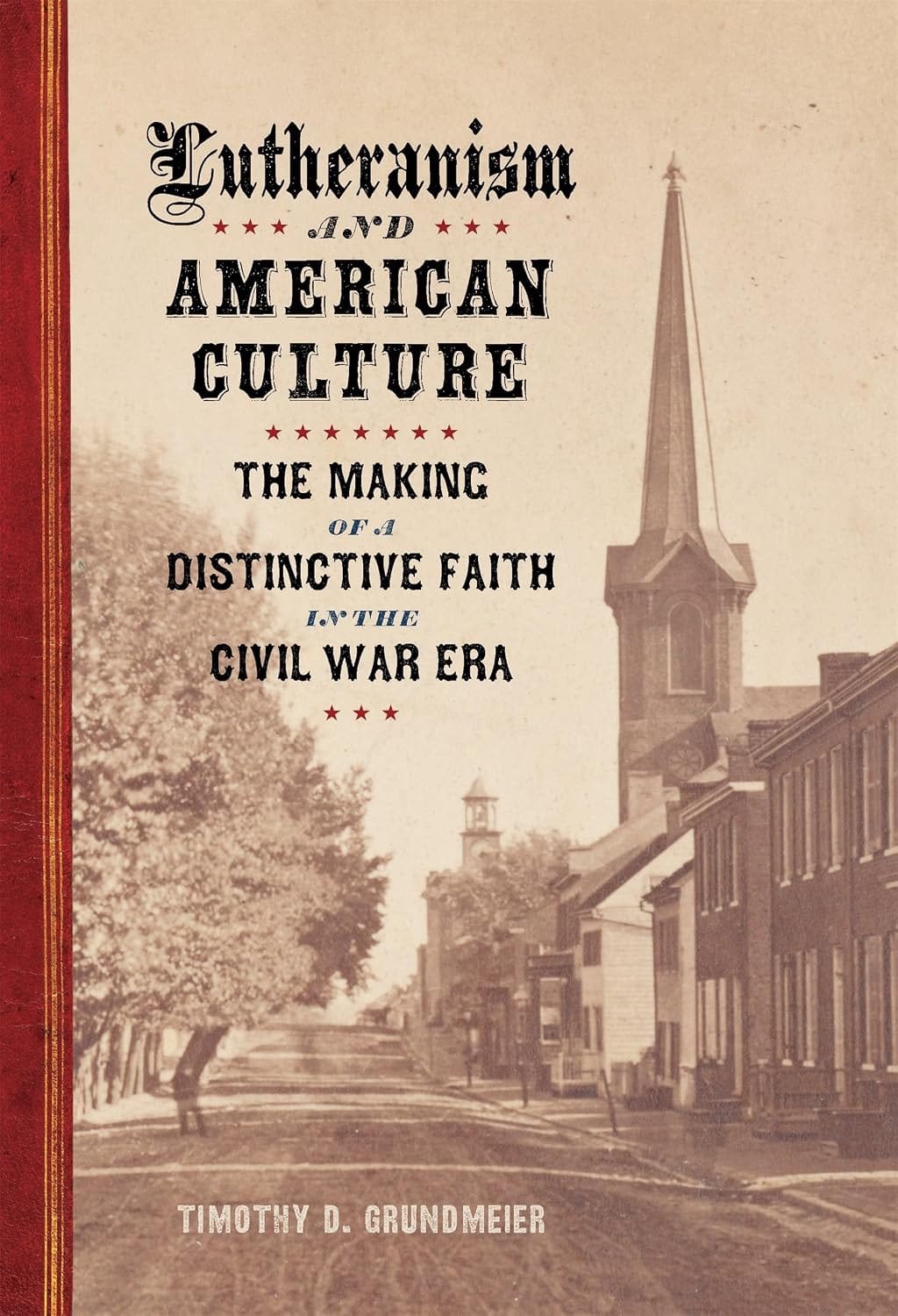
Lutheranism and American Culture: The Making of a Distinctive Faith in the Civil War Era. By Timothy D. Grundmeier. Baton Rouge, LA: Louisiana State University Press, 2026. Hardback, 300 pp. $25.89.
Reviewed by Evan Portman
The last decade has witnessed a growing body of scholarship dedicated to the religious history of the Civil War. Timothy D. Grundmeier’s Lutheranism and American Culture: The Making of a Distinctive Faith in the Civil War Era is an essential entry in that literature.
Grundmeier’s purpose for his study is two-fold: to “tell the story of American Lutheranism” and “to situate that story in the broader debates, movements, and rhetoric of the nineteenth-century United States.” (9) He accomplishes both, arguing that the Civil War accelerated American Lutheranism’s movement away from Anglo-American evangelical trends and toward a more rigidly confessional and conservative religious tradition.
The book both draws upon and counters traditional arguments surrounding the role of the Lutheran church in American history. Much like other scholars, Grundmeier asserts that American Lutherans occupied a sort of “middle ground” between the mainstream Anglo-American Protestant establishment and marginalized religious groups like “Roman Catholics, Mormons, or non-Christian religions.” (10) This granted American Lutheranism a unique, if nebulous, identity.
The Civil War is central to the book’s overarching narrative, which chronicles the history of nineteenth century American Lutheranism at large. Grundmeier notes that “different interpretations of the Civil War were instrumental in shaping and fueling […] intra-Lutheran disputes.” (13) Chapter 4, titled “The Lutheran Civil War,” is particularly important in developing this claim. By 1863, the General Synod split into two distinct schools over the meaning of the war, Union and slavery. The Old School, entrenched in tradition and confessionalism, rescinded its previous tolerance for religious plurality and largely embraced orthodoxy. The New School, on the other hand, recognized that the war had resulted in Americans’ failure to find common ground over important issues and sought theological compromise. The schism also revealed varying attitudes over slavery and Union. Grundmeier notes that Old School Lutheranism was “staunchly pro-Union and more vocally antislavery” that the emerging New School. (13)
Pennsylvania also features prominently in Lutheranism’s relationship to the Civil War. Of course, the country’s oldest Lutheran theological seminary—in Gettysburg, Pennsylvania—became the war’s bloodiest battleground in July 1863. Grundmeier discusses this in the culmination of chapter 3. The fact “that the war’s pivotal battle had taken place in the town that housed their church’s preeminent educational institutions filled General Synod Lutherans with a poignant sense of pride.” (101) But the Commonwealth also became a figurative battleground between Old School and New School Lutherans. They held important meetings in Lancaster and York to debate the issues of slavery and Union as well as adherence to the Augsburg Confession (the Lutheran fundamental statement of faith). A confessionalist church body emerged from the meeting of the Pennsylvania Ministerium in Lancaster in 1866, called the “General Council,” marking the church’s turn towards conservatism during the Reconstruction Era.
One of the book’s underlying arguments situates it within the literature of immigration history. Grundmeier’s analysis of the German and Scandinavian American ethnic groups, both of whom numbered high among Lutherans, demonstrates how religious institutions helped immigrant communities negotiate the relationship between European traditions and American national identity. He argues that Lutherans increasingly rejected assimilation into mainstream Protestantism while simultaneously embracing their identity as Americans. This challenges previous assumptions that assimilation necessitated the adoption of religious practices of mainstream Anglo-American Protestantism.
Thus, the Civil War left Lutheranism in a peculiar situation at the end of the nineteenth century, embracing a strong identification with the United States and its distinctive national character but also distancing itself from other Protestant denominations. Grundmeier therefore concludes that Lutherans cultivated a unique form of American exceptionalism.
Grundmeier’s monograph is a high-level analysis, and his language is academic. This might dissuade a popular audience from engaging with his work. However, he includes a helpful glossary of terms at the end of the book to guide readers who might be unfamiliar with the Lutheran faith. Lutheranism and American Culture is nonetheless a crucial addition a blooming literature on the intersection of religion and the American Civil War.


