They Had the Same Regimental Number and Were from the Same State: The Encounter of the 12th Tennessee Cavalries at Nashville
On December 16, 1864, Colonel Edmund W. Rucker was ordered to hold open the Granny White Pike. After Gen. John B. Hood’s defeat at Nashville, Hood’s retreating army clogged the Franklin Pike. Holding the Granny White Pike protected the vulnerable army’s flank as it moved south to Brentwood. The 29-year-old, Tennessee-born Rucker commanded a brigade of cavalry consisting of his old regiment, the 12th Tennessee, now commanded by Colonel John U. Green, along with the 14th Tennessee, and 7th Alabama Cavalry regiments.[1]
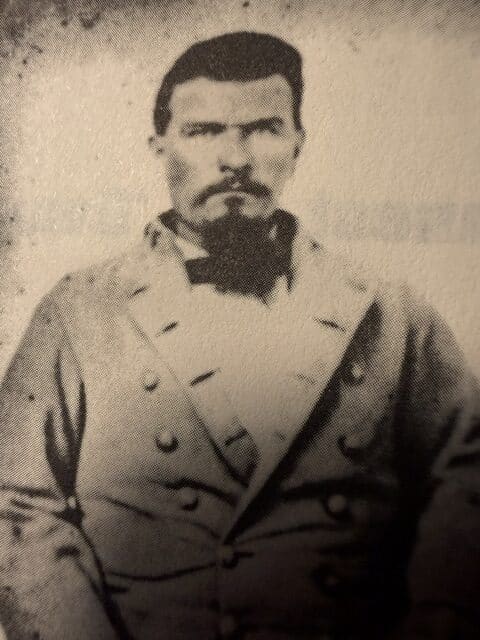
Union Gen. James Wilson’s cavalry was trying to cut off Hood’s escape routes. Rucker placed his brigade across the Granny White Pike near the intersection of the road to Brentwood south of Nashville and ordered his men to construct a barricade across the road. With the sun setting, he placed the 12th Tennessee on the pike in the center of his line. Soon Lieutenant Colonel David Kelly’s 3rd Tennessee Cavalry came galloping to the barricades, joining Rucker’s men, after skirmishing with the advancing Yankee cavalry a mile and a half north.[2]
The 12th Tennessee Cavalry (Confederate) was nervous. As one historian wrote: “The 12th Tennessee (CSA) had been roughly handled, having been forced to retreat earlier in the day from [a nasty fire-fight]. In addition, they overheard David Kelly talking to the commander of the 14th Tennessee about [the large numbers of Federals ahead and rumors] of the enemy passing to the left” to outflank them. The shaky troopers of the 12th peered ahead into the darkness for any signs of the Yankee cavalry. They didn’t have long to wait.[3]
The Federal cavalry brigade commanded by 33-year-old Colonel Datus E. Coon[4] soon approached south along the pike. Coon’s brigade had three regiments, the 6th and 8th Illinois Cavalry and the 12th Tennessee Cavalry led by Colonel George Spalding.[5] A cold rain turned to sleet as night fell. In the pitch-black darkness, Coon had the two Illinois regiments dismount on the flanks, while Spalding’s Tennesseans remained mounted in the center of the line arrayed perpendicular across the pike. When Coon gave the word the Union battle line moved forward.
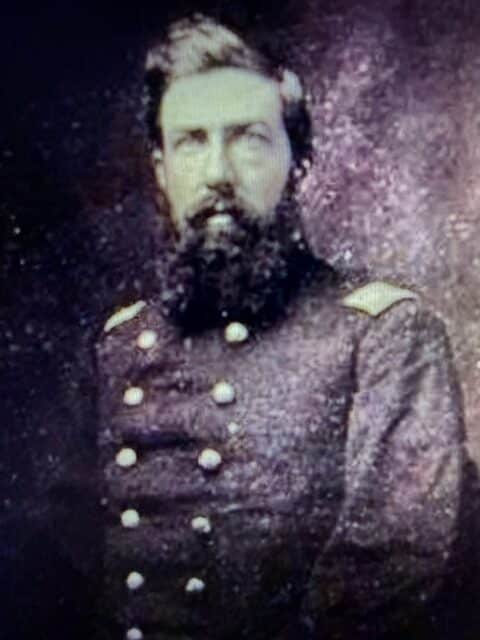
The troopers of the 12th Tennessee (Confederate) could hear them coming but could not make out their targets in the dark, until the charging Federals from Tennessee were 20 rods from their front. They let loose one volley before breaking to the rear for their horses. This created a gap in the center of the Confederate line which allowed the 12th Tennessee Cavalry (Union) to penetrate. The two-12th Tennessee cavalries soon became inextricably mixed-up in a hand-to-hand fight. In the dark, mad confusion, it was difficult to recognize the color of the uniforms, making it almost impossible to distinguish friend from foe. One U.S. cavalryman later recalled, “It was so dark we could not see the ears of our horses.” There was no way to tell other than by the usual challenge, “Halt, who comes there?” The answer, “12th Tennessee” did little to allay any confusion. In the melee, Majors Kirwan and Bradshaw of the Federal 12th had charged entirely through the Rebel 12th. While returning to their friends through the Rebels, when challenged, they passed themselves off as belonging to the 12th Tennessee (Confederate) and with vows of wanting to kill Yankees.[6]
On another part of his line, Colonel Rucker could hear the increased noise coming from the direction of the center. He rode over expecting to find his 12th Tennessee. When he neared the melee, he asked a trooper where his colonel was? The trooper pointed at a mounted officer, then rode away. Rucker approached the officer in the dark.
Colonel Spalding was in the foremost of the charge and was intermingled in the melee when he heard a clear voice ring out, “Who are you, anyhow?” He saw the figure before him and answered, “I am Colonel George Spalding, commander of the 12th Tennessee Cavalry.”
Rucker grabbed at the reins of Spalding’s horse and declared, “Well, you are my prisoner, for I am General Ed Rucker, commanding the 12th Tennessee Rebel Cavalry.”
“Not by a damned sight,” shouted Spalding, and putting spurs to his horse, with a bound, broke free and leaped out of danger. Nearby Yankee troopers began to shout,” Kill the man on the white horse.” A trooper tried to cut off Rucker from escaping, but the colonel struck him down with his sword.[7]
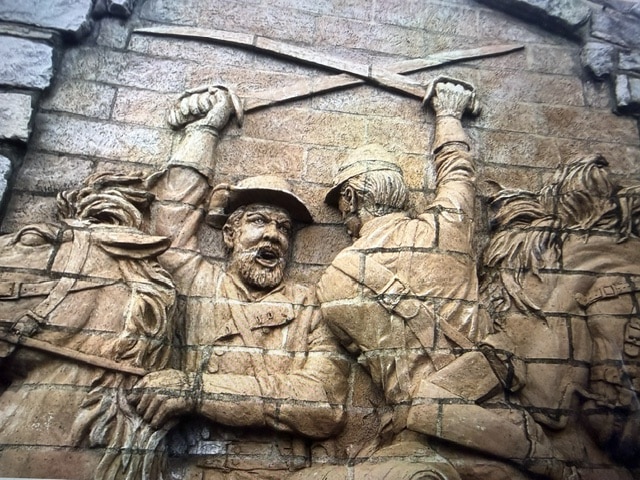
Captain Boyer of the 12th Tennessee (Union) witnessed this exchange and rode at Rucker with uplifted sword. Rucker slashed at Boyer, wounding him on the forehead with the hilt of his sword. Boyer lunged at Rucker’s sword hand and was able to wrench Rucker’s sword from his grasp. Rucker countered by seizing Boyer’s sword and the two continued to whack at each other with exchanged swords. Seeing this exchange, some unidentified Union troopers opened fire at Rucker. As shots flew, one shattered Rucker’s left arm above the elbow and killed his horse, pitching him head-over-heels into the barricade of fence rails. The shaken and badly wounded, Rucker was compelled to surrender.[8]
In the melee, Private Barry Watson (12th Tennessee Union) captured the colors of the 12th Tennessee (Confederate), killing the Confederate color bearer and grabbing the flag. A Confederate officer rode up to Watson, mistaking him in the gloom for the Southern color bearer. Trying to rally his men, the Confederate officer called out, “Stick to your colors, boys!” Watson, not waiting for more Confederates to gather, replied, “I’ll do it,” and bolted off with his prize.[9]
With Rucker wounded and captured, his brigade was overwhelmed and cut in two. Losing a third of their numbers, the Confederates retreated toward Brentwood leaving control of the Granny White Pike to the Federals.
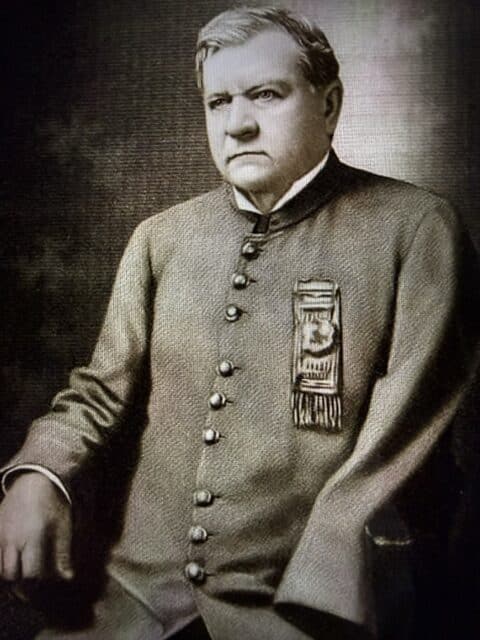
Rucker would survive his wound but lose the arm. He was imprisoned at Johnson’s Island, Sandusky, Ohio. After the war he returned south residing in Memphis and then Birmingham working as a railroad executive and banker. George Spaulding was mustered out as a brevet brigadier general and returned to Monroe, Michigan where he served as postmaster and mayor. After studying law he was elected to Congress serving until 1899 when he returned to Monroe to practice law and banking.
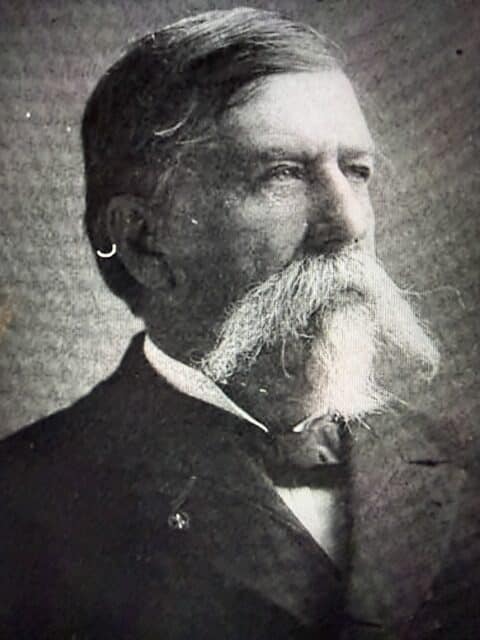
The encounter between the two colonels of the 12th Tennessee cavalries would not be forgotten. In 1889 Rucker invited Spaulding to visit him on the 25th anniversary of their encounter on the Granny White Pike. When they met, Spaulding returned Rucker’s sword and field glasses which he had obtained upon the Confederate’s capture.[10]
The encounter would also not be forgotten for the rare occurrence of two regiments with the same regimental number from the same state battling each other during the Civil War. How often did that happen during the Civil War?
[1] “General Edmund W. Rucker,” Confederate Veteran, Vol. XXXII, May 1924. pp 163-164. Edmund Winchester Rucker (July 22, 1835-April 13, 1924) was born in Tennessee and at a young age worked as a surveyor on the Nashville & Decatur Railroad. A self-taught engineer, he settled in Memphis and became that city’s engineer. On the outbreak of the Civil War, he enlisted as a private in a Sapper unit and was soon promoted as a lieutenant of engineers. He transferred to the artillery and was a captain at New Madrid and Island No. 10. He again transferred to the cavalry, serving under Forrest and Chalmers and fought at Chickamauga, Chattanooga, Brice’s Crossroads and Tupelo. He was promoted colonel of the 12th Tennessee Battalion and was later given brigade command. He was described as having “obstinate courage worthy of praise.” For a full biography see Rucker, Michael P., The Meanest & ‘Damnest’ Job: The Civil War Experiences and Civilian History of Colonel Edmund Winchester Rucker, Montgomery, Alabama, NewSouth Books, 2019.The War of the Rebellion: A Compilation of the Official Records of the Union and Confederate Armies, (O.R.), Washington, D.C., U.S. Government Printing Department, 1880-1901. 128 volumes. Rucker received written orders from Gen. Hood at 3:15 p.m. to “. . . hold the Granny White Pike at all hazards.” O.R., Series 1, Vol. 45 (part 1), p.765.
[2] https://tngenweb.org/civilwar/12th-Richardsons-tennessee-cavalry-regiment/ The 12th Tennessee Cavalry Regiment was organized behind Federal lines in February 1863 and first under the command of Colonel Richardson. They were recruited from the counties of Fayette, Tipton, Shelby, Haywood, and Gipson.
Belcher, Dennis W., The Cavalries in the Nashville Campaign, Jefferson, N.C., McFarland & Company, Inc. Publishers,2020. pp. 266-268.
[3] Belcher, The Cavalries in the Nashville Campaign, p. 268.
[4] Pierce, Lyman, History of the Second Iowa Cavalry, Burlington, Iowa, Hawkeye Steam Book & Job Printing Establishment, 1865. p.10. Datus E. Coon (1831-1893) was born in New York, moved to Iowa and became a newspaper man. He organized Co. I of the 2nd Iowa Cavalry and fought at New Madrid, Island No. 10, and Corinth, and in the Meridian and Yazoo Campaigns. He was noted as a “zealous worker and brave fighter.” Coon’s Brigade was the 2nd Brigade in General Hatch’s 5th Cavalry Division.
[5] Hunt, Roger D. & Jack R. Brown, Brevet Brigadier Generals in Blue, Gaithersburg, Md., Old Soldier Books, Inc., 1990. p. 573. George Spalding (November 12, 1836 – September 13, 1915) was born in Blairgowrie, Perthshire, Scotland and immigrated to the U.S. in 1843. He was a school teacher in Monroe, Michigan and enlisted as a private in Co. A, 4th Michigan Infantry. He was promoted through the ranks to colonel of the 12th Tennessee Cavalry organized in Nashville on August 24, 1863. He was promoted to brevet brigadier general on March 21, 1865. After the war he became postmaster, then mayor of Monroe and was elected to Congress 1895-99.
[6]The War of the Rebellion: A Compilation of the Official Records of the Union and Confederate Armies, Series I, Vol. 45, pt.1. pp. 591-592 & 765. Report of Datus Coon.
[7] Ibid. Pp.591-592. Wilson, James, Under the Old Flag, Vol. II, New York & London, D. Appleton & Co., 1912. pp. 122-123. Rucker actually held the rank of colonel although he commanded a brigade. His men referred to him as general out of respect for his position and even General Forrest on occasion referred to Rucker as “one of my best and bravest generals.” Rucker, Michael P., The Meanest and ‘Damnest’ Job, p. 212
[8] Ibid. It is unclear who shot Rucker. One account says Boyce drew his pistol and shot the colonel, another says it was an unknown soldier. The author thinks there were multiple shots at Rucker, especially when the call went to “Kill the man on the white horse,” and since Rucker’s horse was also shot and killed in the melee. Rucker’s left arm was amputated and he was sent to Johnson’s Island Prison in Sandusky, Ohio. Rucker, Michael P., The Meanest & ‘Damnest’ Job: The Civil War Experiences and civilian History of Colonel Edmund Winchester Rucker, Montgomery, Alabama, NewSouth Books, 2019. fn. p. 287. Captain Boyer presented Rucker’s saber to Colonel Spalding as a trophy. Spalding returned the weapon to Rucker 25 years later amid considerable publicity. Sword Wiley, Embrace an Angry Wind: The Confederacy’s Last Hurrah: Spring Hill, Franklin, and Nashville, New York, Harper Collins Publishers, 1992. p. 389.
[9] Ibid. Thanks to historian Greg Biggs for pointing out that some sources mistakenly say the flag was Rucker’s colors. Private Watson was promoted to sergeant by Colonel Spalding the night of the conflict for “gallant conduct.” There is much controversy over the Confederate banner. It is thought that the flag was not the regimental flag of the 12th Tennessee Cavalry as they never mentioned in any accounts that they lost their colors. Instead, some researchers contend it was Rucker’s Brigade flag. For more information see www.crwflags.com/fotw/flags/us-csrub.html/
[10] Allardice, Bruce S., Confederate Colonels: A Biographical Register, Columbia, MO: University of Missouri Press, 2008, p. 329. Autobiography and Portraits of the President, Cabinet, Supreme Court and Fifty-fifth Congress, Vol. II, U.S Government Printing Office, 1899, pp. 418, 460. Rucker, The Meanest & ‘Damnest’ Job, pp. 211-212, fn. p. 287.


Another instance was the two 1st Maryland’s meeting at Front Royal, VA during Jackson’s 1862 Valley campaign.