A Page from History: Alexandria’s Prisoner Diversity – The January 1865 Prison Report

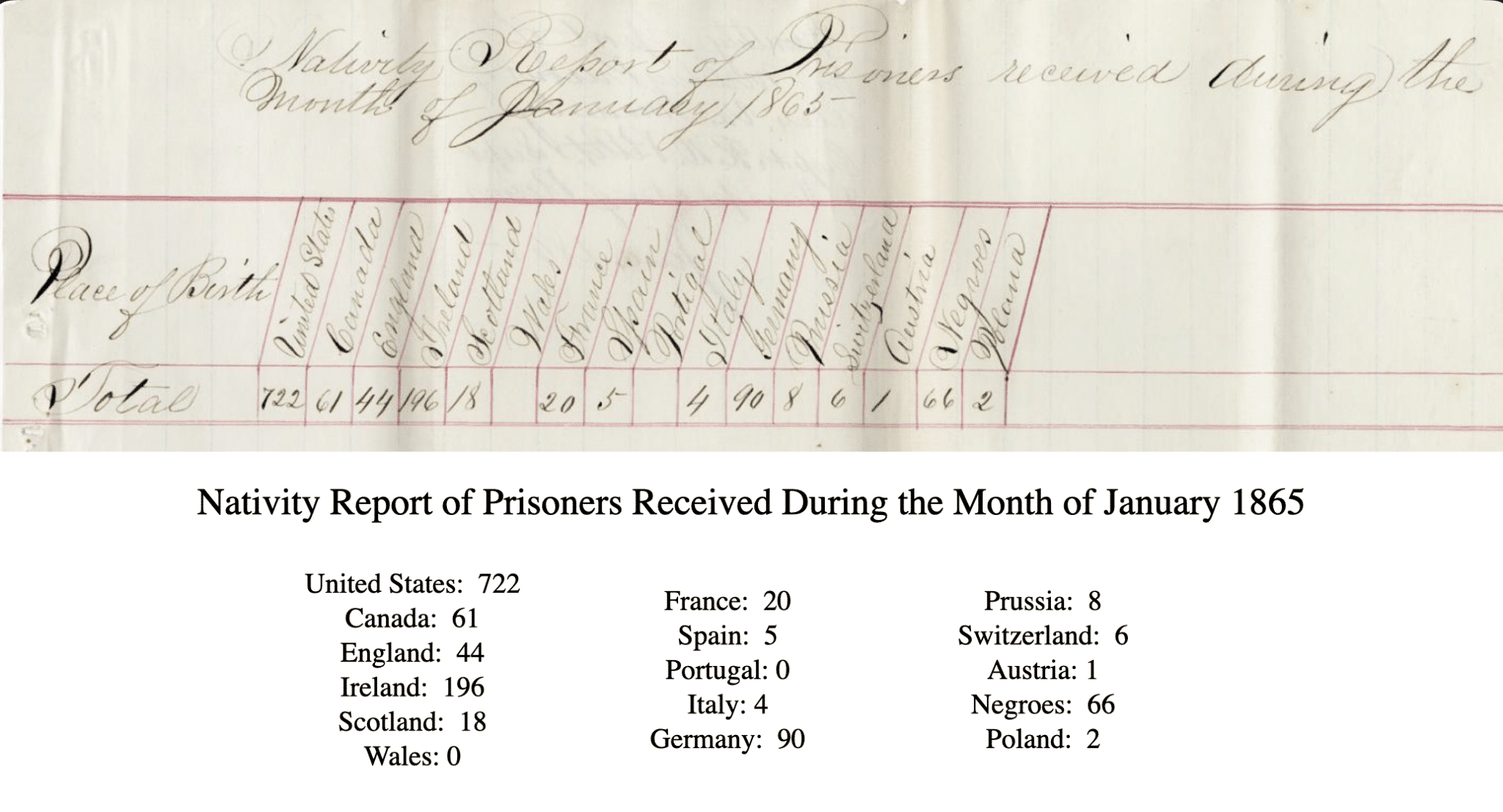
Within the wartime papers of Captain Rufus Dudley Pettit lies a very telling document. While in his role as the Superintendent of U.S. Military Prisons at Alexandria, he enumerated the national origin of the prisoners under his jurisdiction for January 1865 – but only recorded these figures once in over thirty reports.[1]
Rufus Pettit joined Alexandria’s military government in July 1864 after reassignment from Battery B of the 1st New York Light Artillery to the 12th Veteran Reserve Corps. Sent home after a wounding at Chancellorsville, he became dissatisfied with life back on his upstate farm during a time of war. This administrative role in Alexandria fit the bill, but the only issue was Pettit himself. He exhibited signs of post-traumatic stress, determined to wage a war against desertion and disloyalty in this Southern port city.
Shortly after assuming the role of prison superintendent, Pettit began what can be summarized as a “reign of terror.” Details of his cruel and unusual actions against suspected deserters drew immense media and legal attention after the war.[2] The prison on Washington Street, which was the largest facility by sheer size and capacity, practically transformed into an interrogation chamber. (To learn more about Alexandria’s prisons, check out this ECW article written by the author). Pettit was dishonorably discharged for his actions at Alexandria in January 1866.
Pettit’s reports were sent to the military governor of Alexandria, Brigadier General John Potts Slough, trimonthly from July 1864 through May 1865. Filled with pleas for supplies, requests for citrus fruits to treat scurvy, and disheartened descriptions of recent escapes, this focus on nativity seems quite random in the prison documents. Why start to list the countries of origin for the Union, Confederate, and civilian inmates warehoused in Alexandria’s five haphazard correctional facilities? Even more confusing, why stop tracking this data piece? Pettit was not known for his kindness and empathy. It is possible that this interest in his wards’ origins came from a higher rank, but we can only wonder.
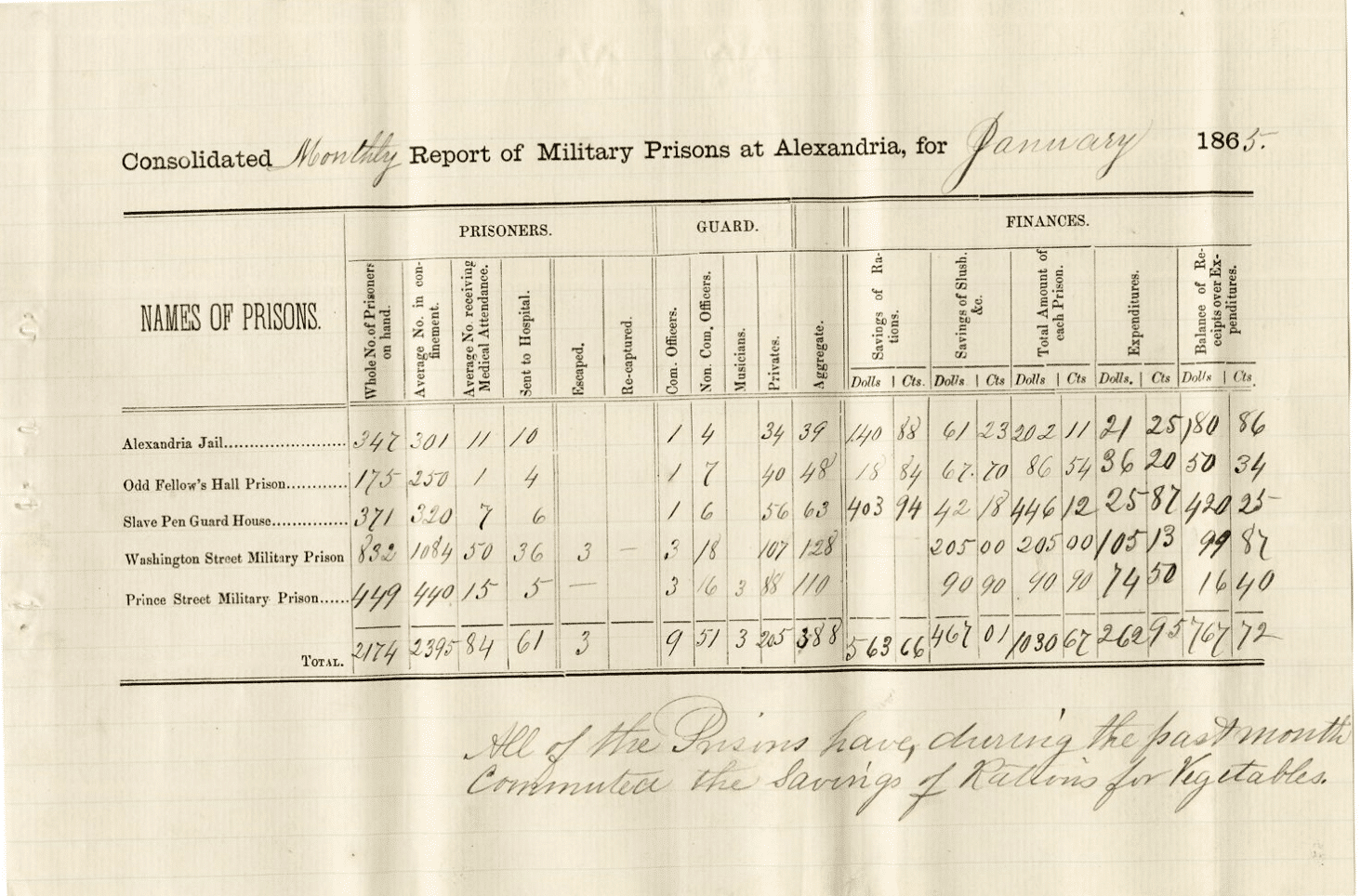
January 1865 was a strained time for Alexandria prison culture. The prisoner population exploded to 2,174 with over 80 receiving medical attention while imprisoned and 60 sent to one of the city’s Union Army hospitals. The cessation of prisoner-exchange left a devastating result in Alexandria, which operated as a transfer station and first stop for many Confederates heading north to larger prison camps. Alexandria’s reputation as a lawlessness hellscape, and its track record of soldier crime and violence, consistently filled the five prisons to capacity. (To learn more about combatting crime in Union-occupied Alexandria, read this ECW article by the author).
The nativity document sheds light on several interesting points. Aside from the United States, Ireland and Germany hold the highest number of soldiers, due to how many of their countrymen fought for both sides of the conflict. The number of African Americans is not surprising considering the history of Alexandria itself as an epicenter for the slave trade and the city’s role during the Civil War. As a Union-occupied locale, it became a safe haven for thousands of self-emancipating enslaved persons who joined the already present free Black persons in the city. The United States Colored Troops were barracked and medically treated in Alexandria, which also accounts for any arrests made.
The inclusion of Portugal and Wales, despite zero identified soldiers, indicates that there were Portuguese and Welsh persons documented within the city at one point. Some nationalities may be more surprising, such as France, Italy, Spain, and Poland. These are not the typical “immigrant soldiers” that we imagine. Rather, they reflect the diverse backgrounds of those who were enlisted, drafted, or conscripted into the dueling armies.
While we cannot be sure why Captain Pettit enumerated the origins of his prisoners, the total number does not add-up to over 2,000 imprisoned in the city in January 1865. Why were several hundred unaccounted for? Were many uncooperative in light of Pettit’s cruelty against them, or were there political motives at play? Regardless, this document is a fascinating piece of history that illuminates more of what life was like inside Alexandria’s prisons – even if for just one month.
[1] “Prison Reports, January 1865,” Captain Rufus D. Pettit Papers (MS093), Alexandria Library Digital Special Collections, https://alexlibrary.access.preservica.com/uncategorized/IO_76d79142-9f43-4b80-a600-3c62b9722122/.
[2] The Alexandria Gazette published updates on the Pettit trial. See: “Image 3 of Alexandria Gazette (Alexandria, D.C.) 10 October 1865,” Library of Congress, https://www.loc.gov/resource/sn85025007/1865-10-10/ed-1/?sp=3&q=pettit&r=0.031%2C0.747%2C0.845%2C0.437%2C0&st=pdf.


