Soldier Blues: The Rise and Fall of “Billy, Don’t Be a Hero”
ECW welcomes back guest author Keith Moore.
Warfare has long influenced contemporary popular music. Vietnam inspired numerous hit songs in the late ‘60s and early ‘70s. Even the American Revolution enjoyed a brief (if obscure) moment in the spotlight when Scotland’s the Sensational Alex Harvey Band hit the UK charts in 1976 with the song “Boston Tea Party.”
The Civil War achieved its own moment of pop music glory in 1971 when Joan Baez’s cover of The Band’s “The Night They Drove Old Dixie Down” cracked the Top 5. However, it was an eerily cheerful tale of heartbreak and despair that triumphantly took the Civil War to the very top of the charts.
Written by the British songwriting duo of Peter Callander and Mitch Murray, “Billy, Don’t Be a Hero” — also stylized as “Billy Don’t Be a Hero” and “Billy—Don’t Be a Hero” — was first recorded by an English-based quintet called Paper Lace (led by a singing drummer and a guitarist by the oddly familiar-sounding name of Carlos Santanna). Released in February 1974, the track promptly went to No. 1 in Australia, Ireland and the United Kingdom.
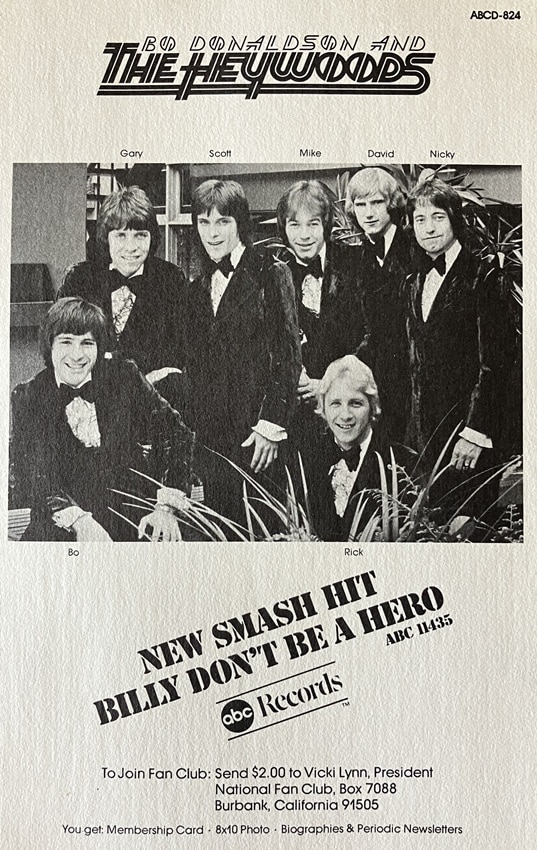
A few months later, a Cincinnati-based group known as Bo Donaldson and the Heywoods recorded its own version of the song; their rendition climbed all the way to the top spot in both Canada and the United States. Interestingly, Donaldson was the band’s keyboardist and not its lead singer; the septet’s vocals were handled by Mike Gibbons.
In short, the song tells the story of a young man about to go off to war. His fiancée’s plea for him to stay safe so they can marry upon his return serves as the song’s hook and provides ‘70s pop music with arguably one of its most infectious and recognizable choruses:
“’Billy, don’t be a hero, don’t be a fool with your life
Billy, don’t be a hero, come back and make me your wife’
And as Billy started to go, she said, ‘Keep your pretty head low
Billy, don’t be a hero, come back to me’”[1]
Often thought to be written about the Vietnam War (which makes sense given the period in which it was composed), “Billy, Don’t Be a Hero” actually describes events that take place during the Civil War. The introductory fife and military-style snare drum are a hint, as are the lyrics, most notably the multiple references to “soldier blues” (the uniforms worn by the Union Army). Take the song’s opening verse, for instance:
“The marching band came down along Main Street
The soldier blues fell in behind
I looked across and there I saw Billy
Waiting to go and join the line”[2]
The lyrical climax of the song occurs when Union leadership asks for a volunteer to try and secure additional soldiers to bolster the army’s sagging defenses. Ignoring his fiancée’s request, Billy offers his help:
“The soldier blues were trapped on a hillside
The battle raging all around
The sergeant cried, “We’ve got to hang on, boys
We’ve got to hold this piece of ground
I need a volunteer to ride up
And bring us back some extra men”
And Billy’s hand was up in a moment
Forgetting all the words she said”[3]
Tragically, the song’s protagonist doesn’t survive. His death — the exact cause of which remains a mystery to the listener — is revealed in the final verse:
“I heard his fiancée got a letter
That told how Billy died that day
The letter said that he was a hero
She should be proud, he died that way
I heard she threw the letter away”[4]
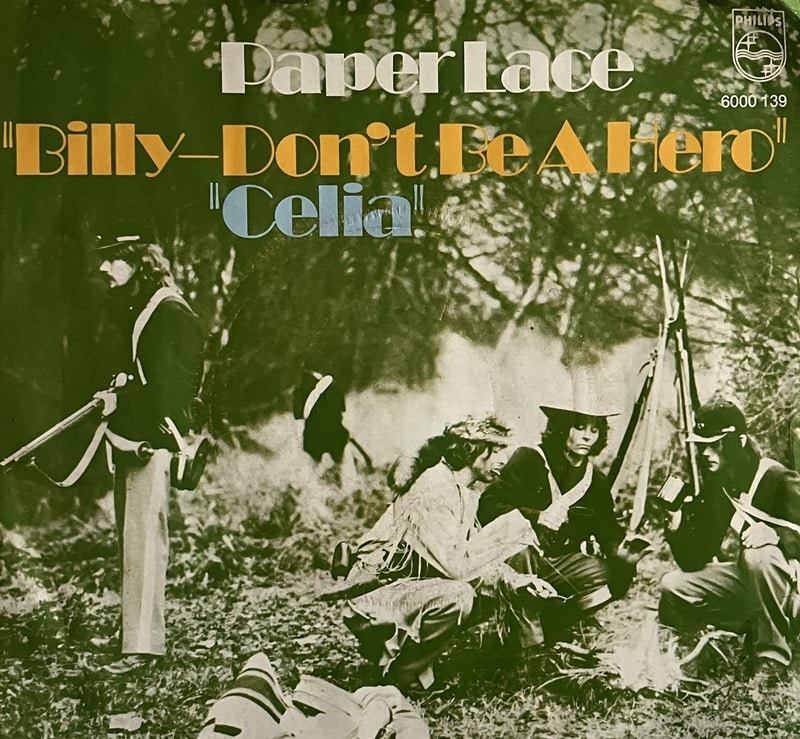
Paper Lace didn’t shy away from playing up the Civil War aspect of the track; the band at times dressed as Federal soldiers during promotional performances of their hit (reminiscent of the Civil War uniforms worn by Gary Puckett and the Union Gap during their late ‘60s heyday). They also appeared in “soldier blues” on the picture sleeve of the original “Billy, Don’t Be a Hero” 7-inch 45 single. Bo Donaldson and his group, on the other hand, eschewed the Civil War outfits for more contemporary ‘70s-era dress.
***
Neither Paper Lace nor Bo Donaldson and the Heywoods were able to maintain the enormous success of “Billy, Don’t Be a Hero.” Paper Lace did follow up with another hit (this time in the States) with a second Callendar and Murray historical composition — “The Night Chicago Died,” a fictional account of gangster Al Capone’s battle with law enforcement, peaked at No. 1 in August 1974 — but the band never recorded another album.
Bo Donaldson and the Heywoods’ career was similarly short-lived. The band recorded three albums for three different labels between 1972 and 1976 — “Special Someone” (Family), “Bo Donaldson & The Heywoods” (ABC) and “Farther On” (Capitol) — and released a handful of non-LP singles, but the group never came close to matching the success of its biggest hit. The band’s last chart record was the appropriately titled “Our Last Song Together.”
Time has not been kind to “Billy, Don’t Be a Hero.” A 2011 survey by Rolling Stone found the song to be the eighth worst hit of the 1970s (not as terrible as Debbie Boone’s “You Light Up My Life” and “Seasons in the Sun” by Terry Jacks, according to the poll, but only slightly better than both “Feelings” by Morris Albert and Minnie Riperton’s “Loving You”). The magazine described it as “insipid 1970s drivel.”
Part of the criticism leveled at the song is its upbeat mood, which stands in stark contrast to its relatively dark tone. Matthew Thomas addressed this in a June 2026 article for Men’s Journal called “52 Years Ago Today, a 1974 Track Voted One of the ‘Worst Songs of All Time’ Hit No. 1.”
“It [the song] has also been accused of being manipulative and simplistic with its almost celebratory tone flying in the face of its subject matter,” he wrote. “With music that sounds like it could be played during a parade and lyrics that tell a tragic story, the mismatch makes it a strange piece of music history.”
Similarly, Jonathan Eig, in “Ten Worst Number-One Hits of the 1970s,” a July 2024 article that appears on the website AudioPhix, describes the song as a “tragic tale sung like the theme to ‘The Brady Bunch’ ” (incidentally, Eig ranks the song at No. 8, which makes it somehow more offensive than Rick Dees and His Cast of Idiots’ “Disco Duck”).
Love it or hate it, “Billy, Don’t Be a Hero” — the only pop song about the Civil War to hit No. 1 on the Billboard Hot 100 — still generates a reaction more than 50 years since it topped the charts. Perhaps it’s only fitting that Bo Donaldson has the last word:
“We just got it [the song] certified Platinum last year (2025),” he told Gary James of the website ClassicBands. “What did they use to say, any publicity is good publicity?”
Keith Moore is a native New Englander with an advanced degree in literature from the University of Oklahoma. His short fiction has appeared in Bluestem Magazine, Ponder Review and The Raven Review; his writing has also been published in The Boston Globe, the Cape Cod Times, and PopMatters.
Endnotes:
[1] Callander, P. and M. Murray. (1974). Billy, Don’t Be a Hero. On Paper Lace… and Other Bits of Material. Bus Stop Records.
[2] Callander, P. and M. Murray. (1974). Billy, Don’t Be a Hero. On Paper Lace… and Other Bits of Material. Bus Stop Records.
[3] Callander, P. and M. Murray. (1974). Billy, Don’t Be a Hero. On Paper Lace… and Other Bits of Material. Bus Stop Records.
[4] Callander, P. and M. Murray. (1974). Billy, Don’t Be a Hero. On Paper Lace… and Other Bits of Material. Bus Stop Records.


When Joan Baez prepared her cover of The Night They Drove Old Dixie Down she misunderstood the sung lyrics. That is why General Stoneman lost his credit in her version. “Stoneman’s cavalry” became “so much cavalry came.”