Book Review: Winchester and the Civil War: A Walk Through History

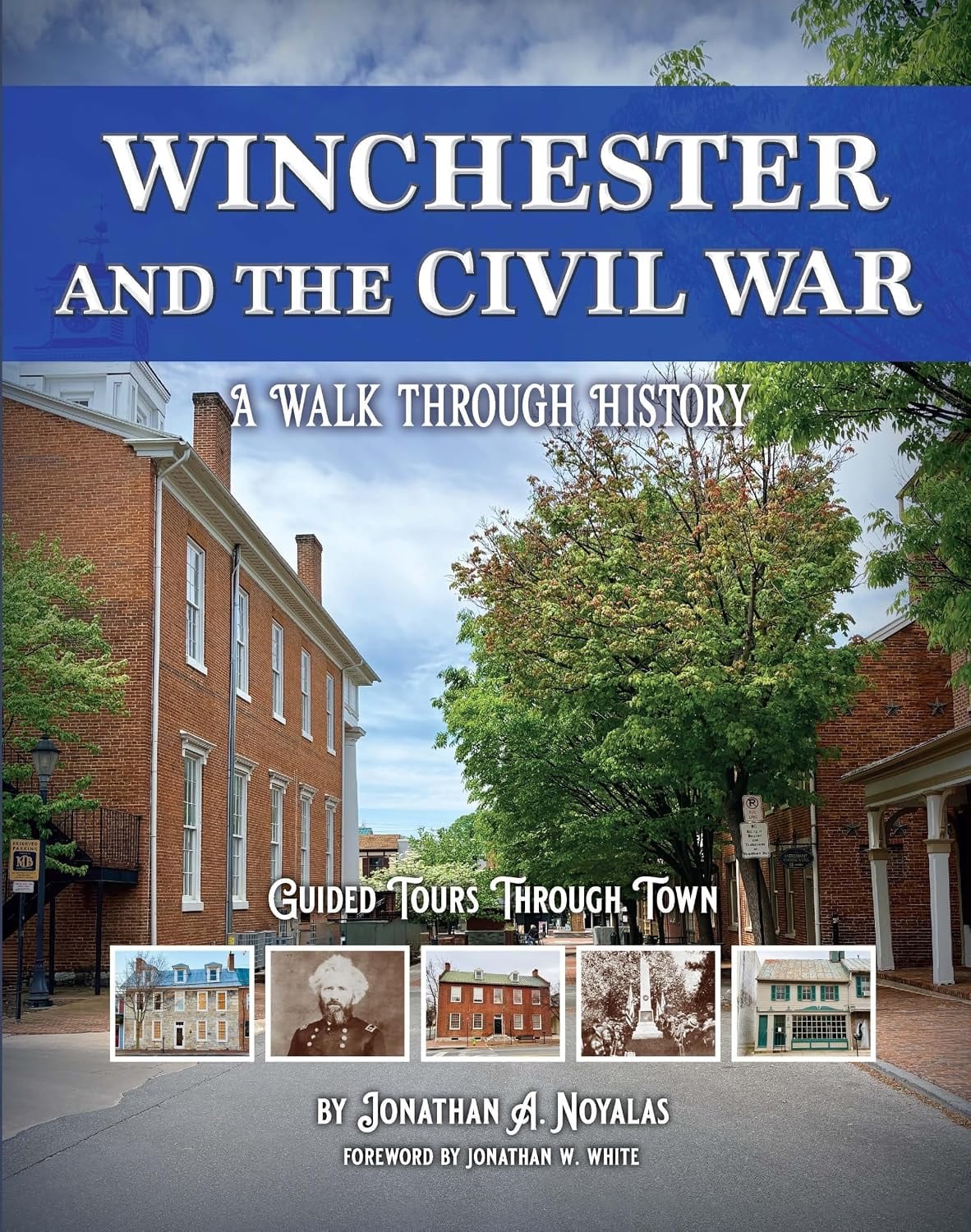
Winchester and the Civil War: A Walk Through History. By Jonathan A. Noyalas. St. Louis, MO: Reedy Press, 2026. Softcover, 42 pp., $17.00
Reviewed by Kevin C. Donovan
The National Park Service, custodian of many of our nation’s historical sites, asks the question, “Why Historic Places?” Its answer: “American history is the history of place. It’s where history happened. Since time immemorial, humans have interacted with and created meaning from their physical surroundings.”
Students of the Civil War know Winchester, Virginia as a “historic place.” The site of three battles whose name has been attached to each, Winchester also is known as the place which changed hands more times—over seventy—than any other place during the war. The town thus both is a place of military history and a petri dish for examining a multitude of civilian wartime experiences. Yet few may know about many of the underlying stories clinging to this place, stories that are illustrated by remarkable physical vestiges of the past in the form of surviving concrete pieces of the town’s history.
Professor Jonathan Noyalas offers those stories against the backdrop of place. In his Winchester and the Civil War: A Walk Through History, Dr. Noyalas highlights eighty sites in the town and provides enlightening stories associated with each. The sites include still-existing buildings that were used for military purposes (such as Gen. Thomas “Stonewall” Jackson’s headquarters), historic churches, residences of persons who played a role in the town’s Civil War experience, period schools and businesses. Other sites are graves and monuments. Still others are places where wartime buildings no longer stand, one due to the war itself, yet still represent sites with underlying stories affixed.
Accompanying each site chosen by Dr. Noyalas is a vignette explaining its significance to Winchester’s Civil War history. A still-standing Presbyterian manse sheltered Mary Anna Jackson while her husband was away on campaign. A medical college site ceased to exist in May 1862 after a U.S. general ordered it burned because the bodies of some of John Brown’s supporters, including his son, had been brought there for dissection and study by its students. In one church attended by U.S. soldiers, the pastor defiantly offered prayers for the failure of the Emancipation Proclamation. A female seminary counted one of Robert E. Lee’s young daughters among its students until impending federal occupation caused her to flee. One highlighted residence was the home of a woman whose nighttime battlefield care for a wounded Confederate officer inspired the famous painting A Night on the Battlefield (also known as Woman’s Devotion). Other sites are associated with prominent local Confederate sympathizers, pro-Union residents—including a church from which a suspected Unionist spy was dragged out during a service, later to die in Libby Prison—or enslaved or free African Americans. A somewhat incongruous Grand Army of the Republic Post building remains to remind the visitor of Winchester’s divided loyalties. Grave sites and post-war monuments and their accompanying stories (including how U.S. and Confederate veterans reacted to each other at post-war U.S. monument dedications) fill out the site selections.
The author also sprinkles interesting “Did You Know?” sidebars throughout the work. For example, one town resident, George William Cook, then a seven-year-old enslaved youth, fled in May 1862 with the evacuating U.S. troops. Cook subsequently graduated from Howard University as valedictorian and went on to hold various academic positions at Howard, including dean of its School of Commerce and Finance.
A remarkable fifty-three of the chosen places still exist; the remaining twenty-seven are presented as the site where some piece of history once stood, often accompanied by a period photograph. The book itself is filled with photographs of the existing sites, useful for identifying the same for the tourist.
The sites are grouped together in separate parts of five different walking tours of the town. Three of the tours cover different areas of Winchester. The remaining two are dedicated to the National and Confederate cemeteries, respectively. Useful maps direct the walker stop-by-stop to the chosen sites. Each tour offers visitors to the town a manageable amount of walking while providing numerous sites for viewing. In an “Afterword,” Dr. Noyalas offers recommendations for further study of Winchester and its wartime experiences, backed by an extensive list of sources backing up his own text.
The book’s text of course does not purport to provide a comprehensive history of Winchester at war. Nor is it a battle study. Neither are its purpose. But the work accomplishes a goal of bringing to life many of the stories that make the town such a fascinating historic place. The author notes that about 10-15 percent of the residents supported the Union, an uneasy minority among the general populace. Indeed, in discussing Winchester National Cemetery sites, Noyalas notes that he seeks to “highlight stories that offer valuable insight into its complexities.” (31)
That goal provides what could be seen as a theme of the book. Wartime Winchester and its people’s stories, many of which might have remained unknown but for this book, furnish a compelling study in the complexities of a town with divided loyalties whose citizens endured years of stress brought on by the back-and-forth occupations by rival forces. And that study is greatly aided by being furnished with a guide for visiting the specific sites that are so much a part of Winchester’s value as a historic place.


