The Case of George Bentley’s Incorrect Obituary
The day after George Frank Bentley’s April 1914 death, the Norwich Bulletin printed a lovely obituary. This Connecticut newspaper, where many Bentleys reside, touched on his well-lived life as a machinist, husband, and eldest son of seven siblings. The Bulletin failed, however, to accurately report his Civil War service, simply stating that George “never enlisted with any company.”[1] There is no mention of his actual assignment within the U.S. Army. While it may be 104 years too late, let’s correct that now for the historical record.
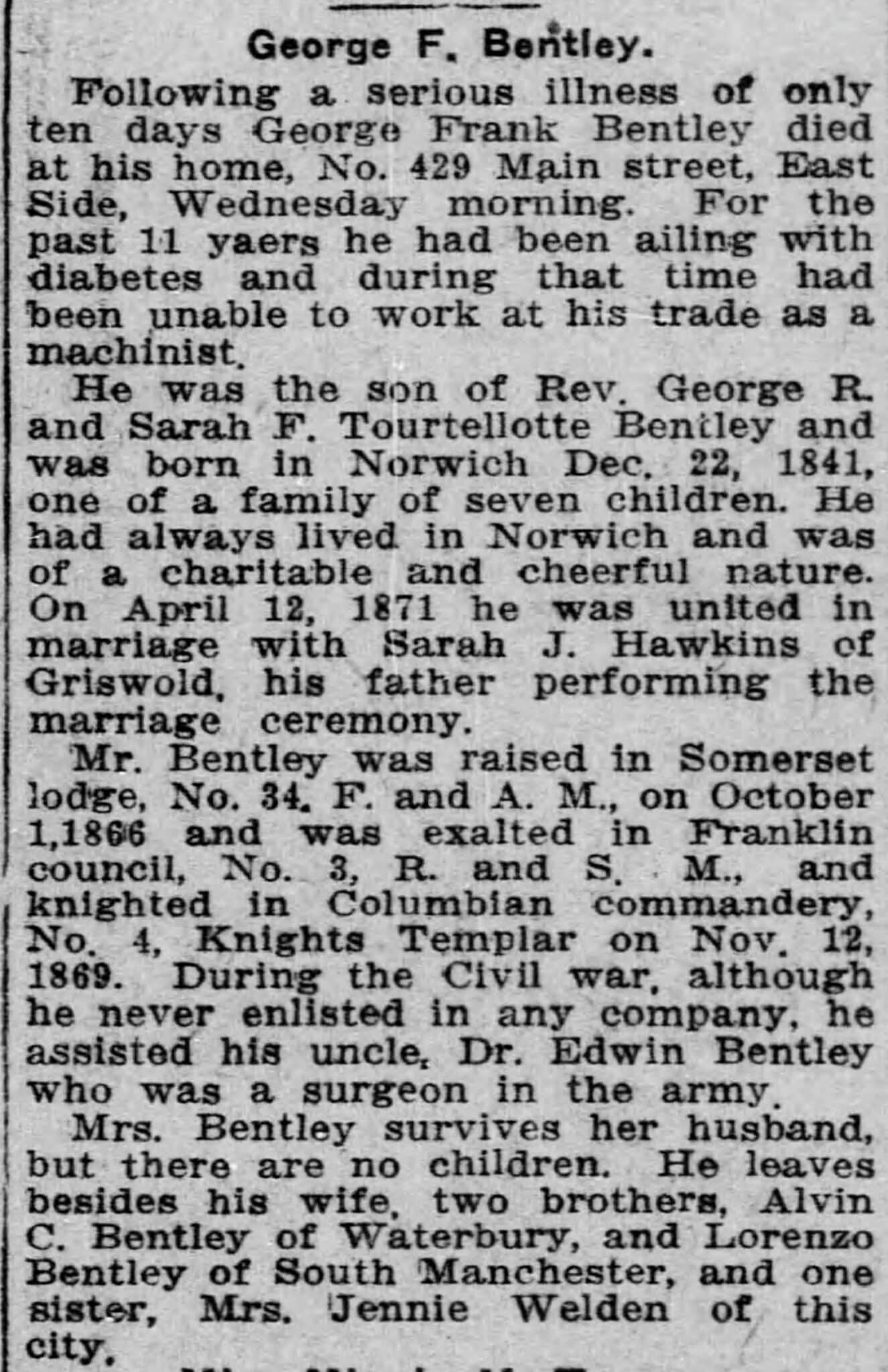
The first child and first son of George Rix Bentley and Sarah Tourtellotte, George Frank was born in 1841 into this prominent family with deep roots in the region. His great-grandfather, Ezekiel Bentley, served in the Continental Army for Rhode Island. After the Revolution, one could find many physicians and clergymen in the branches of George’s family tree, including his own father Reverend George Rix.
The Civil War brutally altered the Bentleys. A year prior to George’s enlistment, first cousin Adam Bentley (26th Connecticut Infantry) died from fever at Louisiana’s Camp Parapet in March 1863.[2] His father’s brother Edwin Bentley, an innovative and renowned surgeon who performed the first successful blood transfusion of the war, was likely an inspiration to George as he considered joining the cause. Adam’s death occurred just as Edwin took command of several hospitals in Alexandria, Virginia.
The 1914 obituary noted that George “assisted his uncle, Dr. Edwin Bentley, who was a surgeon in the army.” Assistance is a comforting word. It gives us the idea that George decided to move down to Alexandria, where Uncle Edwin now served as its Superintendent of U.S. Military Hospitals, and asked to help. It does not consider that George had no prior training in this field, working only as clerk in his youth, and that this adventure couldn’t have been born from the musings of a bored youngster. The tragic death of his cousin, coupled with the reality facing his surgeon-uncle, was not lost on 22-year-old George.
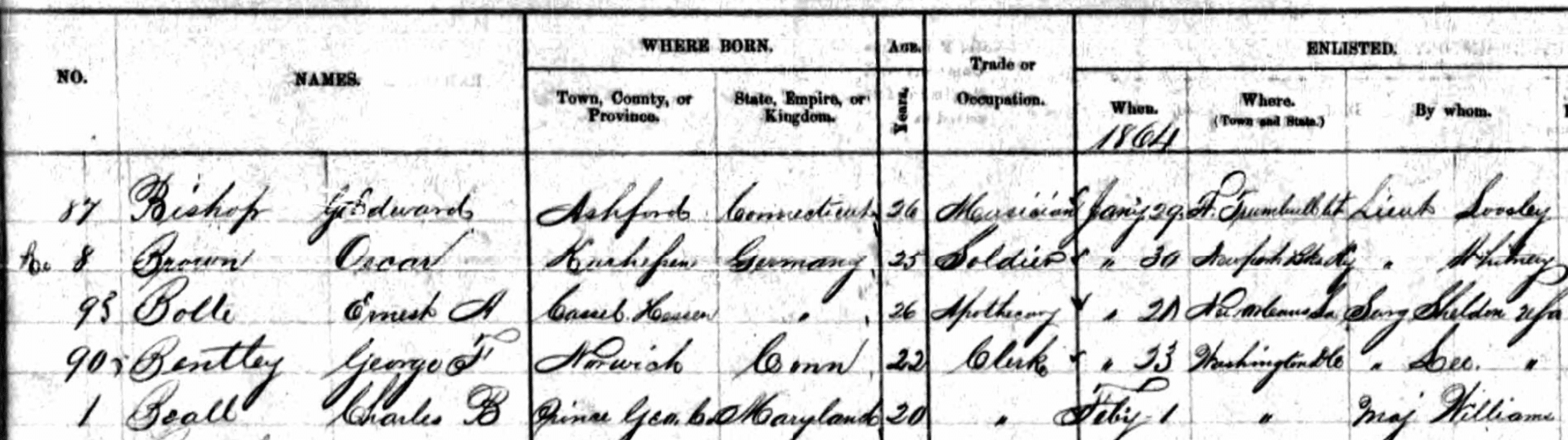
On January 23, 1864, George is listed in the U.S. Army Register of Enlistments.[3] The fact that the obituary ommitted that George actually did enlist with the U.S. Regular Army as a hospital steward is rather odd. Did this newspaper not qualify enlistment if it was not attached to a combat regiment? Or was his service not commendable enough? Even if it was a simple mistake, it should be interpreted more like an unfortunate error.
Arriving in Washington, D.C., George needed to request to serve by Uncle Edwin’s side. The Department of Washington was massive, consisting of at least 80 hospitals, dozens of forts, and several military prisons just within the Capital Region.* Due to Edwin’s status and remarkable reputation, he finished out the final part of the war in Alexandria. It is unknown at this time which hospitals George was stationed, but it is highly likely that he “floated” among Alexandria’s 30 hospitals and five prisons with Superintendent Bentley as one of his assistant surgeons.
After his October 1865 discharge, George married Sarah Hawkins in 1871. He remained in New London County like many of the Bentley Connecticut clan. What makes this obituary additionally strange is that Uncle Edwin was still alive. Dr. Bentley retired from the U.S. Army in 1888, but remained a prominent medical figure, university founder, and socialite until his 1917 death in Arkansas. A familial contribution to the obituary or the addition of an inquiry into Edwin’s Civil War career could have provided George’s postmortem clipping with much needed facts and context.
The choice, or ignorance, to leave out the true nature of George’s military service may seem benign or arbitrary. But for George and countless others whose sacrifices were not properly recorded for posterity, it can be quite personal. The moral of the story: don’t take every historical document at face value and go the extra mile to corroborate its contents – you never know what else you will find.
Madeline Feierstein is an Alexandria, VA historian and founder of the history education company Rooted in Place, LLC. Madeline is the Education Department Manager for Emerging Civil War and has written for Emerging Revolutionary War, Civil War Monitor, and the National Museum of Civil War Medicine. She specializes in the history of hospitals, prisons, and wartime America. She is the author of Occupied Alexandria: How the Civil War Transformed a Southern City (2026). Madeline holds a Bachelor of Science in Criminology from George Mason University and a Master’s in American History from Southern New Hampshire University. Explore her research, schedule a meeting, and book a guided tour at www.madelinefeierstein.com.
[1] “George Frank Bentley,” Norwich Bulletin (Norwich, Connecticut), 23 Apr 1914. Accessed from Newspapers.com
[2] “Adam C. Bentley,” Registers of Deaths of Volunteers, Compiled 1861-1865 in Box 1 of Records of the Adjutant General’s Office, 1780’s-1917. NAID: 656639. 18 March 1863. National Archives, Washington, D.C. Accessed from Ancestry.
[3] “George F. Bentley,” Register of Enlistments in the U.S. Army 1798-1914 in Records of the Adjutant General’s Office, 1780’s-1917. NAID 575272. National Archives, Washington, D.C. Accessed from Ancestry.
* The Department of Washington comprised mainly of District of Columbia, parts of Northern Virginia, and elements of what is now Montgomery and Prince George’s County (MD). As it evolved, it stretched as far as the prison at Point Lookout.


