The Last Stand of Lieutenant George W. Van Pelt
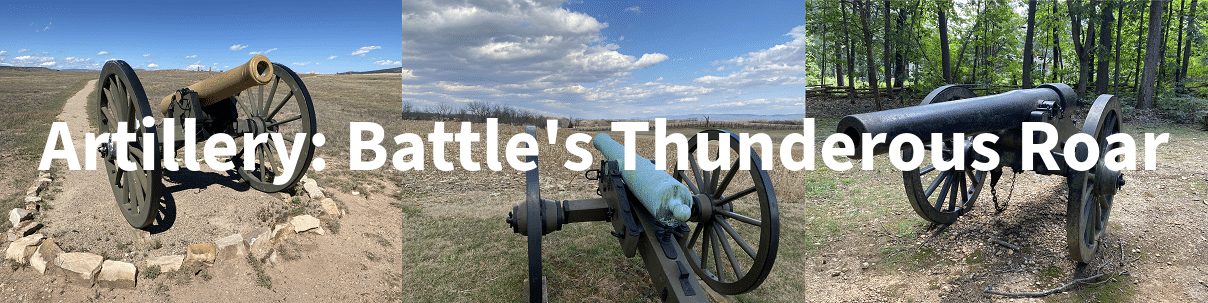
In the memory of the battle of Chickamauga, it is often the grand dramatics of September 20, 1863 that loom largest. This is certainly understandable, as James Longstreet’s devastating assault on the Union center and George H. Thomas’s stalwart defense of Kelly Field and Horseshoe Ridge earn a place as among the most climatic moments of not just the battle, but the war. Nevertheless, the previous day, September 19, also witnessed brutal combat between the two armies. It became the scene of much fierce contestation, including the life-and-death struggle of Lt. George W. Van Pelt and Battery A, 1st Michigan Light Artillery.
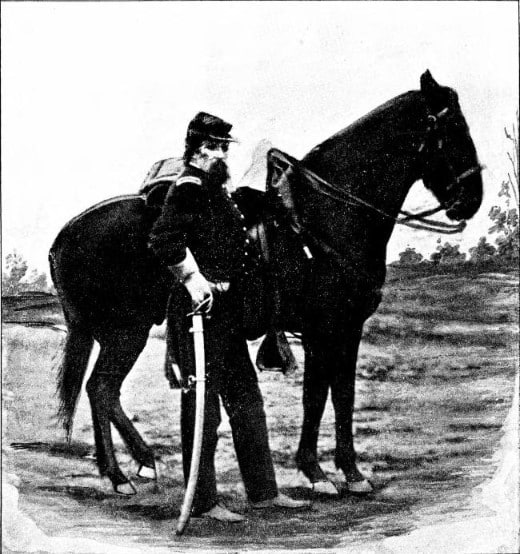
Two years in the fierce furnaces of war had prepared Van Pelt and his battery for this moment. Enlisting into the battery on March 31, 1861 in Detroit, Michigan, the 25-year old gained the rank of sergeant major when the unit mustered in for three years of service.[1] Captain Cyrus O. Loomis, who originally commanded the six-gun battery, capably led them during the battles of Middle Fork Bridge and Rich Mountain in the 1861 West Virginia campaign. By the end of the year, the unit had earned distinction for their marksmanship. This led to their transfer to Maj. Gen. Don Carlos Buell’s Army of the Ohio in Louisville, Kentucky, with Van Pelt rising to the rank of junior lieutenant.[2]
They took part in the capture of Bowling Green, Kentucky; Nashville, Tennessee; and Huntsville, Alabama, but their superb reputation shone once more by their involvement in the battle of Perryville. For his conduct, Loomis rose to command all the division’s artillery, leaving Van Pelt in command of Battery A. Commissioned junior first lieutenant on November 24, 1862, Van Pelt gained the chance to prove his mettle for command in the battle of Stones River.[3]
Originally brought into action to relieve the immense pressure on Maj. Gen. Lovell H. Rousseau’s division, he and the battery were later shifted to join two other batteries and Brig. Gen. John M. Palmer’s division in repulsing a Confederate assault. Their fire proved so intense that when they commenced firing at point-blank range, the Confederate attack dissolved.[4] In his report after the battle, Rousseau noted that concerning the conduct of Battery A, “I cannot say too much” and “without them we could not have held our position in the center.” He also specifically recommended Van Pelt for promotion.[5] This came in April, 1863, with him rising to senior first lieutenant.[6]
Van Pelt and his battery continued to burnish their stellar reputation within the Army of the Cumberland, once again earning plaudits from their superiors for their conduct during the Tullahoma campaign.[7] The lieutenant found another joy for himself as the Army of the Cumberland began the march that ultimately led to Chickamauga. His wife Mary had followed the battery since its departure from Detroit in 1861. Circumstances of war, however, often dictated that she had to be in the rear, serving in the hospitals of Nashville and Murfreesboro. When the army began to march once more, she reunited with her husband and the battery, who appreciated her as a caretaker.[8]
While moving through Lookout Valley on September 14, the Van Pelts came under the notice of the highest echelons of army command. Major General George H. Thomas observed the couple as he rode with his staff. Inquiring who they were, his provost marshal, Col. John Gibson Parkhurst, informed him who they were and their tradition of travelling together. Although impressed by their devotion, Thomas nevertheless ordered Parkhurst to send Mary to the rear, which she reluctantly obeyed.[9] Five days later, her husband entered into a fight for his life.
When the fighting at Chickamauga began on September 18, Van Pelt and Battery A hurried to the scene of combat. They arrived after the fighting for that day concluded, but fully expected a fierce struggle the next day. One of Van Pelt’s peers asked for his thoughts on the eve of battle. The lieutenant reportedly replied, “We shall beat them. Men fighting in a cause like ours must conquer in the end.”[10]

As the preparations for battle began on September 19, Battery A attached to the brigade of Col. Benjamin F. Scribner. Initially positioned at the center of the division, the battery repositioned four times before it finally opened fire on the Confederates.[11] They had been brought forward to pour fire on Georgians fleeing across Winfrey’s field, but arrived too late to inflict any damage. For the moment, Scribner’s brigade and Van Pelt’s battery were triumphant in their portion of the battlefield, but the Confederates were preparing a counter-attack.[12]
With the brigade and battery stationed on the northern edge of Winfrey’s field, they watched as two Confederate brigades advanced on their position. Battery A opened fire and threw sixty-four rounds towards the Rebels, but for once the battery’s accuracy faltered. They fired over the heads of the Confederates, who determinedly continued their advance even in the face of stern Union resistance.[13]
As the two Confederate brigades drew closer, what had been hidden by the dense forest soon became apparent, namely that one had come up on the flank of Scribner’s brigade. The threatened regiments, the 10th Wisconsin Infantry and 38th Indiana Infantry, broke and fled under the pressure.[14] Scribner conceded in his post-battle report, the attack “broke my lines” and “rendered it impossible to withdraw in order”.[15] His other two regiments, the 2nd and 33rd Ohio Infantry, were consumed by the Rebel assault.[16]
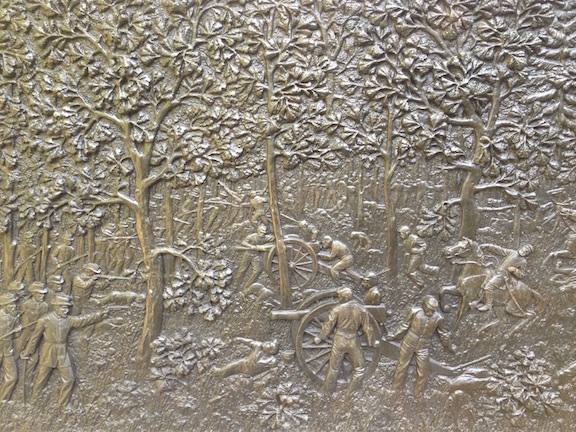
The flight of Scribner’s brigade left Van Pelt and Battery A with no support. As the 8th Arkansas Infantry and 1st Louisiana Infantry drew near, they chose not to join their compatriots in flight.[17] The battery’s horses had been shot, leaving them unable to remove the guns. Van Pelt, who was described by one compatriot as “lov[ing] his pieces with the same unselfish devotion which he manifested for his wife,” could not fathom abandoning them. Instead, he drew his sword and prepared to defend them. Reportedly, his last words were, “Scoundrels, dare not to touch these guns!” before being fatally run through by a bayonet.[18] Joining him in death were five other gunners, while nineteen others were wounded or captured alongside five of the battery’s six guns.[19]
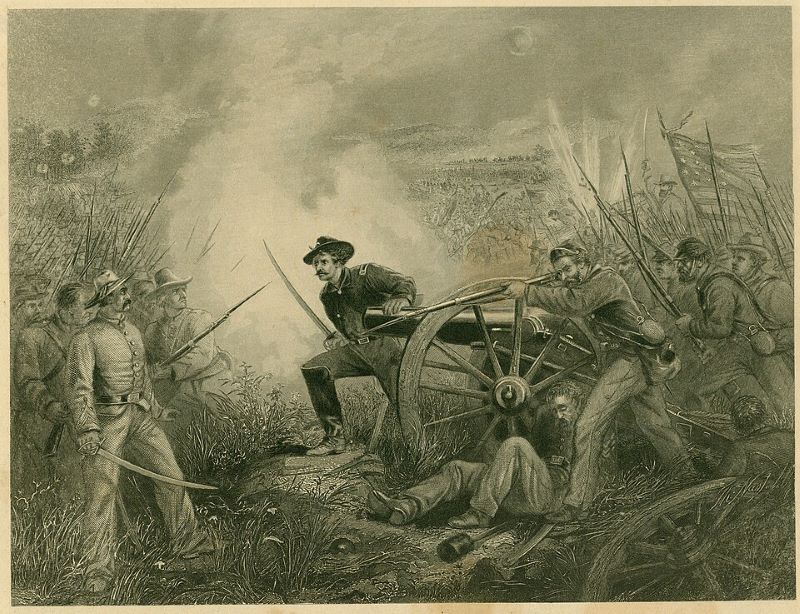
The death of Van Pelt closed the battery’s involvement in the battle. His cannons, however, remained the object of fierce contesting. Four were recaptured by Union forces over the course of the day, but a night assault by the Confederates retrieved three of those pieces.[20] After the close of the battle, Van Pelt and his slain artillerists were thrown into “a shallow, water-washed gully near where he fell.”[21]
Even in death, however, the legacy of Van Pelt and his battery lived on. After the battery, rumors circulated that he had merely been captured, not killed, due to a report sent from the Army of the Cumberland to the newspapers of the Union. From Vermont to Iowa, rumors spread of how “Capt. Van Pelt, commanding the battery, was taken prisoner.”[22] Even his devoted wife Mary did not know his true fate until a month after the battle.[23]
Once his fate became apparent, his superior officers lamented his loss. Colonel James Barnett, the Army of the Cumberland’s chief of artillery, noted in his post-battle report, “Lieutenant Van Pelt, commanding First Michigan Battery, well known and appreciated in this army, fell like a hero at his post.” Captain George A. Kensel, who commanded the division artillery that included Van Pelt, recorded “that everything was done by them which bravery and a devotion to the cause could accomplish.”[24]
Scribner added that “the service and the country lost heavily when . . . Lieutenant Van Pelt, commanding battery, [was] killed.” Perhaps the most touching and personal ode came from Van Pelt’s second in command, Lt. Almerick W. Wilbur, who said, “His death has left a blank in the army of the Union.”[25]
His soldiers showed their devotion in a different way. When the Union once more gained control of the Chickamauga battlefield, the survivors of Battery A scoured the field in search of the lieutenant’s remains. Once they were found, they were disinterred and brought to a new resting ground in Chattanooga National Cemetery.[26]
As Van Pelt predicted, the Union would indeed “conquer in the end.” Although their time in active service ended with Chickamauga, the remnants of Battery A saw the war to its conclusion. Twenty-two members re-enlisted in January 1864. They continued their service until they returned to Michigan to be mustered out on July 28, 1865.[27]
Their memory, as well as that of their commander, is perpetuated by a monument in Chickamauga & Chattanooga National Military Park. The oration given for the dedication of the Michigan monuments on the battlefield recalls the lasting legacy of Lt. Van Pelt’s last stand, declaring “brave Van Pelt, with the reckless valor which ever distinguished him, fell defending with his sword the guns he loved so well.”[28]
Endnotes:
[1] George H. Turner, Record of Service of Michigan Volunteers in the Civil War, 1861-1865, vol. 42 (Kalamazoo: Ihling Bros & Everhard, 1900), 25
[2] Turner, Record of Service, 1-2, 25
[3] Ibid, 2, 25
[4] Larry J. Daniel, Days of Glory: The Army of the Cumberland, 1861-1865 (Baton Rouge: Louisiana State University Press, 2004), 213-214
[5] U.S. War Department, The War of the Rebellion: A Compilation of the Official Records of the Union and Confederate Armies, Series 1, 53 vols. (Washington D.C.: Government Printing Office, 1887), Series 1, vol. 20, part 1, 380
[6] Turner, Record of Service, 25
[7] U.S. War Department, The War of the Rebellion: A Compilation of the Official Records of the Union and Confederate Armies, Series 1, 53 vols. (Washington D.C.: Government Printing Office, 1889), Series 1, vol. 23, part 1, 434, 437
[8] Charles Eugene Belknap, History of the Michigan Organizations at Chickamauga, Chattanooga and Missionary Ridge, 1863 (Lansing: Robert Smith Printing Co., 1899), 173
[9] Ibid, 173
[10] John W. Barber and Henry Howe, The Loyal West in the Times of the Rebellion (Cincinnati: F. A. Howe, 1865), 410
[11] U.S. War Department, The War of the Rebellion: A Compilation of the Official Records of the Union and Confederate Armies, Series 1, 53 vols. (Washington D.C.: Government Printing Office, 1890), Series 1, vol. 30, part 1, 282, 285
[12] Peter Cozzens, This Terrible Sound: The Battle of Chickamauga (Urbana: University of Illinois Press, 1992), 138-143
[13] Ibid, 143
[14] Ibid, 143-144
[15] U.S. War Department, The War of the Rebellion, Series 1, vol. 30, part 1, 287
[16] Cozzens, This Terrible Sound, 144
[17] Ibid, 144
[18] Barber and Howe, The Loyal West, 411
[19] Cozzens, This Terrible Sound, 144
[20] Ibid, 150, 190, 274
[21] Belknap, History of the Michigan Organizations, 171
[22] The Daily Green Mountain Freeman (Montpelier, VT), Sept. 22, 1863; The Council Bluffs Nonpareil (Council Bluffs, IA), September 26, 1863
[23] Belknap, History of the Michigan Organizations, 173
[24] U.S. War Department, The War of the Rebellion, Series 1, vol. 30, part 1, 236, 282
[25] Ibid, 282, 288
[26] Belknap, History of the Michigan Organizations, 171
[27] Turner, Record of Service, 3
[28] Belknap, History of the Michigan Organizations, 237


I enjoyed this article. Very good writing.
Very good article about a brave man. I wish that he had received the Medal of Honor!
Very good article!
Excellent and moving writing, thanks