Book Review: Three Speeches that Saved the Union: Clay, Calhoun, Webster, and the Crisis of 1850

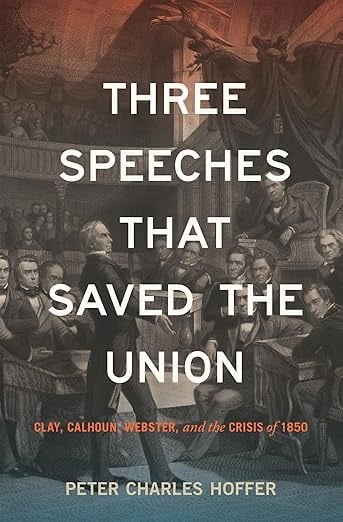 Three Speeches that Saved the Union: Clay, Calhoun, Webster, and the Crisis of 1850. By Peter Charles Hoffer. New York: New York University Press, 2025. Hardcover, 237 pp. $32.00.
Reviewed by Codie Eash
In the growing historiography on the American Civil War’s causes, scholars have divided studies into several chronological camps. Many have taken on the short-term buildup to the conflict following the likes of John Brown’s raid, the 1860 presidential election, and the Secession Winter. A growing throng has begun taking a longer-term view of the war’s origins, surveying the Antebellum era through a broader lens dating back several decades earlier.
David M. Potter’s Pulitzer Prize-winning The Impending Crisis, 1848-1860 (New York: Harper & Row, 1977), has long stood as an essential volume, and, especially in the 21st century, standalone books on events in 1850 have received more treatment. More than two decades ago, John C. Waugh featured United States senators Henry Clay, John C. Calhoun, and Daniel Webster in portraits on the cover of his widely respected On the Brink of Civil War (Wilmington, DE: Scholarly Resources, 2003). And in its subtitle, Fergus M. Bordewich’s more recent America’s Great Debate (New York: Simon & Schuster, 2012) has viewed Clay’s and Stephen Douglas’s legislation as the Compromise that Preserved the Union.
Now, adding to these and other titles—and a host of biographies and collected works on his three principal actors—Peter Charles Hoffer has presented Three Speeches that Saved the Union: Clay, Calhoun, Webster, and the Crisis of 1850, a thorough analysis of what the University of Georgia professor deemed the most consequential speeches ever delivered on the floor of the U.S. Senate. At the heart of Hoffer’s assessment is not the traditional narrative, customary of many academic analyses of historical rhetoric, especially known to students of the Civil War in the context of Abraham Lincoln’s many celebrated orations. Instead, Hoffer reproduced the entirety of a trio of Clay’s, Calhoun’s, and Webster’s iconic senatorial addresses.
Respectively delivered on February 5-6, March 4, and March 7, 1850 and reproduced in the pages of major period newspapers and the appendix of the Congressional Globe, the orations came as the Senate debated an omnibus bill, the future of slavery’s expansion, and the admission of new states to the Union amid national debates following the Mexican-American War.
“Surely, it was a time when politicians’ words counted for something,” wrote Hoffer, “and nowhere more so than in the great deliberative body,” where “the speakers’ efforts on this occasion were Herculean” (1, 4). Each “is an excellent example of mid-nineteenth-century political oratory, perhaps exceeded only by Lincoln’s two inaugurals and his Gettysburg Address,” Hoffer boldly argued (5). Presented here for the first time collectively, edited and with extensive annotations, Hoffer insisted that previous authors on the subject utilized the texts but “did not take the three speeches as seriously as they should” (9).
Organized by order of delivery, Hoffer subdivided the speeches, offering contextual analysis after each paragraph (or, in many cases, after every few paragraphs) featuring additional sources and noteworthy details. Dozens of footnotes, helpfully presented at the bottom of each page, incorporate supporting evidence—nearly all published, as opposed to archival accounts or manuscripts—from primary sources including period press articles, congressional proceedings, and correspondence, and secondary sources including biographies, studies of the eras in question, and annotated collected writings. Notably, for most audiences, this is a work likely best appreciated by those utilizing it for research purposes, as opposed to pleasure reading or those seeking a more traditional historical narrative.
The speeches themselves hit all the major topics of the era, especially including slavery, for, Hoffer noted, “No matter the starting point of the speech, slavery found its way to the center” (217). In both the speakers’ texts and Hoffer’s annotations, a greatest-hits list of other subjects weaves its way in, too: abolitionism, antiquity, the California Gold Rush, colonization, constitutional law, emancipation, free labor doctrine, geography, journalism, indigenous peoples, nature and climate, pending fear of secession and civil war, political theory, political violence, race relations, religion, sectionalism, states’ rights, unionism, and Western expansion, among others. Likewise, Hoffer provided ample biographical background for each speaker, describing Clay’s, Calhoun’s, and Webster’s lives, careers, and speaking styles.
“Physically daunting, emotionally draining, intellectually demanding, with the Senate and the nation hanging on their every word, their speeches were epic performances…,” Hoffer concluded. “Words had saved the Union from internecine warfare in 1850, but incautious words could also be a provocation to violent acts” (219, 221). Soon thereafter, he projected, “the inflammatory potential of senatorial oratory” turned these compromises into crises, and to the next generation of congressmen beyond Clay, Calhoun, and Webster “would pass the final question of the survival of the Union” (220, 221).
Hoffer’s analysis is crisp, fine, and thorough, shedding new light on impactful speeches delivered at a crossroads in American history when civil war may have been—and for a brief moment, thanks in large part to this volume’s chief historical actors, was—averted.
Codie Eash serves as Director of Education and Interpretation at Seminary Ridge Museum and Education Center in Gettysburg, Pennsylvania, where he has been part of the staff since 2012. Having earned his undergraduate degree in Communication/Journalism at Shippensburg University of Pennsylvania in 2014, as of 2024 he is pursuing a Master’s in American History at Gettysburg College through The Gilder Lehrman Institute of American History.


I think of these speeches as being given at a time when the Senate was a deliberative body, not a theatre for performative orations.