A Brother’s Death, A Poet’s Muse: The Oates Brothers at Gettysburg
ECW welcome back guest author Lisa G. Samia.
The poem My Brother Jacob describes two brothers who joined the Confederacy at the onset of the Civil War and fought at the battle of Gettysburg. The poem follows the journey of Caleb and his younger brother, Jacob. They fought battle after battle together and somehow survived until their shared journey ended for one of them after Pickett’s charge on July 3, 1863. One brother lived, and the other died.
The inspiration for the poem comes from Col. William C. Oates and his younger brother, Lt. John A. Oates, both of the 15th Alabama. Both brothers fought at Gettysburg’s Little Round Top on July 2, 1863. One brother lived, and the other died. John died a few days later in a Union field hospital from mortal wounds sustained in the battle and was buried on the farm of Michael Fissel, about four to five miles south of Gettysburg.
Colonel Oates, the surviving brother, led a prosperous life both before and after the Civil War. Before the war, both William and his younger brother John became lawyers in Alabama. In 1861, William joined the Confederate Army as a captain, eventually rising to command the 15th Alabama Infantry in numerous battles before Gettysburg in 1863.
Throughout the remainder of his life, William lamented the loss of his brother John, whom he left mortally wounded in the aftermath of the failed attack on Little Round Top on July 2, 1863. William’s grief at the loss of his brother John remains haunting even today.
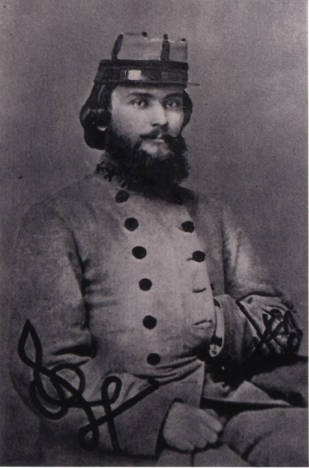
In a letter dated December 24, 1900, William wrote to his son, William Jr., about his ongoing grief. John was sick at the time of the battle at Little Round Top, and William urged his brother not to join the attack. John insisted on going into battle even though he had a premonition it would cost him his life. “These were the last words he ever spoke to me, and every 24th of December [John’s birthday] and every 2nd day of July [the date of his mortal wounding], these brave words recur to us, and I feel sad over his fate.”[1]
After many years of trying to locate the remains of his brother John, on March 3, 1909, William received a letter from Rufus B. Weaver, a Gettysburg native and practicing physician whose specialty was human anatomy. In 1871, the Hollywood Memorial Association of Virginia contacted Weaver to identify and retrieve the remains of Confederate dead from Gettysburg. In a letter to William, Weaver stated, “The remains of Lt. J.A. Oats [sic], together with the remains of eleven others (8 unknown), were shipped in a box labeled ‘A’ because his grave could not be identified separately from the others.”[2]
According to Hollywood Cemetery, “the location of Box A, like the rest, is unknown. There are no records … that depict the exact location of any of the boxes.”[3]
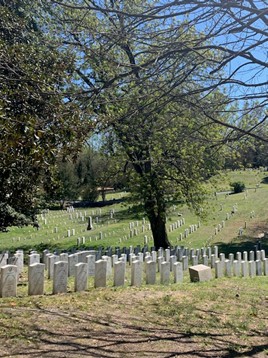
Photo by Lisa Samia.
William passed away on September 9, 1910, still regretting the loss of his younger brother and his unsuccessful quest to find him. It leads us to wonder then about all those unknown brothers who, to this day, remain nameless and faceless in our Civil War cemeteries.
My Brother Jacob
I will tell you a story right here and now
Of my brother Jacob, I do avow
You see, it was the spring of sixty-one
When we first knew secession had rung
And my younger brother Jacob, you see
Sprang to enlist to defend Virginny if ever be
I will never forget his fervor and such
That asked me to join him, it was too much
For you see it was me and him and my ma at home
My pa up and died, it was just us alone
My poor ma she took me aside
And told me with all of her pride
See here Caleb as the oldest of my sons
I don’t want you to go either, God’s will, Thy will be done
But go you must, but for the reason I give
Watch out for your brother, help him live
For ‘tis you we have always relied
And this too I’m afraid we must abide
Not to worry about me my son, she said with a smile
I’ll be waiting for you both, I’ll be here a while
And so you must go you must defend
Our little farm here to the very end
With that said, Jacob and I took our leave
The last sight of my ma caused me to grieve
And in battles that we stayed true
Manassas, Antietam, Fredericksburg to name a few
Jacob and I, well we stayed together every time
Shoulder to shoulder it would us find
And after two years’ time in the battles that bled
Comrades killed so much bloodshed
That Jacob and I did survive you see
But it was Gettysburg that would consume me
It was day three on this impossibly hot day
I was with Jacob in the tree line with all of Virginny, I say
Waiting for our commander General Pickett to order us men
Into the battle and out into the glen
To march in the open field about a mile or so they say
To face the Union artillery along the way
I turned to Jacob as we waited to go
And told him stay close, brother for I know
This day’s battle I believe will bring much sorrow I fear
For all of us men and our loved ones’ tears
Jacob smiled at me with his usual grin
Said Come on brother, we will win
Then the silence was sliced with the battle din and roar
As General Pickett did state it was for
“Remember men you are from Old Virginia,” I heard him say
And so the drums of battle ordered us on our way
Not a sound from the ranks was heard
Only the beating drums that was stirred
And so we marched Jacob right by my side
I wanted to grab him to run and to hide
For in that moment great explosions were all around
The Union cannon was the most deafening sound
And great groans and cries from the men
As one by one they disappeared from the glen
And yet we kept marching, kept going you see
To the copse of trees where the Union they be
Then it seemed all my life stopped in this place
A great blast near me hot to my face
I must tell you I do not remember what happened then
I woke up and lay there, for what or how long, or when
And realized as I raised my head, the battle was over
Oh, so many dead in fields of sweet clover
I carefully inspected myself to be sure I was all right
Only knocked out in this horrific fight
I rose to my feet and panic struck my heart
Where was Jacob, I could not part
It was then I spied him very near a group of the dead
I went to roust him and to move away from the hotbed
I knelt beside him knocked out like me
I cried Jacob, come on, follow me!
Wake up, wake up, it’s time to go!
We will fight another battle, this I do know
I don’t know how long I tried to revive my brother on that field
Only when the ambulance came and told me to yield
My brother’s body to be buried post haste
No time to mourn, no time to waste
My blood froze even through the blazing heat
My brother’s body at my feet
There would be no going home, not for him
I cried and cried in the haze and the din
And thought of my ma and the promise I could not keep
I tried ma to keep him safe, I said, and did weep
But God Almighty had other plans for him; this we prayed not to see
For your sweet boy Jacob, ma… he was not meant to be[4]
Bio:
Lisa G. Samia is an award-winning poet and author. She was selected as the National Parks Artist in Residence for Stones River, Murfreesboro, Tennessee, in 2025, and the National Parks Service Artist in Residence for Manassas National Battlefield Park in 2021, and the National Park Service Artist in Residence for Gettysburg National Battlefield Park in 2020, all for poetry.
Endnotes:
[1] William C. Oates to William C. Oates Jr., 24 December 1900, William C. Oates family papers, LPR234 (Box 4, Folder 2), Alabama Department of Archives and History (Q326765 – Q326768).
[2] Rufus Weaver to William C. Oates, 3 March 1909, William C. Oates family papers, LPR234 (Box 1, Folder 10), Alabama Department of Archives and History (Q326762 – Q326764).
[3] Correspondence with Cheryl Synder, for Hollywood Cemetery.
[4] Lisa G. Samia, “My Brother Jacob”, The Nameless and the Faceless of the Civil War Gettysburg, Manassas & More (Tucson, AZ, Destiny Whispers Publishing, LLC, 2023), 75.


A really enjoyable article by Lisa. A beautiful combination of history and poetry!! It truly makes it personal, which always bring this period of our history to life. Well done.
A beautiful written article, combining history and poetry. Lisa truly captures the very real and personal story during the war. Well done.
This poem captures something that statistics never can, the unbearable weight of a promise broken by war. The fact that William died never knowing exactly where his brother was laid to rest is heartbreaking.
Tertiarally, Colonel Chamberlain, William Oates’ opposite equal at Gettysburg’s Little Round Top, had a brother, Tom, fighting alongside him at the same time, also was at risk of death. Chamberlain ordered his brother to fill a gap in the front line during a pivotal moment of that close fought battle where his men shot almost every cartridge they were carrying. Straying further from the emphasis of this excellent article, two Union brothers at Gettysburg with one being cleaved from life occurred during the 1st Minnesota’s famous charge. Private Isaac Taylor KIA 7/2/63. The next day, after he helped fend off Pickett’s charge, brother Patrick Henry Taylor wrote that he had accounted for the loss of his brother.
The detail about John’s premonition and his insistence on fighting despite being sick adds such tragic weight to this story. Beautiful work bringing their story to life.
The structure of this poem makes the horror of what’s being described even more devastating. You’ve captured not just a battle, but the specific moment a promise dies. Wonderful writing!
Another fine writing and poem Lisa! The emotion has gotten to me too much I can’t even write anymore. Your talent amazes me.