Book Review: Haunted by the Civil War: Cultural Testimony in the Nineteenth-Century United States

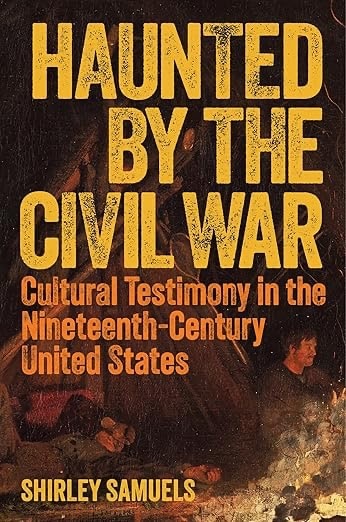 Haunted by the Civil War: Cultural Testimony in the Nineteenth-Century United States. By Shirley Samuels. Princeton: Princeton University Press, 2025. Hardcover, 232 pp. $32.00.
Reviewed by Robin Friedman
Does the Civil War haunt America? If so, why? Shirley Samuels, the Thomas and Dorothy Litwin Professor of American Studies at Cornell University, poses and explores these questions in her erudite, provocative book, Haunted by the Civil War.
Samuels expands upon her questions in the book’s Introduction, where she writes: “why does a series of often inchoate battles fought more than 160 years ago continue to be debated as though the victory or loss contained something like the soul of the country?” (1) Part of Samuels’ answer involves the unprecedented scale of death resulting from the war. But she also explores the tension between the war and why it was fought and the character of the developing American democracy. She sees, properly, the Civil War as having an expansive scope closely tied to Reconstruction, westward expansion, both before and after the conflict, the genocide, in Samuels’ terms, perpetuated on the Indian tribes, and the changing roles of women and the rise of feminism. These and other issues often run together in the book.
The content of the book also is broad ranging. Samuels discusses early expansionist policies in the United States, including the Creek Wars, the Mexican American War, the various attempted compromises over slavery, the events in “bleeding” Kansas, and other events leading to the war. She also discusses the Dakota War of 1862 and the largest mass execution in American history. which occurred on December 26, 1862 at Mankato, Minnesota, with the hanging of 39 Sioux Indians for their role in the Dakota Uprising.
The book consists of a lengthy Introduction, five chapters, an afterword and extensive substantive endnotes with references to many secondary literary and historical sources. The book is a cultural history and examines responses to the Civil War in the literature and art of the Nineteenth Century. It examines familiar sources and figures, including Abraham Lincoln, Frederick Douglass, Walt Whitman, Herman Melville, Emily Dickinson, and Mark Twain as well as writers many readers will find less familiar.
The book considers novels, speeches, articles, and poetry. It also considers art and photography, with long reflections on the latter art and on the unique ways it focused attention on the Civil War. The book includes 18 historically-themed illustrations, many of which receive extended commentary and are among the most fascinating parts of the study. For example, in her Introduction, Samuels shows a photograph of a set of grim iron “Manacles” recovered after the fall of Richmond (21) and returns to comment on their significance throughout the book.
Samuels sets out her project at length in the book’s Introduction and in a section near the end of the study titled “Final Thoughts” (146-150). The first chapter of the book, “Visions of Democracy,” discusses Whitman’s poetry, but its focus is on historical sources and about how tensions over slavery, race, and land ownership challenged the development of democratic ideals and continue to do so.
The second chapter, “Poetry and War” discusses poems by Whitman, Dickinson, and Melville, including Melville’s short poem “Shiloh” from his collection of poetry “Battle-Pieces and Aspects of the War” (1866) with its emphasis on the death and suffering caused by battle. “What like a bullet can undeceive?” (56), Melville asks in “Shiloh.” The chapter also includes lengthy meditations on Lincoln based upon Lincoln’s own writing and on Whitman’s poetry including his elegy on the death of Lincoln, “When Lilacs Last at the Dooryard Bloom’d.”
The third chapter, “Democratic Mourning,” is the first of two chapters devoted to women’s writing and to what Samuels calls “the haunted aftereffects of war.” (9) The chapter discusses familiar works by Louisa May Alcott and Harriet Beecher Stowe, but the focus is on a novel by Elizabeth Stewart Phelps, “The Gates Ajar” (1868), a story about loss, grievance, and religious faith following the events of Bleeding Kansas.
Chapter four, “The Republic of Men at Sea,” focuses on the Mississippi River and its role in the Civil War, following its flow from North to South. Samuels discusses the portrayal of the river and its history in two works: Mark Twain’s memoir “Life on the Mississippi” (1883) and Herman Melville’s novel “The Confidence Man” (1857). Samuels contrasts the lives of slavery and economic huckstering with the life of free people, leaving land behind to navigate the waters of the Mississippi.
The book’s final chapter, “Women at Home.” returns to literature written by women emphasizing the rise of feminism and changing concepts of domestic life. Samuels works to relate the rise of feminism to reflections on the casualties of war. The authors considered include Charlotte Perkins, Harriet Jacobs, Lucy Larcom, and Frances Harper. Among the works considered is Larcom’s short poem “Weaving” (1862), which beautifully ties in the work of a young woman in a New England textile mill with reflections upon the work of enslaved women in the southern states harvesting the cotton for the mills.
“Haunted by the Civil War” is an ambitious study which is itself haunted by the cultural history it recounts. The writing style of the book is often dense, and the book will probably be of most interest to an academic audience. Still the book succeeds in its aim of showing how American life and culture, in the Nineteenth Century and beyond, remain “haunted” by the ghosts of the Civil War and by the tension between democracy and slavery.
Robin Friedman retired from a career as an attorney with the United States Department of the Interior in 2010. In retirement, he pursues his passion for American studies, including literature, history, philosophy, and the Civil War.


It’s a worthy topic for a book, and the individual questions are worthy, because yes, the issues – the great harm done the American Indian (no, not genocide – that word is terribly misunderstood and thus misused in the 20th century), women’s rights, slavery and the rights of newly-minted citizens, the freed slaves – are all important. But the answer to the question, “Why does the Civil War haunt America?” has always been clear and apparent, though it’s not clear that Samuels answered it.
America was a revolution, and a miracle: Democratic self-government by a people, in Republican form. The world had not run this way, and Kings, who fashioned themselves the children of God, hated the idea and tried – they’re still trying – to stamp it out, and maintain their dictatorial rule over ordinary people, kept in the form of peasants, serfs, subjects – pick your term. This is why nearly all the nations of Europe pitted everything they had against Napoleon. The French had overthrown and executed their King, and their new ruler, whether good or bad, was not the son of God. The American Revolution terrified them, but at least it was 3,000 miles away; they did not want freedom, democracy and regicide spreading to Europe. In America, as well, there was a revolution within the revolution.
Brilliantly recognizing that the strength of America rested in the individual states – everyone from George Washington to Ruth Bader Ginsburg has publicly asserted this – the Founding Fathers fashioned a small, weak, limited central government to ONLY administrate affairs that dealt with the collective; kept most of the power in the States’ hands; and that the Chief Executive of said government would be chosen by the Electoral College in order to ensure fair representation to one and all, an invention as important as splitting the atom, for it not only preserves Americans’ rights, but “prevents tyrannical despots with concentrated followings in just small areas from seizing the White House and destroying the country” to quote my high school history teacher, and he was proved right in 2016.
This form of government is near and dear to Americans, and thus the Civil War, which saw one part of the country attempting, through armed resistance, to preserve its Constitutional Rights of Federalism, also called “States’ Rights,” against the armed, extremely violent assault on Federalism, by those wishing to drain all power into the Corrupt Swamp of Washington, D.C. was the most vital event in the 250 year history of America – more important than even the Revolution itself, or the Great Depression or World War II. Thus it is logical that it haunts the nation, not least because the struggle persists, especially in this century, as the attempt to not only destroy Federalism once and for all, but to wipe out the Constitution, is ongoing. Never forget that every single Democrat Party candidate for President since 1992 has insisted that “the states be done away with – no more borders – just one America.” Their view has extended outward as well; encouraging mass illegal immigration from around the world in order to finally do away with these pesky Americans who keep insisting on their Constitutional rights, they also proclaim there should be no borders anywhere.
Haunting indeed.
Thanks for reading and for your comment.
Definitely 5 out of 5 stars
Swiss-American intellectual property prof: Haunted by The Civil War still runs the show. And it is a page turner.
I came to Haunted by the Civil War the way a lot of people in my lane come to nineteenth century literary history: by accident, with my mind still full of patents, licensing language, and the slightly absurd human hope that an idea can be safely bottled and owned.
I am an adjunct professor at Cornell University, lecturing on innovation and intellectual property management. On paper, I am about as far from Professor Shirley Samuels’s subject as you can get without drifting into astrophysics or motorbike repair. And yet this book pulled me in with the quiet force of something both scholarly and alive. Not just readable, but genuinely gripping. Page turner is a phrase that usually belongs to airports and thrillers, not to a richly illustrated study of cultural testimony with the long shadow of a national rupture.
Samuels’s central move is both simple and bracing. She treats the Civil War not as a sealed historical event but as an ongoing presence that keeps speaking through American cultural artifacts. The haunting is not only post war. It is also pre-war. The conflict, in her account, is already haunted by earlier histories of racial violence, dispossession, and exclusion from democracy. In other words, the war does not merely leave scars. It reveals older wounds that were already there, already festering under the language of ideals.
What surprised me, and what made the book feel strangely relevant to someone who lives among innovation frameworks, was how much Samuels is really writing about systems. About how a society stores memory, how it edits itself, and how it uses images and stories to make the unbearable bearable. In my world, we talk about intangible assets, provenance, attribution, chain of title. In her world, the chain of title is the chain of testimony. Who gets to tell the story. Who gets to be seen. What is framed as heroic, what is cropped out, what returns later like a debt with interest.
The Afterword, titled The History of the Present, is where the book’s method becomes impossible to ignore. Samuels reaches forward into contemporary literature and art, and then backward again into the archive, as if time itself were a room with mirrors. She brings in George Saunders’s Lincoln in the Bardo, the vocabulary of reenactment and performance, and a cluster of thinkers who insist that images are not innocent and that spectatorship is a moral position. This is where the book truly becomes an interpretation of a country.
So why did Samuel’s book land so strongly for a Swiss born, former farmer?
Because Switzerland trains you, culturally, to believe in neatness. In procedures, in files, in civic calm. We like our narratives orderly, our neutrality polished, our conflicts politely archived. Our national story leans toward the idea that stability is a virtue that can be planned and engineered. And in many ways, it does. But Samuels’s book nudges a reader like me into an uncomfortable comparison: stability can also be a kind of aesthetic. A way of keeping the surface smooth while the deeper currents are left unexamined.
America, by contrast, carries its contradictions in a louder register. The Civil War is an open scar in the civic imagination, impossible to fully domesticate (a former plant breeder, too, I use this metaphor not lightly). Samuels shows that the scar tissue is cultural. It appears in literature, in theatre, in monuments, in photographs, and in the recurrent national argument over who belongs to the we. Reading her from my Swiss vantage point, I kept thinking: perhaps Switzerland’s ghosts are quieter, but that does not mean they are absent. We simply have different habits of listening.
In short, this is a book that should not have been my kind of reading. It became exactly my kind of reading. It reminded me that the most consequential inheritances are not always legal, and not always acknowledged, but they are always enforced, somewhere, by someone, in the stories we agree to live inside.
Thanks for your thoughtful comment on the book.