From The Regimental Flag: An Introduction
Introduction to a series
If you do any sort of research at all, you understand the simultaneous danger and delight of rabbit holes. I’m about to take you down one I recently stumbled into while doing so research at the Delaware Public Archives in Dover.
I’ve been on the hunt for some information about the 2nd Delaware Infantry at Spotsylvania Court House. During the advance on the Mule Shoe on May 12, 1864, Confederates near the Landrum Farm opened up on the left flank of the advancing Federal formation. The 2nd Delaware was pulled out of formation and detailed to protect that flank for the remainder of the advance. Their commander, Lt. Col. David L. Stricker, was killed in that attack. I went to Dover to track down some sources that will help me flesh out this sliver of the day’s action.
Known as the “Crazy Delawares,” the 2nd Delaware was actually the first group of men from the state to answer the call for volunteers at the outbreak of the war. Initially a three-month regiment, they were designated the 1st Delaware; when their terms expired, most of them immediately reenlisted for three-year terms. However, in the meantime, another regiment’s worth of men had enlisted for three-year terms, and they were given the designation 1st Delaware, consigning the original First to the designation of Second. This became a sore point for the Crazy Delawares for the rest of the war (as we’ll see in the coming weeks).
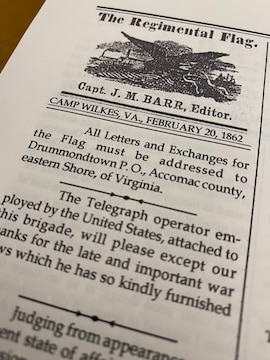
As part of my search for Spotsy info, I came across copies of the regiment’s newspaper, The Regimental Flag. The paper was printed while the 2nd Delaware was stationed at Camp Wilkes near Drummondtown, Virginia, “after taking possession of a rebel printing office in that town,” according to a member of the regiment, Robert G. Smith [1]. Drummondtown was located in Accomac County on Virginia’s eastern shore (that little tip that sticks off the end of Maryland and divides the Chesapeake Bay from the Atlantic Ocean)—an area The Regimental Flag described as an “almost unknown and uninhabited country.”[2]
Captain Joseph M. Barr of Company K, who hailed from Wilmington, Delaware, edited The Regimental Flag. He published eight issues of the paper in the early weeks of 1862, with the last one appearing on March 13, 1862, just before the regiment shipped out to join George McClellan’s Army of the Potomac in its move up the James Peninsula.
Independent scholar Darrell N. Middleton of Georgetown, Delaware, reproduced and compiled copies of The Regimental Flag in his 2005 collection of documents about the regiment, The Second Regiment Delaware Volunteers, and it was this collection I had come to the archive to find. I wasn’t looking for the paper or specifically for items from early 1862, but that’s the rabbit hole I happily fell into. I’m a sucker for old newspapers, and regimental newspapers are particularly fun.
Unfortunate, Middleton’s collection contained only six and a half issues of the paper (issue five was only partially readable and issue one was missing entirely). Those extant issues provided a lot of entertainment, though! Of particular delight was the wonderful sense of humor that comes through in the newspaper. “It is a spicy little sheet,” the Philadelphia Evening Journal said of the paper.[3] I agree!
Over the next few weeks, I’ll share the wealth from my unexpected find. I’ve chosen a number of random snippets from The Regimental Flag to pass along. They will, I hope, give you a small glimpse into soldier life during a relatively peaceful period during the war.
————
[1] Robert G. Smith, A brief account of the services rendered by the Second Regiment Delaware Volunteers in the war of the rebellion (Wilmington, DE: The Historical Society of Delaware, 1909), 4–5.
[2] The Regimental Flag (Vol. 8), March 13, 1862, 2.
[3] The Regimental Flag (Vol. 4), February 6, 1862, 2.


Chris: I’ve never heard of Drummondtown on the Shore and I litigate for clients in Northampton and Accomac. Any idea what current town used that name back then or if the town no longer exists at all?
Accomac became Drummondtown for a while, but then went back to being Accomac in the 1890s. Here’s a good little history: https://www.accomac.org/overview.
Looking forward to the future postings! Regimental newspapers often contain information that can’t be found elsewhere, in addition to a window on wartime humor.
Chris: Nice work. Accessing “embedded” army correspondents’ letters to hometown newspapers has become a customary research practice over the past 10-20 years, but these regimental newspapers have long been an unknown and/or under utilized primary source. Fortunately that appears to be changing.
“Unfortunate, Middleton’s collection contained only six and a half issues of the paper (issue five was only partially readable and issue one was missing entirely).” It appears that a copy of the first issue (Vol. 1, No. 1 – January 16, 1862) of The Regimental Flag may be in Special Collections at the University of Virginia.