Book Review: Soldier of the South: Lieutenant General Richard H. Anderson at War and Peace

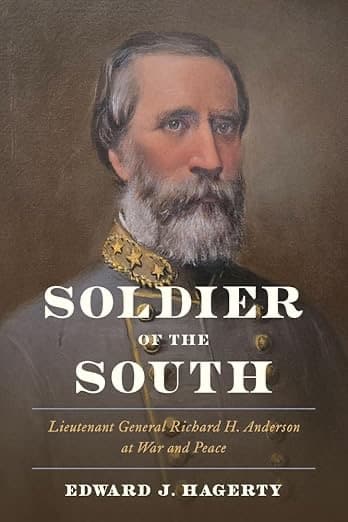
Soldier of the South: Lieutenant General Richard H. Anderson at War and Peace. By Edward J. Hagerty. Columbia: University of South Carolina Press, 2026. Hardback, 438 pp. $36.99
Reviewed by Sean Michael Chick
The list of battles that Richard H. Anderson fought in reads like a catalogue of the war in Virginia. From Williamsburg to Sailor’s Creek, he was in nearly every major engagement. He held high commands for virtually the whole war, commanding a division for almost two years and a corps for nearly a year. Yet, he received only two biographies, a sympathetic treatment by C. Irvine Walker in 1917 and a 1985 book by Joseph Cantey Elliott. Anderson was in need of a contemporary work. Edward J. Hagerty fulfills that need.
There is much in Soldier of the South devoted to Anderson’s family background, upbringing, and the world that created him. Anderson was a product of the elite planter class of South Carolina, with a deep martial tradition. He was descended from the family of William Wallace (yes, the one Mel Gibson played in Braveheart), and his grandfather Richard Anderson fought during the Revolution at Germantown, Camden, and Cowpens. That ancestor was one of the young officers of the war who earned a sterling reputation and were seen as the backbone of the army, along with the likes of Henry Laurens and Benjamin Tallmadge. Along with the Marquis de Lafayette, he was a pallbearer when Johann, Baron de Kalb’s remains were reinterred.
The book is good as a fair account of a commander who is often maligned but did have a talent for defensive warfare, quick marches, and leadership. On page 296 Hagerty gives a brief account of Anderson’s role at Deep Bottom. It was possibly his worst showing as a commander, but he quickly rallied his command after a confusing battle that saw Philip Sheridan’s cavalry rout three infantry brigades. One of his generals, James Connor, had never seen Anderson in battle, but wrote after the defeat “he is a regular trump, cool as an ice box, calm and serene when the enemy are all around us…I never saw anyone less excitable; I was charmed with him.” (296) Hagerty shows that Anderson did well in brigade command, but in division and corps command he was mixed, doing well at Harpers Ferry, Chancellorsville, and Spotsylvania, but less so at Antietam, Cold Harbor, Deep Bottom, and Gravelly Run. The Gettysburg discussion is particularly good. Anderson is taken to task for his tactical choices, but Hagerty points out that A.P. Hill and Robert E. Lee were nearby and also bear responsibility. Neither intervened with an officer who had a reputation as a solid fighter but a man given to indolence. As to Sailor’s Creek, and Second Bull Run, Hagerty offers a good defense of Anderson in each action.
Hagerty does not see Anderson as being devoted to slavery as a cause or to secession. He points to Anderson eagerly embracing peace once the war was over and avoiding politics altogether. Yet, Anderson’s actions do not provide easy answers. In 1850 he supported secession, and his father, William Wallace Anderson, was a fire-eater, if not a major one. Anderson almost fought a duel with Nathaniel Lyon, although that could have been less about Lyon’s comments on slavery and more about honor and Lyon’s poor manners when Anderson was his dinner host. To be fair, Anderson did not view all Northerners as abolitionists and married into a Pennsylvania family. But whereas such marriages nearly always decided if an officer from a different section fought North or South, most famously John C. Pemberton and George Thomas, Anderson chose the South. Yet, Anderson was also rather slow to resign his commission, doing so months after South Carolina left the union. On the question of devotion to the cause, Anderson, at least on this mark, was a very complicated and conflicted man. And while he did leave behind letters, these and other primary sources do not make it clear enough how Anderson thought and felt. All one can say is he was faithful to his cause and homeland, but he would have been unlikely to close ranks with Jubal Early in the war for memory.
Hagerty claims Lee did not want to remove Anderson from corps command, or at least was not eager to in late 1864. This I do not believe. While Anderson was given Fourth Corps, the command was soon reduced to a single division. Lee offered to send Anderson to William J. Hardee as William Tecumseh Sherman was moving on Savannah. Lee did not despise Anderson, but it is clear he had lost faith in him and therefore relieved him after Sailor’s Creek. Anderson promptly left the army and therefore was not at Appomattox, an unusual turn of events considering his nearly uninterrupted service under Lee.
Soldier of the South is an honest account of the man and his times. For instance, the economic and social chaos after Appomattox is well covered, the author being hard both on Southern die hards and Federal mismanagement, in particular the Freedmen’s Bureau. The writing is not lively, but it is clear. In an era of purple prose and histrionics, Soldier of the South offers a humane portrait and a fair command analysis of an officer with one of the war’s longest careers.


Didn’t Anderson have significant economic problems after the war? Is this covered in the book?
He did, and the book goes into that in good detail. It’s a sad story, really, because Anderson refused to leverage his name for political or economic advantage the way some of his colleagues did, and as a result, fell into pretty hard times.
Thank you for your excellent review Sean. I hope you enjoyed exploring the life of “Fighting Dick Anderson!” I did want to elaborate on one point you raised in your review about Lee’s attempts to find a more suitable command position for Anderson after Longstreet retuned in the fall of 1864. Anderson had long since been confirmed as lieutenant general, and the only appropriate field command for an officer of that rank was that of a corps. Lee thus found himself with one too many lieutenant generals in his army, and he created a fourth corps in order to compensate for that. It was initially larger than Early’s Second Corps, but as you say, the infantry component was soon reduced in size to only around 5,000 men when Hoke’s Division was transferred back to Beauregard’s command. This left Lee in an unsatisfactory position–and Anderson in an embarrassing one–of having a lieutenant general in command of corps that was the size of a division. Naturally he sought a more suitable job for Anderson under those circumstances, but other Confederate armies were in similar positions. Hardee would like to have had Anderson’s services, but he too had no suitably sized force for him to command. The real question was not whether Lee wanted to “remove” a valuable lieutenant general from corps command, it was a matter of where to find a position commensurate with his rank. There is no evidence for the former, but all evidence points to the latter.
As a side note, one wonders what might have happened if the army had not been in such disarray during the withdrawal from the Richmond-Petersburg Line. As of April 2, Lee no longer found himself in the position of having a surplus lieutenant general. Perhaps Anderson would have made a competent replacement for A. P. Hill had the army been stabilized and war gone on. Harry Heth was a temporary expedient I think.
Thanks again Sean!
Ed Hagerty
That was basically Pemberton’s problem after Vicksburg: there was no available position commiserate with his rank. He ended up accepting a demotion so he could continue to serve, but I think he felt he had more to prove (as a Yankee) than Anderson did, and so Anderosn might not have been as open to that sort of solution to the rank/command problem.
I have a feeling from what I was able to learn about Anderson’s modesty and sense of duty that he probably would have set aside any personal ambitions for the good of the cause, but I didn’t find any evidence that a demotion was being considered as an option. Lee was one of the primary drivers of the use of the lt. gen. rank for corps commanders in the army rather than using maj. gens. in corps command. He believed that such recognition was warranted. I imagine Lee would not have wanted to set demotion as any kind of precedent in the ANV.
Hi Bill, yes, I did cover Anderson’s post-war career pretty extensively in a final chapter that runs about 33 pages in length. His economic ruin was notable particularly because he did nothing to try to capitalize on his former position as a key Confederate leader. According to his first wife, he was loath to ask favors.