“Only Patriots―or Traitors”: Douglas, Logan, and the Secession Crisis in Southern Illinois
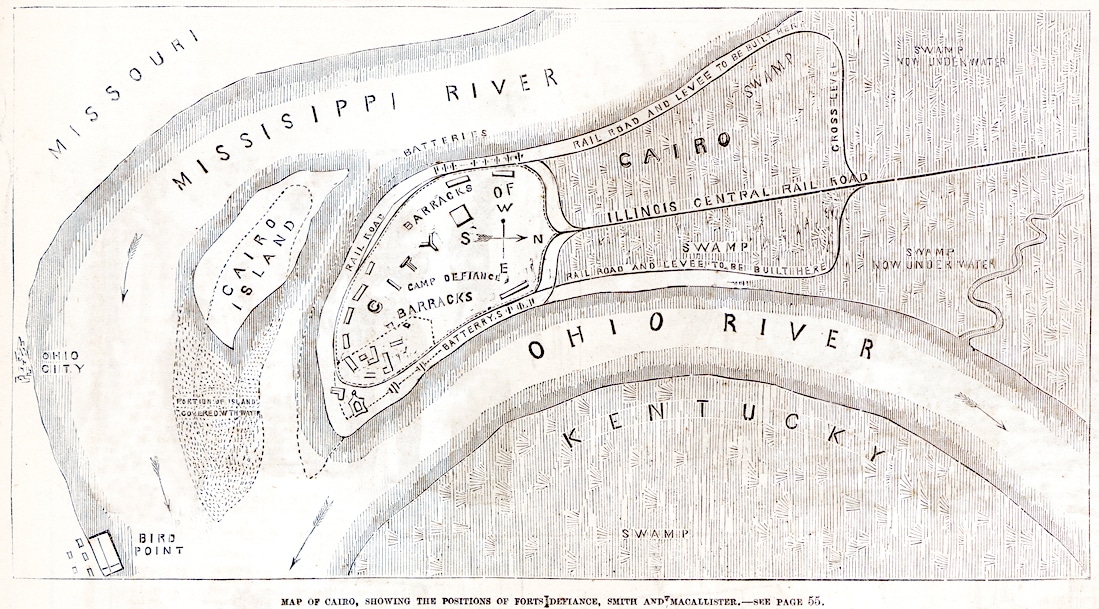
As Secession Winter gave way to spring, the Democratic stronghold of southern Illinois teetered on the brink of open revolt. The strategically vital town of Cairo, at the confluence of two great rivers, lay geographically farther south than Richmond, Virginia. More than anyone else, Stephen A. Douglas and John A. Logan proved instrumental in reversing Southern sympathies in the region and ensuring its men rushed to fight under the Stars and Stripes.
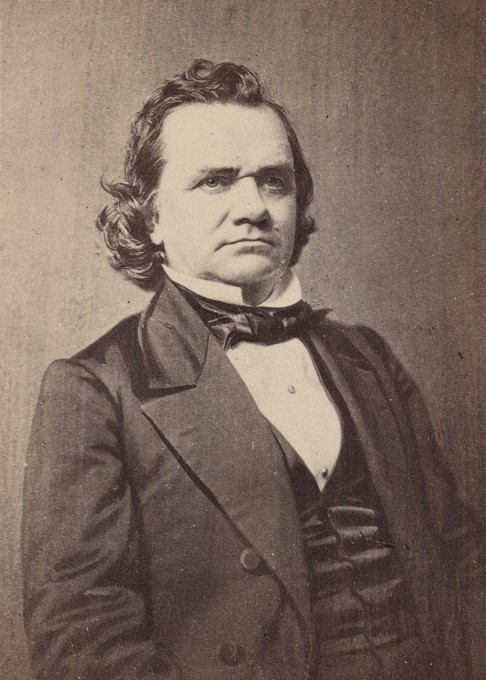
In the 1860 presidential election, two politicians from Illinois appeared on the ballot: Republican Abraham Lincoln and Northern Democrat Stephen A. Douglas. The Democratic Party had fractured along sectional lines, with Southern Democrats nominating Vice President John C. Breckinridge of Kentucky. Douglas, a sitting U.S. senator from Chicago, was known as the “Little Giant,” a nod to his short stature and outsized political influence. Lincoln and Douglas had faced off before in the 1858 Senate race, where Douglas emerged victorious.
A clear voting pattern emerged in 1860. With few exceptions, northern Illinois broke strongly for Abraham Lincoln, while western and southern Illinois favored Stephen Douglas. Lincoln carried the state narrowly, winning 50.69 percent of the popular vote.
Southern Illinois, settled largely by Scots-Irish migrants from Virginia, Tennessee, and Kentucky, maintained strong cultural and economic ties to the Upper South. The region lies below the cultural Mason-Dixon Line, and even today a Southern drawl is common south of Interstate 70. In Gallatin County before the Civil War, hundreds of slaves harvested salt on John Hart Crenshaw’s Hickory Hill plantation despite Illinois’ status as a free state. Crenshaw was also allegedly involved in the “Reverse Underground Railroad,” sending escaped slaves, and even freemen, south into bondage.[1]
Southern heritage did not perfectly predict voting habits or attitudes toward slavery and racial equality. Abraham Lincoln himself, after all, was born in Kentucky. Edward Coles, Illinois’ second governor, was a Virginian and an abolitionist who freed his slaves before settling in the Illinois Territory. (His son, Edwards, however, fought for the Confederacy and died at the battle of Roanoke Island.)[2]
But in general, Douglas’ share of the vote rose alongside the proportion of residents with Southern roots. Johnson County, near the Kentucky border, gave Douglas 96.96 percent of its vote. Statewide, John C. Breckinridge received less than one percent, yet his strongest showing came, ironically, in Union County along the Missouri and Kentucky border, where he captured 40.34 percent.[3]
Following the Confederate bombardment of Fort Sumter in South Carolina, citizens of Williamson County, Illinois, gathered to consider throwing their support behind secession. They drafted a resolution declaring, in part, “the interest of the citizens of Southern Illinois imperatively demands at their hands a division of the State. We hereby pledge ourselves to use all means in our power to effect the same, and attach ourselves to the Southern Confederacy.” Word spread quickly, and the resolution was withdrawn amid fears that the army might intervene.[4]
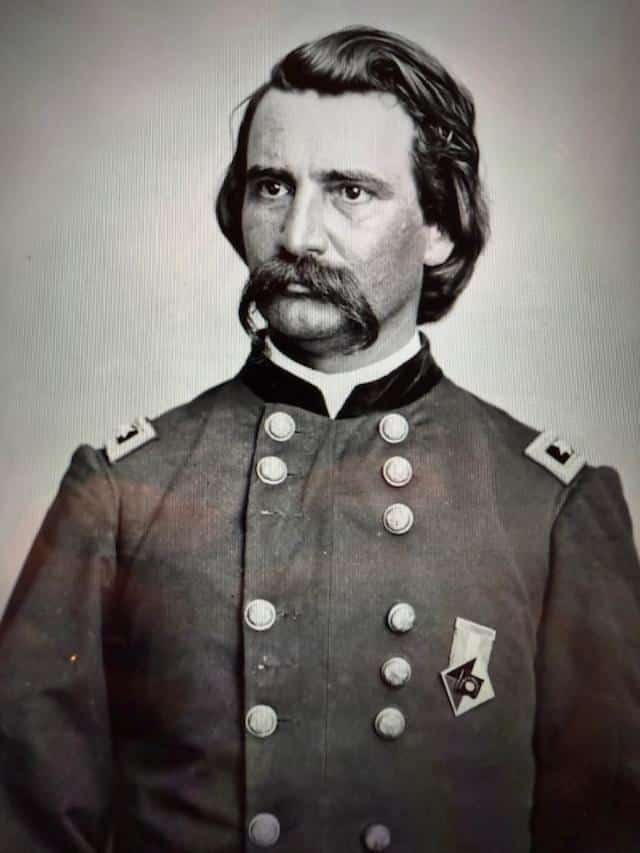
Later, U.S. congressman and future Union general John A. Logan, a loyal follower of Douglas, was accused of participating in the conspiracy, though those actually involved denied he had taken part.[5] In 1853, as a state representative, Logan introduced legislation authorized by the 1848 Illinois Constitution that barred free blacks from entering the state and prohibited bringing slaves into Illinois for the purpose of setting them free. Violators faced fines and, in the case of freedmen, the risk of being sold back into slavery.[6] Logan was, at least initially, no abolitionist or Lincoln supporter, but he did love the Union.
Some hard-nosed secessionists balked at the withdrawal and posted notices calling for recruits for the Confederacy, but Logan returned home and warned them that “the resolutions were treason, and they would all be hung.” The notices were quickly torn down.[7]
Regardless, a small company of about thirty-four men from Williamson and Jackson counties elected Thorndyke Brooks as their captain and headed south. Among them was Hibert B. Cunningham, Logan’s brother-in-law. These Illinois men served alongside volunteers from Missouri, Kentucky, Minnesota, and Pennsylvania in Company G of the 15th Tennessee Infantry Regiment. Brooks, a Maryland native, eventually rose to lieutenant colonel of the 15th Tennessee.[8]
Newspapers in southern Illinois reacted sharply against President Lincoln’s call for volunteers to put down the rebellion. In late April, the Cairo City Gazette declared, “we are opposed to our Legislature voting one cent to aid in equipping troops to be sent out of the state for the purpose of prosecuting the unnecessary war inaugurated by the present administration.”[9]
The convergence of the Mississippi and Ohio rivers at Cairo made the town strategically vital, and genuine rebellion in southern Illinois would have complicated efforts to control the region, not to mention prove politically embarrassing for the President. Something had to be done. On April 19, Illinois Governor Richard Yates, a Republican, called for an armed force to assemble in Chicago and ordered militia Brig. Gen. Richard K. Swift to “take possession of Cairo.”
“Perhaps the state of feeling in Southern Illinois may require the utmost dispatch and secrecy,” the governor’s messenger cautioned. One company was detailed to guard the Big Muddy Bridge on the Illinois Central Railroad, while the Chicago Highland Guards and a company of Chicago zouaves reached Cairo by rail on April 21.[10] In the weeks that followed, additional companies from northern and central Illinois arrived, forming the 8th and 10th Illinois Infantry regiments.
In Washington, DC, Stephen Douglas conferred with Lincoln and pledged his support to his former rival. He then hurried back to the Midwest to persuade Democrats to stand with the Union. “There can be no neutrals in this war,” he said in his final speech in Chicago, “only patriots—or traitors.” That address was delivered on May 1, 1861. When he died of typhoid fever a little over a month later, he was mourned across the North. Secretary of War Simon Cameron described him as “a man who nobly discarded party for his country.”[11]
Douglas’ words, perhaps amplified by his untimely death, had a striking effect. According to historian Wood Gray, he “stamped out the secession movement [in southern Illinois], and heavy enlistments began that would make the district . . . the banner recruiting area of the state.”[12] Union County, despite giving Lincoln only 7.73 percent of its vote, furnished roughly 3,000 Union volunteers from a population of 11,181.[13]
In Gallatin County, Michael Kelly Lawler recruited the 18th Illinois Infantry and became its colonel. He was later promoted to brigadier general and breveted major general at the end of the war. Lawler was married to Elizabeth Hart Crenshaw, daughter of John Crenshaw.[14] They are buried in Hickory Hill Cemetery, within sight of the Old Slave House.
John “Black Jack” Logan initially served as an unattached volunteer with a Michigan regiment, where he fought at the Battle of Bull Run. He then resigned his seat in Congress and became colonel of the 31st Illinois Infantry. His conversion to a Lincolnian and Radical Republican is well known. Leading by example, he persuaded many in southern Illinois to abandon “The Democracy” and embrace Republicanism. In the fall of 1863, his brother-in-law deserted the Confederate army and joined him as an aide-de-camp.[15]
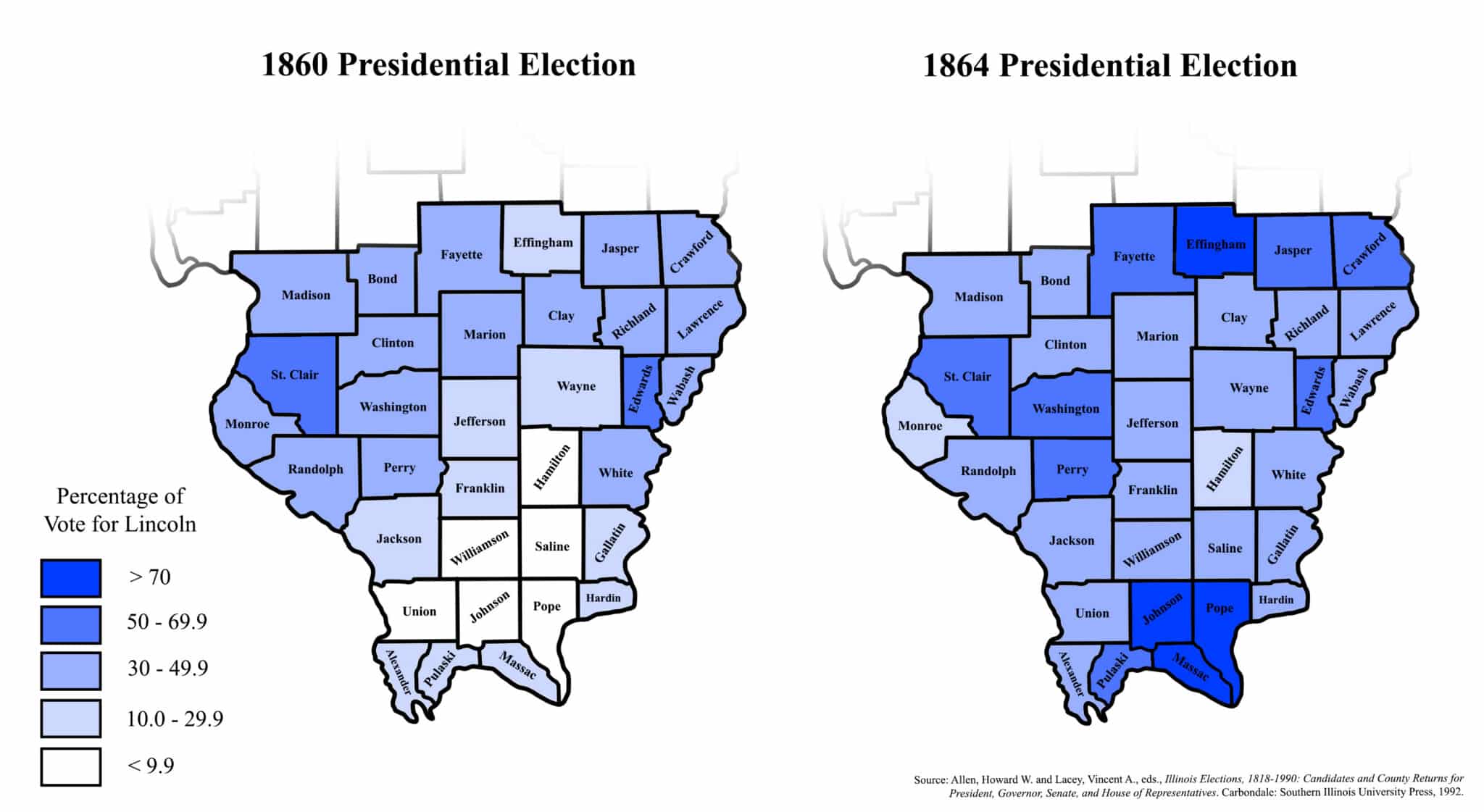
Not only did southern Illinois far exceed its enlistment quotas, its citizens’ voting habits shifted dramatically as well. What had long been a Democratic stronghold moved sharply toward the Republican camp. Just four years after Johnson County gave Stephen Douglas nearly 100 percent of its vote, it delivered Lincoln a 74-point swing. Lincoln’s share of the vote rose by 20 percent or more in 13 counties.[16] Such a dramatic turnaround would not have been possible without the early efforts of men like Douglas and Logan, who placed loyalty to the Union above all else.
[1] For more on the Illinois Salines, John Crenshaw, and the slave exemption, see Jacob W. Myers, “History of the Gallatin County Salines,” Journal of the Illinois State Historical Society 14 (Oct. 1921): 337-350 and Jon Musgrave, Slaves, Salt, Sex & Mr. Crenshaw: The Real Story of the Old Slave House and America’s Reverse Underground R.R. (Marion: IllinoisHistory.com, 2004).
[2] E.B. Washburne, Sketch of Edward Coles, Second Governor of Illinois, and of the Slavery Struggle of 1823-4 (Chicago: Jansen, McClurg & Company, 1882).
[3] Howard W. Allen and Vincent A. Lacey, eds., Illinois Elections, 1818-1990: Candidates and County Returns for President, Governor, Senate, and House of Representatives (Carbondale: Southern Illinois University Press, 1992), 144-5.
[4] Milo Erwin, History of Williamson County, Illinois: From the Earliest Times, Down to the Present, 1876 (Marion: The Herrin News, 1914), 254-6.
[5] Goodspeed Publishing Co., History of Gallatin, Saline, Hamilton, Franklin and Williamson Counties, Illinois (Chicago: The Goodspeed Publishing Co., 1887), 491-2.
[6] Gary L. Ecelbarger, Black Jack Logan: An Extraordinary Life in Peace and War (Guilford: The Lyons Press, 2005), 29-30.
[7] Erwin, History of Williamson County, Illinois, 258.
[8] Richard P. Weinert, “The Illinois Confederates,” Civil War Times Illustrated, Vol. 1, No. 6 (October 1962): 44-45; Ed Gleeson, Illinois Rebels: a Civil War Unit History of G Company, Fifteenth Tennessee Regiment, Volunteer Infantry (Carmel: Guild Press of Indiana, 1996).
[9] As quoted in the Chicago Tribune, April 30, 1861.
[10] J. N. Reece, ed., Report of the Adjutant General of the State of Illinois, Vol. 1, Containing Reports for the Years 1861-66 (Springfield: Phillips Bros., 1900), 243-5.
[11] Martin H. Quitt, Stephen A. Douglas and Antebellum Democracy (New York: Cambridge University Press, 2012), 183; Roy Morris, Jr. The Long Pursuit: Abraham Lincoln’s Thirty-Year Struggle with Stephen Douglas for the Heart and Soul of America (New York: HarperCollins, 2008), 217.
[12] Wood Gray, The Hidden Civil War: The Story of the Copperheads (New York: The Viking Press, 1942), 59.
[13] Lulu Leonard, History of Union County (Anna: s.n., 1941), 64.
[14] J. T. Dorris, “Michael Kelly Lawler: Mexican and Civil War Officer,” Illinois State Historical Society Journal 48 (Winter 1955): 367, 380-1.
[15] James Pickett Jones, Black Jack: John A. Logan and Southern Illinois in the Civil War Era (Carbondale: Southern Illinois University Press, 1995).
[16] Allen and Lacey, Illinois Elections, 1818-1990, 154-5.


M.A. Kleen, Congratulations on covering a lot of ground in minimal words. As I read this exceptional report through for the third time, several evocative thoughts came to mind…
First, during the Presidential Election of 1860 the State of Illinois acted as “the United States, in miniature,” as it was one of the few states that had ALL of the major candidates – Lincoln, Douglas, Breckinridge, Bell and Gerrit Smith — included on the Ballot. By contrast, most Southern state ballots did NOT include the name of Abraham Lincoln. And most ballots, North and South, failed to include Gerrit Smith.
Second, the State of Illinois had a diverse population, reflecting diverse viewpoints on Slavery, Abolition, religious teachings on “the plight of the slave” and support for the Constitution as it was in 1860.
Third, Abraham Lincoln knew from his years as a Circuit Court rider how diverse was the thinking of his fellow Illinoisans; and Lincoln was aware that “a fine line must be walked” …that his words must keep the majority of voters on his side; that his rhetoric not be allowed to reveal too much, too soon. Thus, Saving the Union – rallying around Patriotism, doing “what was Right” – figured prominently in President-elect Lincoln’s early speeches.
Meanwhile, John Logan did NOT possess the depth of knowledge of his fellow Illinoisans; he was not as well travelled through that state. Logan suffered from the group-think of fellow inhabitants of Little Egypt [as Southern Illinois was known] where “everyone” supported slavery and voted Democrat. He may even have floated the idea of “leading Little Egypt out of the State of Illinois, into the embrace of Southern interests…” and been taken aback by the lack of resolve possessed by Southern Illinois inhabitants to “match their words with deeds” …and reverted to “Support of the Constitution” as his focus. Congressman Logan took up his rifle during the Manassas Campaign; fought like a lion at Fort Donelson; experienced an epiphany during the Siege of Vicksburg; and ended the war with a respect for the Black Man that he did not possess in 1860.
Well Done!
Mike Maxwell
Thank you! Appreciate your comments and observations. Illinois is an interesting case. It was the only state carved out of the Northwest Territory not to abolish slavery outright. A lot of people have conveniently forgotten this history. I tried my best to summarize what is a *very* complex, far-ranging history. I’m not sure slavery was really supported in southern Illinois. But the motive for keeping slavery out of the state was more a reflection of racism (not wanting blacks in the state at all) rather than any notion of tolerance and racial equality. During the war, there was an effort to expel freedmen who sought refuge in the state. I plan to write about all of this more in the future.