Book Review: Moses Jacob Ezekiel: Jewish, Confederate, Expatriate Sculptor

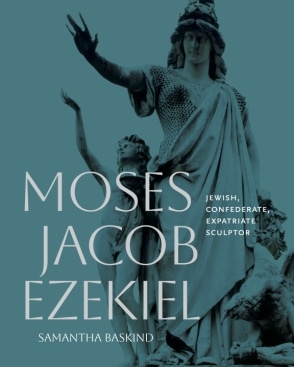
Moses Jacob Ezekiel: Jewish, Confederate, Expatriate Sculptor. By Samantha Baskind. University Park: The Pennsylvania State University Press, 2025. Hardcover, 294 pp. $49.99.
Reviewed by Sarah Kay Bierle
Civil War buffs and historians probably think of the battle of New Market or recent monument controversies when they hear the name Moses Jacob Ezekiel. The first Jewish cadet to attend the Virginia Military Institute, Ezekiel numbered among the cadets who charged into the battle at New Market on May 15, 1864, and cared for his dying friend, Thomas Garland Jefferson, in its aftermath. His experiences in combat and grief profoundly affected him for the rest of his life and inspired personal tributes in art and his embrace of the Lost Cause ideology. Ezekiel’s talent for sculpture and casting received international recognition beginning in the late 1860s and continuing until his death in 1917. His studio in Italy attracted numerous visitors and his weighty, artistic figures crossed the Atlantic to find prominent places in the United States.
Samantha Baskind, a Distinguished Professor of Art History at Cleveland State University, offers a detailed examination of Ezekiel’s art and the context of its creation in her new book. The chapters thematically explore Ezekiel and religious liberty, Judaism and the Bible, Zionism and the Bible, Arts and the Antique, United States Presidents, and the Confederacy. The descriptions of the art pieces are beautifully written and, whenever possible, accompanied by photographs. There are plenty of details about Ezekiel’s life included, but this volume is intended as an art study rather than a traditional biography. Baskind includes detailed citation notes and bibliography along with an excellent index. A timeline of Ezekiel’s art projects and major life events could have been a helpful appendix addition since the chapters are thematic, but readers can create their own through quick notes if necessary.
The chapters delving into Ezekiel’s understanding of his Jewish faith and culture and embraced it in his art are particularly helpful to readers looking at 19th Century religion and its influence. Tracing the history and beliefs of Judaism on American shores and how Ezekiel championed the ideal of religious liberty outside of a Christian tradition is enlightening. Ezekiel’s chosen habitation in Italy also presents interesting aspects as he saw the United States and Jewishness through a different lens than many experienced.
Readers with a Civil War interest will particularly find Chapters 5 and 6 fascinating. Ezekiel eventually welcomed Grant to his Italian studio during the former president’s world tour and the two Americans abroad apparently had an enjoyable visit. Ezekiel’s sculptures of Abraham Lincoln draw particular spotlight to an artist’s dilemma: creating art that will sell despite past political feelings. With thoughtful nuance, Baskind examines Ezekiel’s creation of Confederate memory through art in the final chapter of the book. Putting this chapter of his art at the end of the book allows readers to pause and gain a deeper understanding of Ezekiel’s life, times, and motives in other themes of art before delving into the pieces that have more recently been in news headlines, like Stonewall Jackson (Charleston, WV and another originally at the Virginia Military Institute) and New South (originally in Arlington National Cemetery).
While there is ongoing discussion about the propriety and intent of Confederate monuments, Baskind offers a contextualized view. The introduction and final statements of the book give this reflection: “In the complex twenty-first century, where oppositional lines are meticulously drawn and zealous judgements are broadly cast about what is good and what is bad, historians face significant risk in their statements and research. Metal should often be melted, but ideas not so much. Recovery should always be vital to historians’ work. And it bears repeating: Recovery does not necessarily mean acceptance.” (211) The inclusion of 2023 correspondence and perspective on a cancelled art display in 2022 show the current debate around deceased artists and historical art. Though Baskind expresses strong reservations about Confederate monuments, she presents a plea to consider the “entire story” and larger context of an artist’s moment, life, and creations. Ezekiel has name recognition right now for his “Confederate sculptures” but these pieces represent actually a small portion of his entire portfolio. While his war experiences and love for the state of Virginia clearly inspired some of his art, Ezekiel had other artistic themes and values, consistently freedom of religion and Jewish perspective on religious figures or scenes.
Moses Jacob Ezekiel: Jewish, Confederate Expatriate Sculptor will be an excellent addition to the shelf (or coffee table) for anyone who loves to wander art museums and probe the deeper meanings that artists bring to their creations. Aspects of Judaism, civil liberties, historic art, and Civil War memory are molded together in this new book to present a striking view of a Civil War veteran artist who should be re-evaluated and—perhaps—reclaimed.


I’m brainstorming a piece on Jewish Virginians in the ACW, so this is a very timely review for me. Looks interesting. The $50 price tag is pretty steep though, do you think it’s worth the price?
Good review, Sarah Kay. The history of Jewish Confederates is a genre by itself. I read your article about the removal of Jackson’s statue at VMI and it reinforces my resolution to never visit wokedom again, as I often did in the good old pre-2020 days.