“We had a great time here on St. Patrick’s Day”
Who doesn’t love a good party? I like parties. So did the troops of the Army of the Potomac’s Irish Brigade. Many readers may know that in March 1863 the Irish regiments held a large party at their camp on the north side of the Rappahannock River in Stafford County. Always wanting to pinpoint a location, I wanted to find out where it was.
Irish immigrants in the 19th century faced discrimination and racism. Although white, these Europeans were largely uneducated and had Celtic rather than Anglo-Saxon roots, and worst of all, were Catholic. Nineteenth-century racism focused on ethnicity and class as much as skin color.
New York attorney George Templeton Strong wrote, “Our Celtic fellow citizens are almost as remote from us in temperament and constitution as the Chinese.” Women’s Rights advocate Elizabeth Cady Stanton commented on the “stupid Hibernian” servant girls that worked for her family. Despite facing prejudice, thousands of Irish immigrants and those of Irish descent served in the United States army.
The winter of 18626-3 was a dreary time for the Federal army, following the defeat at Fredericksburg. The army was spread out in Stafford County, north of Fredericksburg, in winter quarters. Members of the Irish Brigade planned a massive party to celebrate their heritage that March.
At the time the brigade consisted of the 63rd, 69th, and 88th New York. The unis were primarily Irishmen from New York City. Also in the brigade was the 28th Massachusetts and the non-Irish 116th Pennsylvania. General Thomas Meagher commanded the brigade. They had fought together at Seven Pines, Gaines’ Mill, Malvern Hill, Antietam, and Fredericksburg. By the spring of 1863 the Irish had proven themselves and earned the respect of skeptical commanders and fellow soldiers.
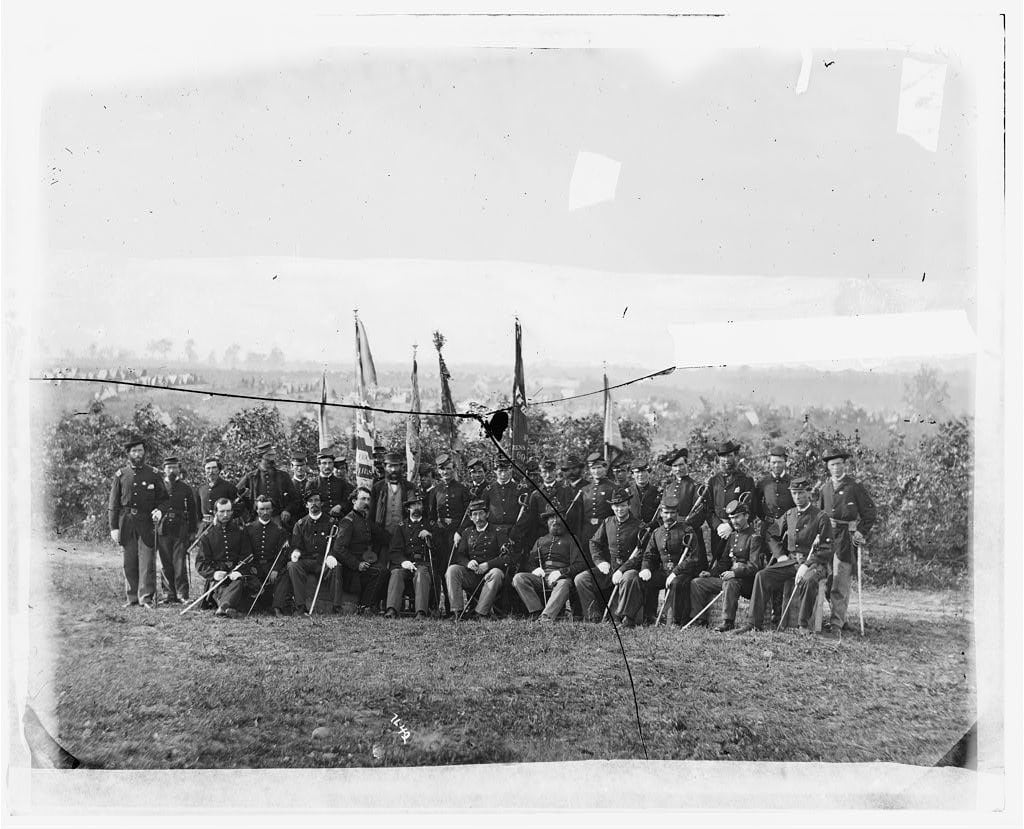
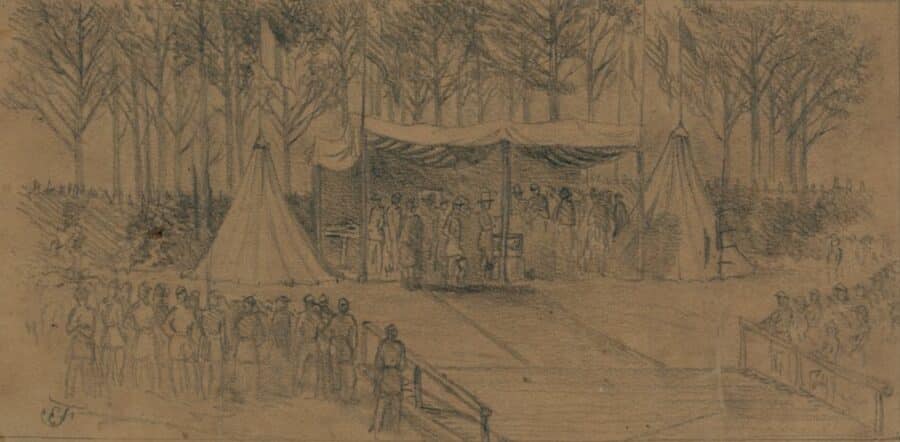
Private Tom Galwey wrote in his diary that “all the world knows the Irish love of fun. As St. Patricks’ Day approaches, great preparations for its observance are made by the Irish Brigade. The large parade ground in front of their camp is fitted up for a steeplechase. A grandstand for the guests is erected and General Meagher’s headquarters are decorated in a very artistic fashion.”
Galwey continued, “The day dawned clear and pleasant. General Meagher’s headquarters are a sight. An arbor of cedar and pine branches has been constructed in front of his tent. At either side of the porch stands a table with an immense pile of cakes. In the middle, elevated on a pedestal, is a huge tub made of pork barrels and painted in green. It is surrounded with a festoon of flowers and shamrogs. This tub is full of good userbaugh (Irish whiskey), and a ladle hangs temptingly at its side. Here the General and other of the upper curst are hospitably seen, and they no doubt are innocent of any shyness at their introduction to the green tub.” Meagher’s tent was also decorated with Irish and American flags. Nearby was a large platform erected as a viewing area for guests.
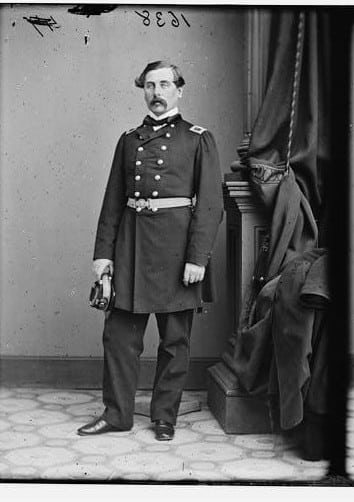
The day began with a Catholic service led by Father William Corby, who had accompanied the unit through its previous battles and would continue to do so. Army bands play liturgical music during the service. Then the fun began.
The bulk of the day was spent in various sports and competitions. There were foot races, sack races, horse and mule races, a soaped pig chase, a wheelbarrow race in which contestants were blindfolded, and a weight toss competition. Soldiers made wagers throughout the games. All activities included cash prizes.
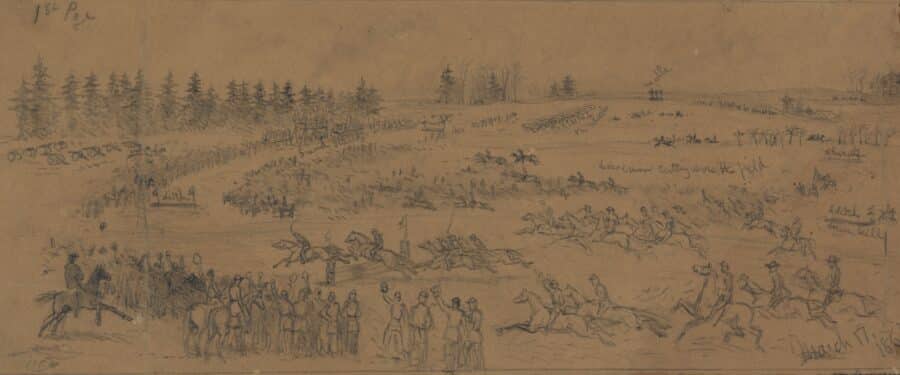
The highlight of the day came at noon: the steeplechase race. Only commissioned officers from the Irish Brigade’s division of the 2nd Corps were eligible to participate. A Boston newspaper reported that “horses and mules of every age, color, and size were led into the course, and at a given signal scampered away pell-mell, helter-skelter, Tam O’Shanter style, leaping first a ditch, then a hurdle, now running, now trotting, now wheeling or stumbling, altogether it was a ‘stampede’ such as has seldom been witnessed, even at the famous Donnybrook Fair.”
The race covered two-and-a-half miles and included four hurdles four-and-a-half feet high, and five ditches, fifteen feet wide and six feet deep. The prize was $500, a large sum of money at the time. Private Samuel S. Partridge of the 13th New York witnessed the race and wrote: “For the Steeple Chase of two heats only eight or ten horses were entered, all of Meagher’s Brigade. Major Genl. Hooker was the umpire.”
“It beat Donnybrook fair all to the mischief . . . Guidons and such things were stuck in the ground to point out the course to the riders. There were four hurdles and three ditches…There were more than 20,000 spectators, soldiers and officers. Everybody who could get a pass from camp was there, some even walking a dozen miles through the mud to get there. The track was slippery blue clay and about half hoof deep.”
He noted that at one hurdle, “when a horse stumbled somebody got hurted” every time.” And the ditch “was in a little valley, the ground sloped towards it each way. It was as deep as it was wide, and so slippery was the bank, that if a horse paused a tenth of a second to measure his distance, he slid in. None but horses who took this hump on the swing got over, and a good many of these fell short. I went over this while four horses and riders were wallowing in the mud.”
The jockeys were colorful that day, Partridge observed. “One rider was clad in white curdoroys, wax top boots, drab cutaway coat and drab stovepipe hat, regular English jockey style. One Greek Captain had a silk goat, one side green with white sleeve, the other side white with green sleeve. His horse bolted the first hurdle and pitched him over it, but he arose with his many colored coat all slate color, remounted and made him take the leap. The horse also went over the twelve foot ditch and left the rider in it, and I saw neither horse nor rider again.”
Partridge noted that both heats were won by a “chestnut stallion with a white mane and tail, ridden by a boy, an officer’s servant, about fifteen years old, and not over ninety weight.”
At one o’clock General Meagher rose and announced that the day’s festivities were not over “by a long shot.” More foot races, wheelbarrow races, and others with competitors bound hand and foot, followed. Then came a horse race just for fun, free to all officers horses. It was even more of a free-for-all than the previous ones.
Partridge joined in this race and recorded his experience: “At the word go! Ten or a dozen horses started straight off and went ten or twenty rods before the riders could turn them. Those of us who know how, executed a “demi-volt” and let em spin. If a horse bolts at a jump, or goes round it, he is out of the race, unless he goes back and takes it again. It is ruleable for a horse to go over everything—no matter how—so he goes over. If he misses he is distanced.”
“I never rode so fast before. It took all the horsemanship I know to do it. I kept a tight rein, till within three lengths of the jump, and then loosened up by holding the bridle hand forward about half way up the back, so as to tighten up after the jump by drawing the hand back again, without loosening the reins and gathering them up again. I remembered too to sit close to the saddle as I ran, and to raise the body from the saddle on the jump, but keep the knees close as though there was a pivot through them.” He summarized it, saying, “It was the biggest spree I ever went on—the wildest ride I ever took—and I don’t want to do so any more.”
Generals Hooker, Butterfield, Meade, Sickles, Sedgwick, and others watched the race in the judge’s stand. General Meagher wore a white hat, blue swallow-tail coat, buckskin knee breeches, and top boots.The brigade officers and their guests consumed 35 hams, a roasted ox, a pig stuffed with boiled turkey, and chickens, ducks, and other game. To wash it down they enjoyed eight baskets of champagne, ten gallons of rum, and twenty-two gallons of whiskey. The enlisted men of the brigade received 2 gills of rum each, many got more.
The evening concluded with refreshments, more alcoholic beverages, songs, and poems. Festivities went on until dark. Among those in attendance was Edwin Forbes, artist for Frank Leslie’s Illustrated Newspaper. Forbes made several sketches that day. His artwork is shown below.
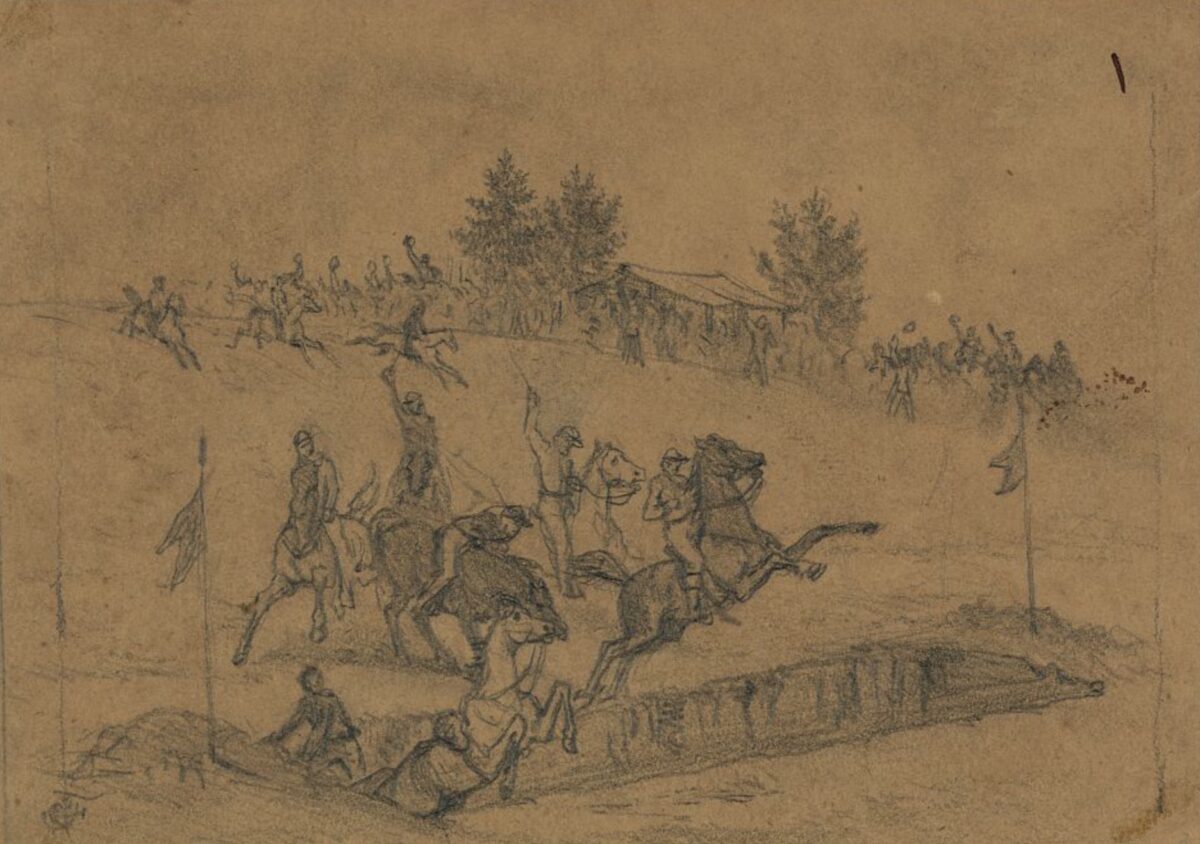
Another event that day was a mule race, which, from Forbes’ sketch of it, looked sort of dangerous. “[T]here … were many falls, many horses injured and a lot of riders.”
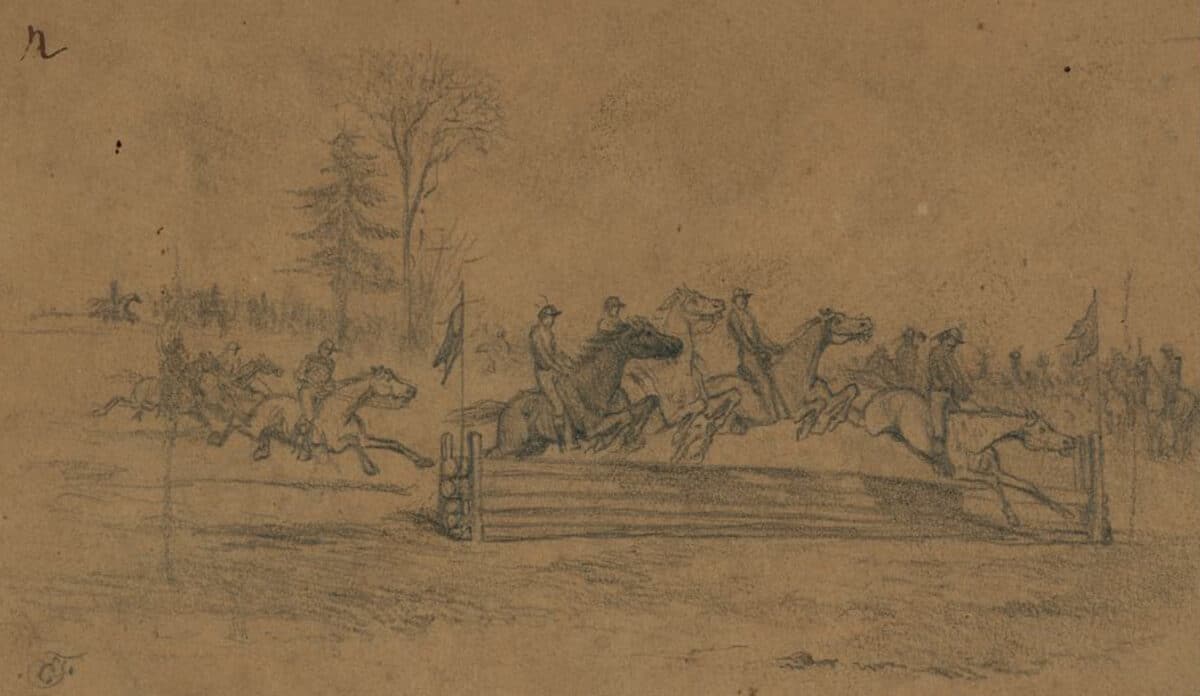
Amongst many notables riding in the train of the commander-in-chief, was the Princess Salm Salm, a beautiful and fearless horse woman. When she first came on the ground, she rode her horse up to a five foot hurdle and nonchalantly took a standing jump, clearing it handsomely.”
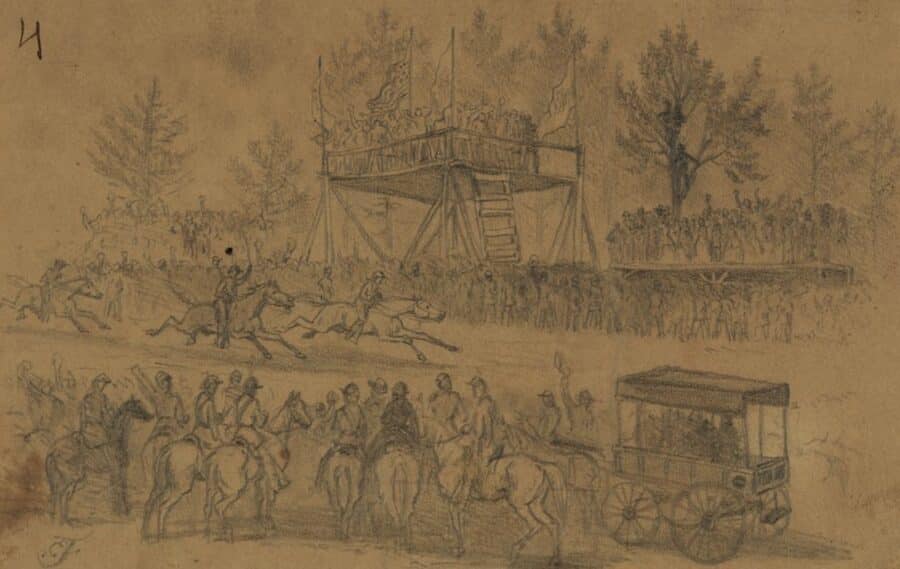
One observer noted, “The course was surrounded by thousands, kept in order by guards posted entirely around the field.”
The day of fun broke the monotony of winter camp. Soldiers described it in various ways: a “rollicking, memorable Saint Patricks’ Day in the Irish Brigade,” and the “most magnificent non-combat event that the army ever experienced.” Another said, “All were invited to partake and such a gathering of jolly, handsomely dressed fellows, I never saw before. The Irish brigade was in its glory. It understood the situation, was master of it, and quite immortalized itself.” Peter Welsh of the 28th Massachusetts simply wrote, “We had a great time here on St. Patrick’s Day.”
There were other things to improve the army’s morale. The weather was improving, and spring was coming. Other army improvements helped: the introduction of corps badges, better rations, and opportunities to take leave. Two months later the army would be engaged in one of its largest battles at Chancellorsville.
Several years ago I researched the campsites of the Army of the Potomac that winter, and consulting relic collector D.P. Newton, I was able to locate the campsite. The site of the 1863 St. Patrick’s Day Party stood just north of exit 133 on Interstate 95 in Stafford County. Today the area is covered by a hotel and shopping centers. I think about it every time I drive by.


Thanks Burt, nice piece.
George Washington also liked a good party … here’s his General Order for 17 March 1780 — “… the General directs that all fatigue and working parties cease for tomorrow the 17th, a day held in particular regard by the People of Ireland —At the same time that he orders this: He persuades himself that the celebration of the day will not be attended with the least rioting or disorder (George clearly knew his Irish Continentals) and the officers to be at their quarters in camp and the troops of each state line are to keep within their own encampment.”
Thank you Mark, and yes, I know about Washington’s order, he was on to something!
Great story! Perhaps as a result of a scheduling quirk, our Williamsburg CWRT met earlier this evening. I commenced the meeting program with a short St. Patrick’s Day narrative of the commencement of the Peninsula Campaign on March 17, 1862, when General McClellan began the embarkation of the AoP down the Bay to Fort Monroe. Our speaker Mike Block picked up the St. Patrick’s story of March 17, 1863 with the fight at Kelly’s Ford, where the Gallant Pelham met his demise. Great sidebars to honor the special day prior to Mike’s scheduled presentation about Mine Run, which commenced shortly after Thanksgiving in 1863.
Thanks Bill! Great minds think
This is a great article! One can see how much St. Patrick’s Day meant to the men of the Irish Brigade from that fact that Father Corby spends a whole chapter of his memoir discussing the events of the 1863 day described so well here.