A Photo Finished
Although the American Civil War was not the first American conflict to be photographed—that honor belongs to the Mexican-American War—, the memory of the conflict is still widely defined by the camera. For many Civil War historians, simply mentioning the name of an iconic shot can bring it to mind: Home of a Rebel Sharpshooter, A Harvest of Death, and Bodies in Front of the Dunker Church.
Perhaps the most famous group portrait of the war is Sherman and his Generals. Fresh from their march through the southern heartland, a steely Sherman sits in the center with his arms crossed while his distinguished lieutenants flank him on all sides. It has been placed on the cover of several books and included in the pages of many more.
But here is a question: how many generals are shown in this iconic image? Surprisingly, there is more than one correct answer. Throughout its history, the image’s edits via the techniques of the time resulted in several versions of the photograph.
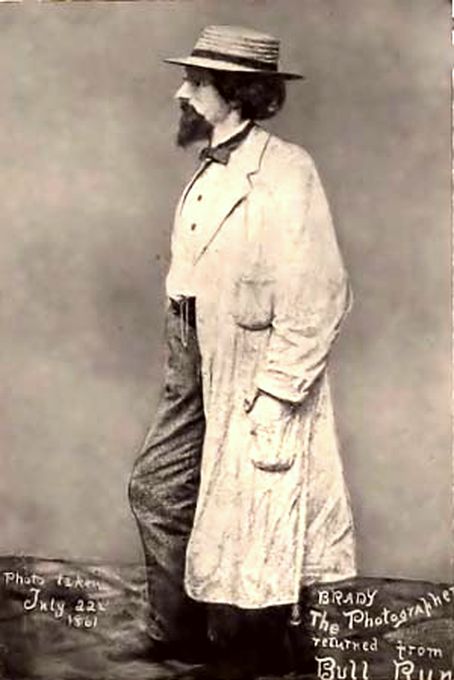
The picture’s story begins with the end of the war and the Grand Review of the Armies. Triumphant in the field, Sherman and his armies were preparing to march through the capital of Washington for a final display of their marital prowess, this time for the public on May 24, 1865. As befitted the time of jubilation, Sherman and his senior subordinates decided to create a permanent memento of their association the day before, May 23. There was no better place to do this than Mathew Brady’s photography studio in Washington D.C.[1]
First, the subjects had to be selected. The plan was to include Sherman, his army commanders, and his corps commanders. Recent command shifts had changed the composition of that group, however. Major General Oliver O. Howard, who had commanded the Army of the Tennessee from the end of the Atlanta campaign through the March to the Sea and the Carolinas campaign, had accepted the position of commissioner of the Freedmen’s Bureau on May 12. Nevertheless, he had intended to retain command of the Army of the Tennessee as well until the conclusion of the Grand Review.[2]
On May 20, however, Sherman requested a meeting at the adjutant general’s office. To Howard’s dismay, Sherman said that he wanted Maj. Gen. John A. Logan, currently commanding the XV Corps, to lead the Army of the Tennessee during the review in recognition of his long and gallant service. Howard had been eagerly awaiting the opportunity to lead his men one final time. In spite of this, Sherman managed to persuade him. As Howard explained in his memoirs several decades later, “Speaking very gently, as Sherman could, … he said: ‘Howard, you are a Christian, and won’t mind such a sacrifice.’ I answered: ‘Surely, if you put it on that ground, I submit.’”[3]
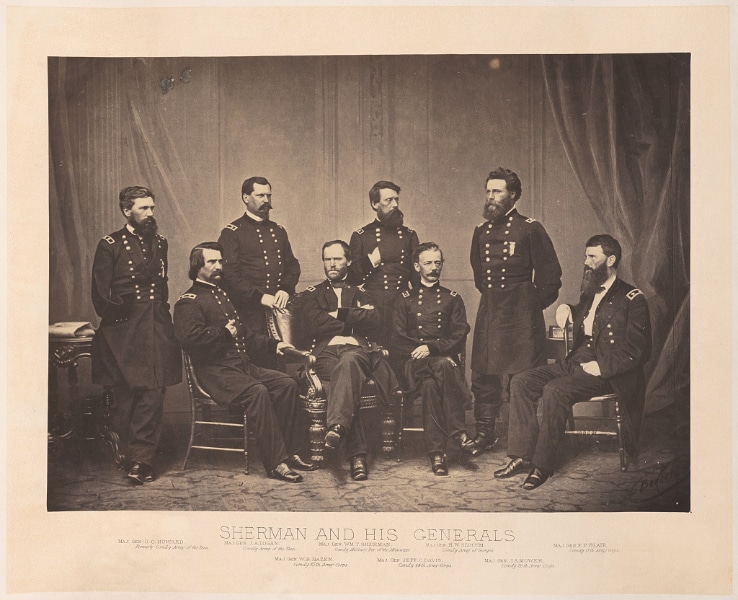
As Logan rose to army command, the XV Corps needed a new commander. This fell to Maj. Gen.l William B. Hazen, one of the most distinguished Union officers of the war.[4] With the commands sorted out, the group emerged: Sherman, his army commanders Oliver O. Howard (formerly Army of the Tennessee), John A. Logan (Army of the Tennessee), and Henry W. Slocum (Army of Georgia), and his corps commanders Francis P. Blair Jr. (XVII Corps), Jefferson C. Davis (XIV Corps), William B. Hazen (XV Corps), and Joseph A. Mower (XX Corps). All that remained now was taking the picture at Brady’s studio in the afternoon of May 23.
But, as Helmuth von Moltke the Elder would declare several years later, no plan survives first contact with the enemy. The commanders that had shown such great skill in combating the Confederates now found their plan floundering against an old foe: time. At the appointed time, seven of the eight generals arrived at the studio. Blair, however, failed to make an appearance as the deadline came and went. With all the preparations necessary for the review the next day, the generals were getting restless about wasting time in the studio, while Brady himself worried about losing his shot. So, as Brady explained, “At 3 o’clock he had not put in an appearance, so we made a negative without him.”[5]
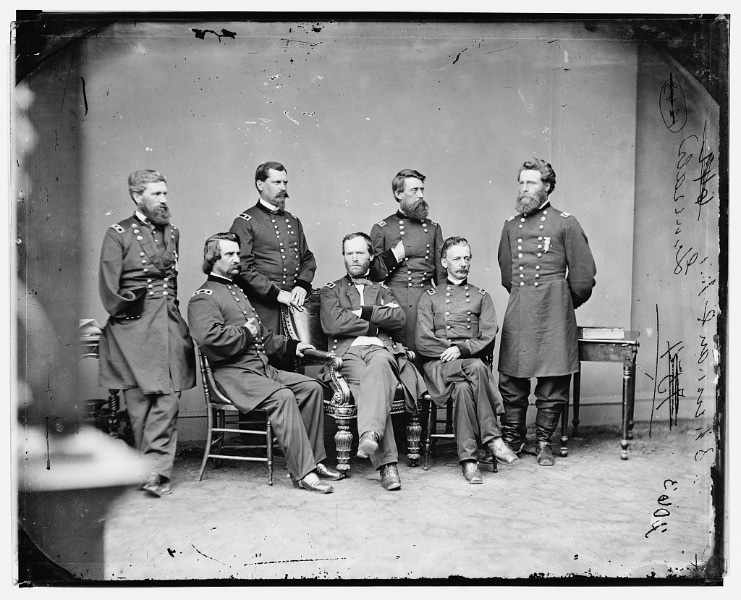
This created the most famous version of the image, featuring Sherman and six of his subordinates. This was not the end of the story, however. Eventually, Blair did make an appearance at Brady’s studio, and Brady was eager to honor the generals’ original intent. Consequently, he took an individual portrait of Blair and used the technique of photomontage to incorporate it into the overall photograph. A second version with eight generals now existed, looking as if Blair had never been late at all.[6]
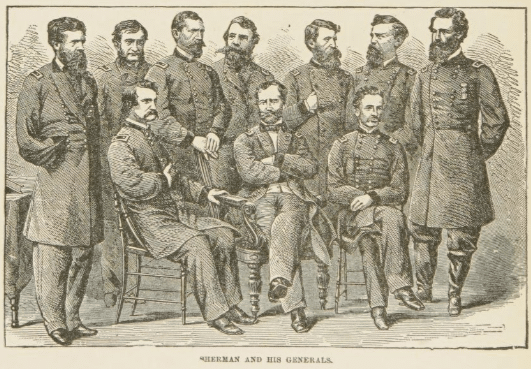
The famous image would undergo one more modification. Following the example of illustrated histories set by Benson John Lossing, Harper & Brothers Publishers wished to create their own illustrated history books. This resulted in the Harper’s Encyclopedia of United States History.
In the entry for “William Tecumseh Sherman,” the familiar image of Sherman and his generals appears. Rather than there being seven generals, or even eight, the illustration depicts ten. Although the creator of the illustration has since been lost to time, it appears he or she wished to recognize the services of two more of Sherman’s senior subordinates from the Carolinas campaign. In addition to the original eight, now Hugh Judson Kilpatrick and Alpheus S. Williams join the entourage.[7]
Sherman and his Generals is hardly the first famous image to witness significant changes over the course of its existence. Indeed, it is a sign of its significance and status that it has so many derivatives. Beyond a simple story of life for generals at the close of the conflict, the photograph also carries lessons on how the techniques of image manipulations were employed in the 19th century.
Endnotes:
[1] Keith F. Davis, George N. Barnard: Photographer of Sherman’s Campaign (Kansas City: Hallmark Cards, 1990), 102.
[2] Oliver O. Howard, Autobiography of Oliver Otis Howard, Major General, United States Army (New York: The Baker & Taylor Company), 2:208-211.
[3] Ibid, 210-211.; Sherman made sure to reward Howard for the favor. During the review, Sherman insisted that Howard ride alongside him with pride of place, Ibid, 212.
[4] William B. Hazen, A Narrative of Military Service (Boston: Ticknor and Company, 1885), 375.
[5] Davis, George N. Barnard, 102.
[6] Ibid, 102.
[7] Woodrow Wilson, et al. “William Tecumseh Sherman,” in Harper’s Encyclopedia of United States History (New York: Harpers & Brothers Publishers, 1912).


As a photographer and instructor of photography, I appreciated this post very much. My students sometimes learn and use techniques of glass plates and a large view camera which Brady would have used for the original negative. We have also produced tin types, which were very popular during the War. To the trained eye photomontage is very obvious. Also the last image was most likely made using the photogravure process.
Thank you, I am glad you enjoyed the post! I appreciate your insight as a professional photographer, because it is far from my field of expertise.
I look forward to reading your posts — and this is another little gem! And i Iearned alot — i thought the first photos were taken in the Crimean War and had no idea photographers could “photomontage” back then. Although I wonder why Brady has them all looking in different directions.
I had not thought of that before, but it is an interesting question now that you mention it. Many group portraits of time do have an obvious sense of direction and focus among the subjects, but “Sherman and his Generals” has the men looking all over the place. Perhaps they were all a bit restless to get back to their commands to prepare them for the review?