Echoes of Shiloh: Myth, Media, and the Civil War Landscape
“There were men from every nation laid on those bloody plains,
Fathers, sons, and brothers were numbered with the slain”
– “Shiloh’s Hill,” M.G. Smith, Company C, 2nd Texas Infantry
The acting left something to be desired, and the animated maps were decidedly pre-digital, but in my adolescent mind, the 1987 Classic Images’ Civil War 125th Anniversary VHS on the battle of Shiloh was something special. It was, by far, my favorite episode in the series. A version of “Shiloh’s Hill” by M.G. Smith, sung by the 97th Regimental String Band, serenaded scenes of hundreds of reenactors battling it out.
The climax featured dozens of artillery pieces blasting away to re-create Daniel Ruggles’ 50-gun bombardment of the Hornets’ Nest–the largest concentration of artillery in North America up to that point. While others my age were playing Sonic, this was just about the most exciting thing I could think of. My understanding of Shiloh was shaped first by childhood imagination and later by the landscape itself, where history, legend, and memory converge.
Fought along the Tennessee River on April 6-7, 1862, Shiloh was one of the ten costliest battles of the Civil War, with a scale of carnage that dwarfed what had come before; the nearly 24,000 casualties exceeded those in the Mexican-American War or the War of 1812. For the first time, the public learned just how brutal the war would become. Among the nearly 3,500 dead was a brother-in-law of Abraham Lincoln, who fought for the South.[1]
In a pattern that would repeat itself, a smaller Confederate force initially rolled back the Union army, only to stumble and ultimately suffer defeat. The Confederacy lost one of its most senior and promising generals, Albert Sidney Johnston. On the Union side, the battle forged a mutual respect between Ulysses S. Grant and William Tecumseh Sherman that would pay dividends later in the war.[2]
The battle was featured in Disney’s Johnny Shiloh (1963), a largely fictional account of the wartime experiences of John Clem.[3] At the age of ten, Clem doggedly pursued the 22nd Michigan Infantry, eventually being accepted as a drummer boy and going on to become the youngest noncommissioned officer in U.S. Army history.
Contrary to the legend, the 22nd Michigan was not mustered into service until August 1862 and did not participate at Shiloh. Clem acquired his famous “Johnny Shiloh” nickname only after the popular song “The Drummer Boy of Shiloh,” by William S. Hays, became associated with him.[4]
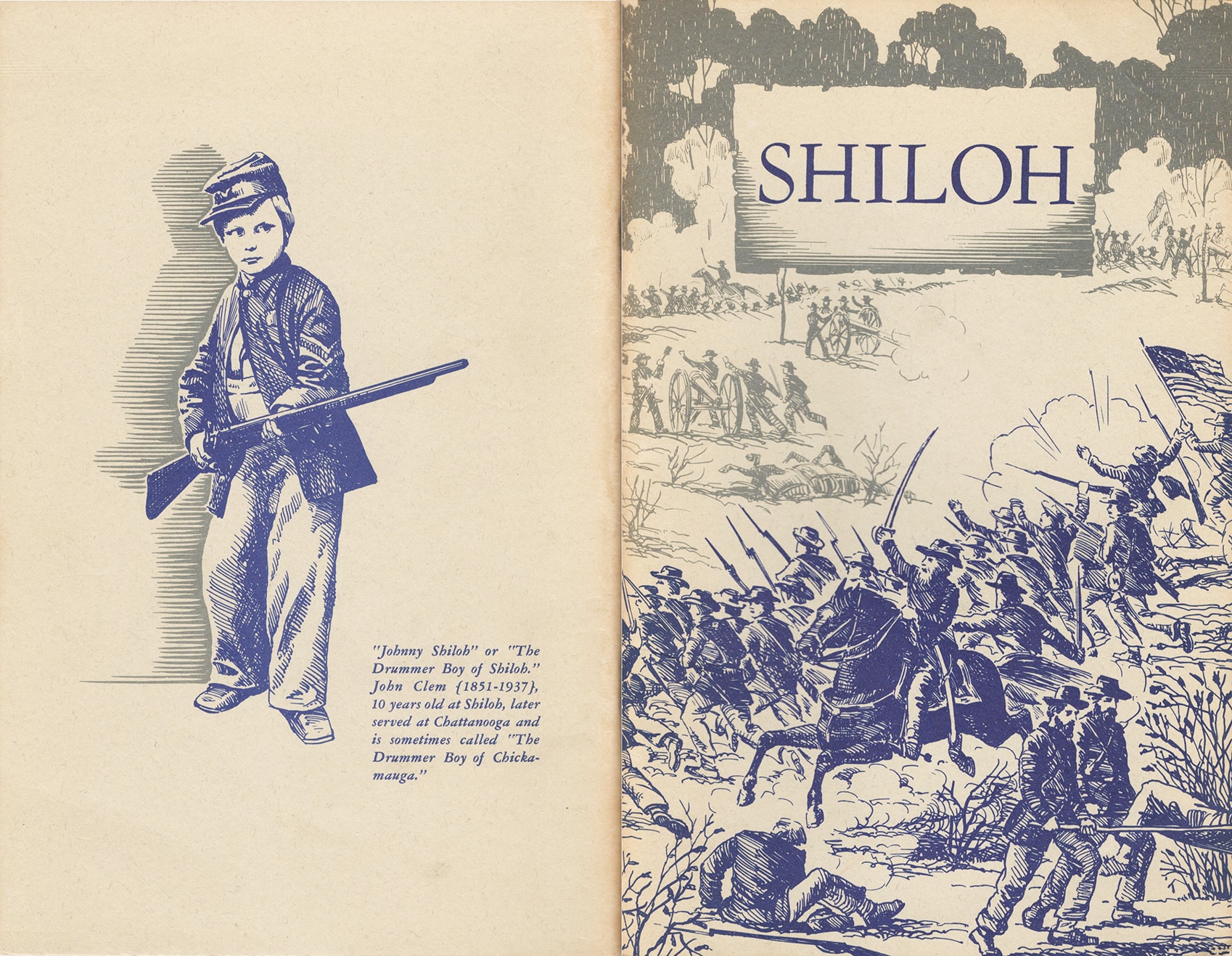
Johnny Shiloh was among my favorite Disney productions as a young kid, alongside Davy Crockett and Treasure Island. Don’t look for it on Disney+, though, it’s been memory-holed, but it is available on YouTube.
I was around John Clem’s age when I first visited the Shiloh battlefield with my dad, a junior high social studies teacher. After a grueling eight-and-a-half-hour drive down I-57 and Tennessee State Route 22 from our home in the northwest Chicago suburbs, we stayed at Pickwick Landing, a few miles south near the Mississippi border.
Shiloh National Military Park was established in 1894 and transferred to the National Park Service in 1933. Because the battlefield is in a predominantly rural area and was preserved within three decades of the war’s end, its appearance has remained remarkably unchanged.
What struck me most in the early 1990s was how much the lightly forested terrain resembled the old illustrations and black-and-white photos I had seen in books, making it easy to imagine the blue and gray battle lines surging through the Peach Orchard, hurling deadly volleys at each other as pink petals rained down. In contrast to other battlefields, particularly those out east, there are no modern buildings or traffic to mar the scene.
What was once one of the war’s bloodiest landscapes has become one of its quietest memorials.
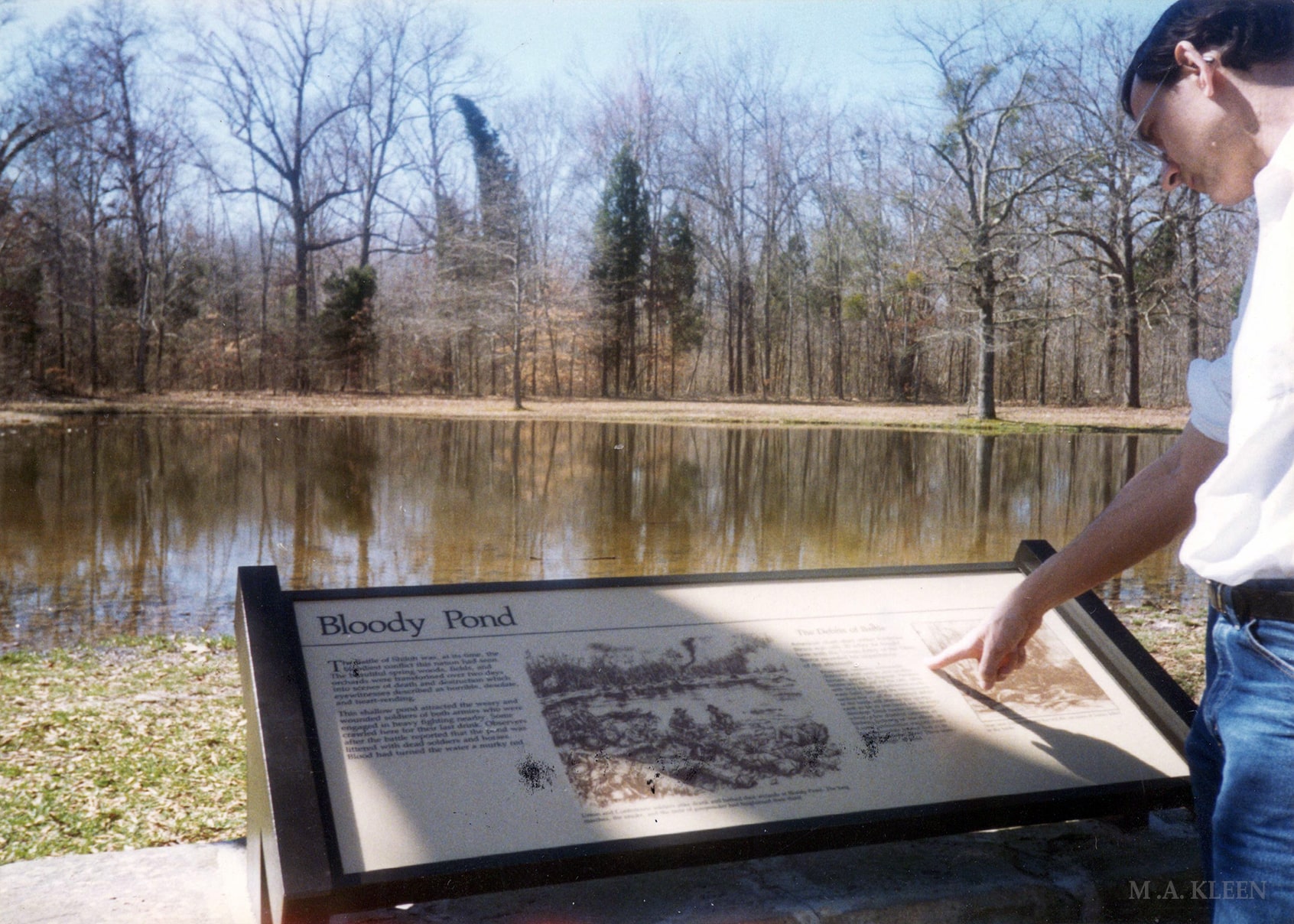
My favorite spot was Bloody Pond, a shallow, muddy pool where wounded soldiers from both sides had dragged themselves to find relief. Standing there on an early spring day, with only the soft breeze and birdsong to break the silence, the hairs on my neck stood on end. The suffering lingers.
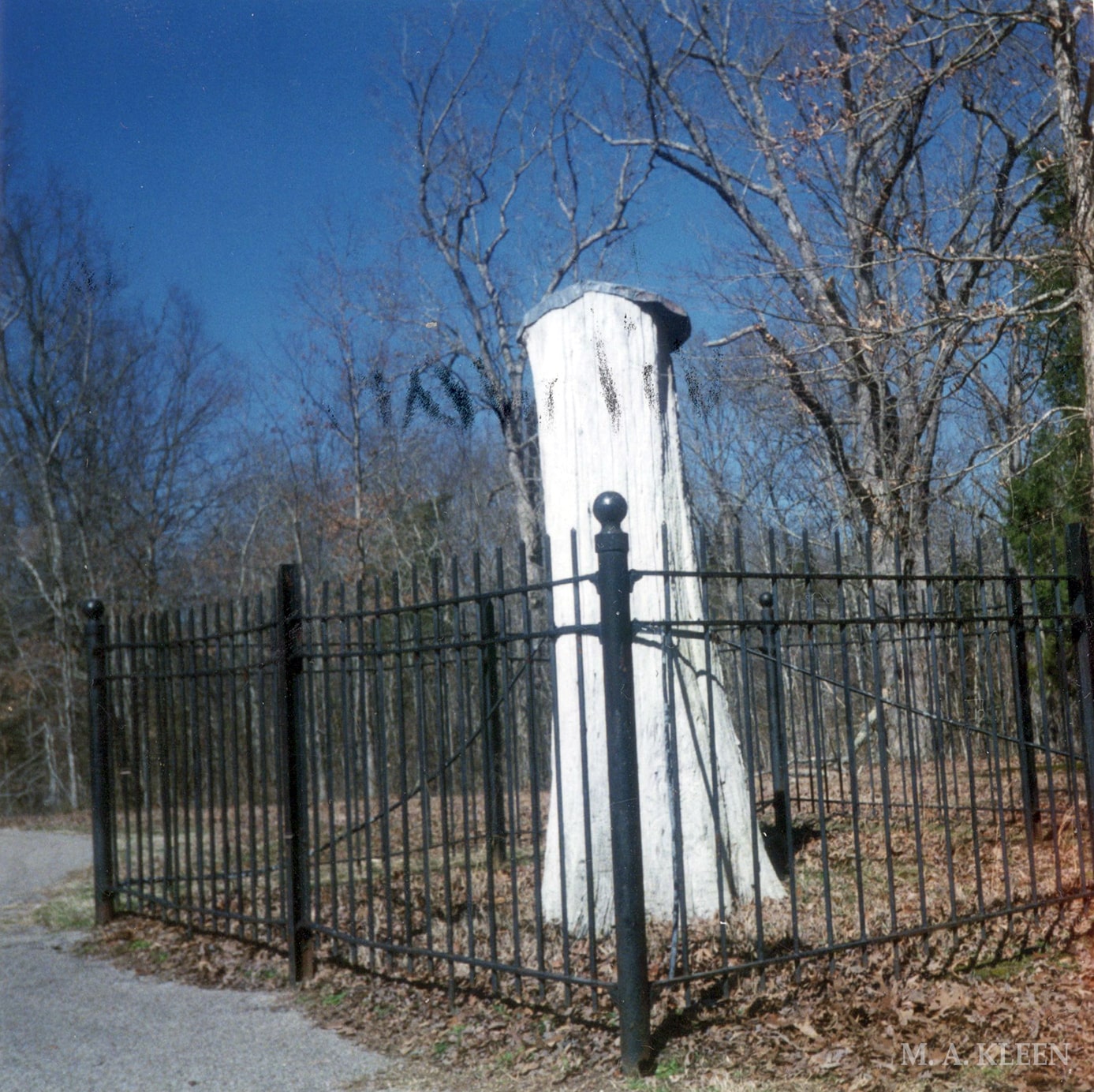
Not far south of Bloody Pond, along Hamburg-Savannah Road, stood an old tree trunk, bleached white, topped with a tin cap, and surrounded by a wrought iron fence. That was all that remained of the oak tree next to which General Albert Sidney Johnston was mortally wounded when a bullet tore through his right femoral artery. At least, that was where, over 30 years later, his aide Isham G. Harris recalled finding Johnston reeling in his saddle.
Johnston died nearby, where a large granite monument stands today. I was fortunate to visit the battlefield while the tree was still standing. It finally succumbed to Mother Nature in 2001.[5]
That wasn’t the only famous tree on the Shiloh battlefield. An unusual granite marker in the shape of a stump sits along Eastern Corinth Road just south of the Hornet’s Nest and Sunken Road. Unlike the Johnston Tree, whose authenticity is disputed, the Putnam Stump was marked immediately after the battle and was where J. D. Putnam of Company F, 14th Wisconsin Infantry was killed during the regiment’s advance on a Confederate battery. His comrades buried him beneath the tree and carved his name into the trunk.
Years later, Putnam’s body was exhumed and reburied in the National Cemetery. After almost four decades, his name was still visible on the stump, which was then replaced with a granite replica.[6]
The battle takes its name from a small log church that was destroyed during the fighting. “Shiloh” was an ancient Hebrew word meaning “tranquil” or “place of peace,” and if warring armies made a mockery of that name in 1862, it certainly applies today. Traversing the park, one gets the impression of crossing consecrated ground.
In the early 1900s, archaeologists identified centuries-old burial mounds within the park’s boundaries built by the South Appalachian Mississippian culture. Owing to preservation efforts connected to the battlefield, the mounds have never been disturbed and remain among the best-preserved sites of their kind in the eastern United States.[7]
Shiloh National Cemetery, adjacent to the visitor center near Pittsburg Landing, was established in 1866. Its 20 acres serve as the final resting place for 3,584 Union dead, most of whom are unidentified. The park itself contains five officially marked Confederate burial trenches, although historical records suggest as many as nine or twelve may exist. These mass graves hold many of the more than 1,700 Confederate soldiers killed in the battle, with the largest estimated to contain over 700 bodies.[8]
The battle of Shiloh may have faded from public memory in recent decades, but somewhere in my mind there will always be that ten-year-old boy standing in the Hornets’ Nest like the mythical Johnny Clem, imagining the roar of cannon on the breeze.
[1] Pvt. Samuel Briggs Todd, Company F, 24th Louisiana Infantry (“Crescent Regiment”). Todd was Mary Lincoln’s half-brother. https://www.findagrave.com/memorial/6045110/samuel_briggs-todd.
[2] For more on the battle itself, see Timothy B. Smith, Shiloh: Conquer or Perish (Lawrence: University Press of Kansas, 2016) or Wiley Sword, Shiloh: Bloody April (Dayton: Morningside Bookshop, 1974).
[3] Tom Elmore, “Walt Disney and the American Civil War,” Emerging Civil War (September 26, 2025), https://emergingcivilwar.com/2025/09/26/walt-disney-and-the-american-civil-war/.
[4] Ellen Robertson, “Major General John Lincoln Clem,” On Point 19, no. 2 (2013): 20–21; The New York Times, August 6, 1915, published an error-filled article on Clem titled “Last Veteran of ’61 to Leave the Army.” Clem had a long and distinguished career in the U.S. Army. The New York Times asserted that Clem earned the nickname “Johnny Shiloh” while fighting in the battle with the 22nd Michigan Regiment, which of course, did not exist in April 1862. The other infantry regiment Clem tried to join early in the war, the 3rd Ohio, also did not fight at Shiloh.
[5] Chris Mackowski, “Albert Sidney Johnston Stumped at Shiloh,” Emerging Civil War (April 8, 2019), https://emergingcivilwar.com/2019/04/08/albert-sidney-johnston-stumped-at-shiloh/.
[6] Albert Dillahunty, Shiloh National Military Park, Tennessee, Historical Handbook Series No. 10 (Washington, DC: U.S. Department of the Interior, 1955), 30.
[7] Paul D. Welch, Archaeology at Shiloh Indian Mounds, 1899-1999 (Tuscaloosa: University of Alabama Press, 2006).
[8] Dillahunty, Shiloh National Military Park, 28-29, 35.


