Another Failure in the Saddle?
On October 21, 1864, Gen. John Bell Hood and P.G.T. Beauregard met in Gadsden, Alabama. Beauregard and Hood discussed prospective strategies for a forthcoming campaign into Tennessee. Hood, the Confederacy’s youngest army commander, presented his intended campaign against Federal installations along the Tennessee River and march into Middle Tennessee. Despite his tacit approval of the plan, Beauregard did express one consideration to Hood. He stipulated that Maj. Gen. Joseph Wheeler and his cavalry corps would remain in northern Georgia to harass Sherman and Maj. Gen. Nathan Bedford Forrest’s command would “form a junction with the Army of Tennessee.” The decision to replace Wheeler, a West Point-trained, experienced cavalryman, with the raider Forrest and his troopers led to a series of delays before the campaign even commenced. Once it had, Forrest’s weakness as a cavalry corps commander within the army level structure became more apparent and severely hampered Hood’s campaign.[1]
Fresh from a raid on the U.S. Army’s supply base at Johnsonville, Forrest’s command crossed back over the Tennessee River to join Hood on November 16 and 17 and brought the total strength of the Army of Tennessee to approximately 33,000 men. Despite his victory at Johnsonville, Forrest’s “men and horses were much jaded” when they arrived in Florence. Adding to the strained condition of the cavalry corps was the presence of a commanding officer in Hood. Forrest, far from a cavalryman in the same vein as Wheeler or other Confederate contemporaries such as J.E.B. Stuart, faced significant difficulties operating within the framework of a conventional command structure. As Hood embarked on his campaign into Tennessee, he would need to rely on Forrest to not only screen the Army of Tennessee’s advance but also gather information and keep him informed as to the movements, strengths, and positions of the U.S. Army. Over the coming days, Forrest’s weakness as a cavalryman showed through. Perhaps Forrest’s worst day came on November 29, at the battle of Spring Hill.[2]
On November 27, Hood called a meeting of his corps commanders at his headquarters and outlined his plans to outflank the 28,000-man force under the command of U.S. Army Maj. Gen. John M. Schofield. Hood’s plan called for two corps of infantry under Cheatham and Stewart to cross the Duck River above (east of) Columbia and march around the Federal left flank to Spring Hill and cut off Schofield from his access to Nashville. This maneuver, however, hinged entirely on the performance of Forrest’s cavalry. For his part, Forrest’s command was to cross the Duck River and drive Maj. Gen. James H. Wilson’s Federal cavalry away from the river and toward the Lewisburg Pike.[3]
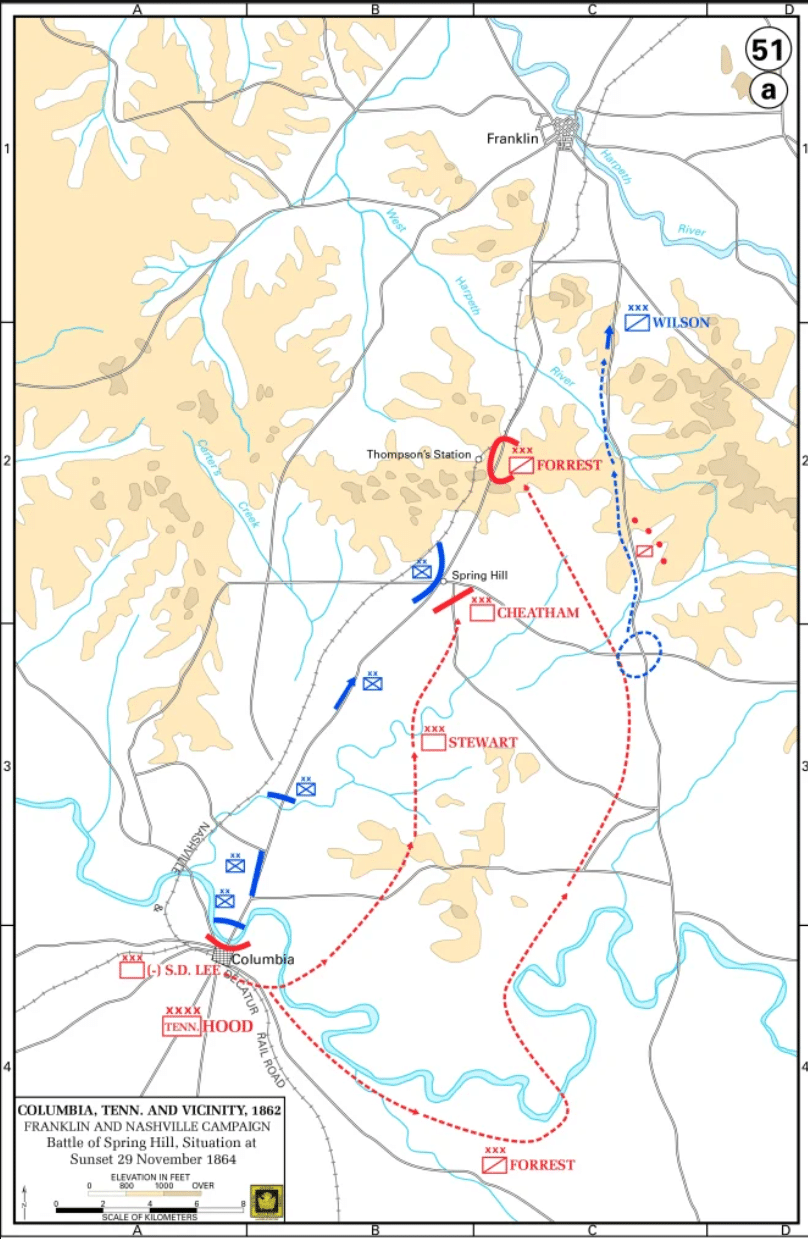
Early the next morning, Forrest began his multi-pronged movement across the Duck. Save for Buford’s battle with Federal cavalry under Col. Horace Capron at Hardison’s Mill, the Rebel advance was uncontested. By midday, fearing Forrest might make a dash for Franklin or Nashville along the Lewisburg Pike, Wilson recalled his command to Hurt’s Crossroads. By sundown, Capron’s command retired from the river crossing and likewise moved to consolidate with Wilson. Throughout the night, Forrest’s troopers maneuvered into position to outflank the Federals at Hurt’s Crossroads, and by daybreak on November 29, a sharp clash sent Wilson’s men in retreat. By 10:00 AM, Federal troopers had withdrawn to Mount Carmel, and after skirmishing there, fell back to Thompson’s Station and onto Franklin. If the day had ended there, Forrest could have taken credit for a job well done. But as the day unfolded, Forrest’s early successes were quickly overshadowed by one of his worst performances in the entire war.
Hours earlier in Columbia, Schofield ordered the evacuation of his supply train as well as the XXIII Corps Reserve Artillery. With his cavalry flung back to Franklin, Schofield tasked Maj. Gen. David Stanley and two of his IV Corps divisions under Brig. Gen. Nathan Kimball and George Wagner to escort the wagon train. Uncertain of Hood’s exact intentions, Kimball assumed a position at Rutherford Creek, and, with only Wagner’s three brigades, the column continued north to Spring Hill. Already posted to the small village, Lt. Col. Charles Hoefling’s 12th Tennessee Cavalry (U.S.) was joined the previous day by the troopers of Company M, 2nd Michigan Cavalry, which gave the Federal defenders only a few hundred men to hold the town with. As he turned off Lewisburg Pike, Forrest and roughly 4,000 men bore down on Spring Hill.
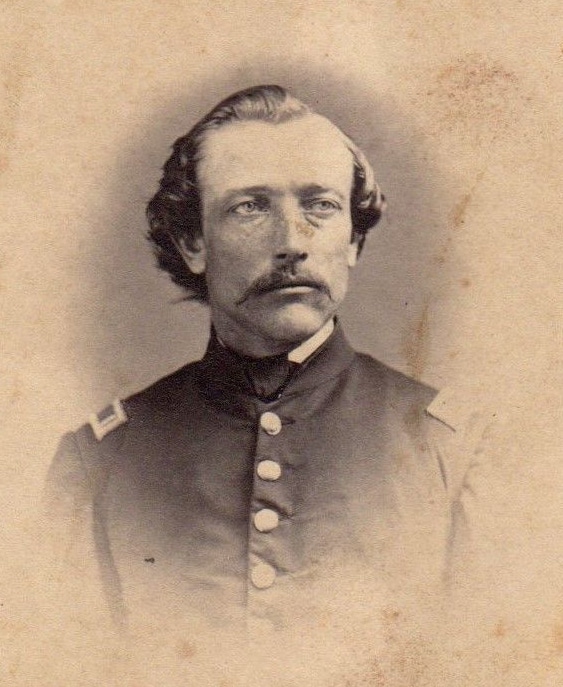
Hoefling and his ad hoc command rode out to meet Forrest’s attack, and two miles from town, they collided first with Confederate skirmishers and then with Brig. Gen. Frank Armstrong’s brigade. Despite being outnumbered, Hoefling’s troopers held back the first of Forrest’s attacks, but the reality of their situation was apparent: they could only delay the Confederate advance, not stop it. Hoefling sent word of the Confederate presence to Schofield:
Three companies been left on picket between [Hurt’s] Crossroads and [Rally] Hill; were attacked, and they retreated to this place, reporting Buford’s division of cavalry marching on this place to attack the wagon trains between here and Columbia. I [have] only a small force, 200 of regiment; all the rest is on courier-line.
In closing this urgent message, Hoefling added, “Communication between here and cavalry headquarters is cut off.”[4]
Stanley, who was still two miles south of Spring Hill, also received word of the imminent threat. Wagner’s division rushed into Spring Hill and deployed to the north and east of the village, and after a delay getting into position, Brig. Gen. Luther Bradley formed to the south.
Forrest not only lost his numerical advantage but also his best opportunity to seize the Columbia Pike at Spring Hill slipped through his fingers.[5]
Wagner’s roughly 5,000-man force established lines of battle and, despite their hasty march from Columbia, prepared to fight for every inch of ground. Rather than scout Wagner’s position, Forrest simply attacked along Col. John Lane’s line to the east of town. Lane, who had only taken command of the brigade that morning, performed ably and managed to throw back Forrest. “I then dismounted my entire command,” explained Forrest, “and moved upon the enemy.” After another repulse, Forrest spied the wagon train and later mentioned it in his report. He even explained that he received orders from Hood during the skirmish. Surely then, if word could be sent from the army commander (who had been the moving infantry columns throughout the day and had little to no understanding of what was unfolding in Spring Hill), a report of the Federal presence at Spring Hill could have been sent. There is, however, no evidence to indicate Forrest ever relayed word of his situation or the strength of Federal forces in the area to his army commander. Yet again, in the heat of the moment, Forrest left his army commander blind to the battlespace’s ever-evolving tactical situation.[6]
Low on ammunition and exhausted after almost twenty-four hours of action, Forrest withdrew his men to the Caldwell House east of the Rally Hill Pike. From there, Forrest waited for the main body to arrive. At this crucial moment, he made no attempt to locate the head of the column, relay intelligence to Hood, or actively scout the Federal position. When the infantry arrived, they would arrive with little understanding of what lay ahead or the relative strength of Wagner’s division.
As Cheatham’s corps arrived, Forrest joined Col. Tyree Bell’s brigade. Positioned to the right of Maj. Gen. Patrick Cleburne’s division, Forrest and Bell went forward. Concealed by woods and by the undulating ground, Bradley’s brigade of Wagner’s division took Cleburne’s lead brigade by surprise. A sharp fire fight broke out, and Cleburne’s command was clearly caught off guard owing to the hasty shifting and repositioning Brig. Gen. Mark Lowrey’s brigade undertook, and the speed with which Brig. Gen. Daniel Govan’s men rushed to the front. Perhaps Forrest exchanged information about the Federal strength with Cleburne, but no evidence exists to support that supposition. Forrest never mentioned any conversation between him and Cleburne, but the latter’s death leaves readers with more questions than answers and a missing perspective on the events of November 29.
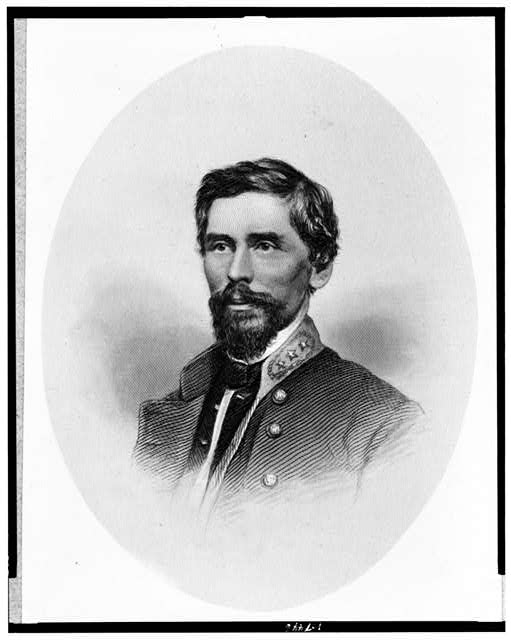
At any rate, from the available evidence, Forrest failed to communicate with Cleburne, Cheatham, or Hood. The dominoes of fate began to fall. By dusk, Schofield arrived south of town with the rest of Stanley’s corps and the entire XXIII Corps. As they came into view, Maj. Gen. William Bate’s division advanced toward the Columbia Pike, the army’s chief objective of the day, and skirmishers exchanged fire. Owing to the confusion of Cleburne’s fight, Cheatham recalled Bate’s division even as they were yards away from securing the road and challenging the Federal advance. Schofield’s daring night march had an open road forward.[7]
In an evening conference, Hood ordered Forrest to move at least a portion of his command to block the road north of town. His options, though, were limited. Most of his men had little or no ammunition, nor had their horses rested in almost thirty-six hours. Nevertheless, Forrest sent word to Jackson’s division and soon, Brig. Gen. “Sul” Ross’s brigade managed to gain control of the Columbia Pike at Thompson’s Station. Without support or adequate communications and supplies from the main body, however, as well as the arrival of Federal Brig. Gen. Thomas Ruger’s division, Ross’s barricade was short-lived.
In 2011, David A. Powell published Failure in the Saddle: Nathan Bedford Forrest, Joseph Wheeler, and the Confederate Cavalry in the Chickamauga Campaign. In his assessment of Forrest’s performance during his sortie with Gen. Braxton Bragg’s Army of Tennessee, Powell asserts, “New to both regular cavalry operations and corps command, Nathan Bedford Forrest struggled to meet the rigorous challenges of his increased responsibilities.” Powell observed Forrest’s weaknesses as:
- Inexperience with corps command and traditional cavalry missions
- His inability to delegate authority and his need to always be at the forefront of any action
If, as Powell argues, “Cavalry provides the eyes and ears for every army commander,” Forrest’s poor intelligence gathering and failure to relay accurate and timely information during the campaign left his commander blind in 1863 and again in the late fall days of 1864. If observers wish to cast blame on any of the Army of Tennessee’s principal commanders in the field that day, that list must include the so-called “Wizard of the Saddle.” “The Tennessean,” Powell concludes, “was evolving from a partisan raider into a more complete cavalry general.” That evolution, however, was still far from complete when Forrest and his command joined Hood and the Army of Tennessee. On November 29, when he was needed most, he failed catastrophically.[8]
————
[1] Report of General G.T. Beauregard, C.S. Army, commanding Military Division of the West, The War of the Rebellion: A Compilation of the Official Records of the Union and Confederate Armies, Series I, Volume XLV, Part 1- Reports, (Hereafter referred to as OR 45), (Washington, D.C.: Government Printing Office, 1894), 648.
[2] Report of Maj. Gen. Nathan B. Forrest, C.S. Army, commanding cavalry, of operations November 16, 1864-January 23, 1865, OR 45, Part 1- Reports, 751.
[3] Forrest Report, OR 45, 752-753.
[4] Hoefling to Schofield, Spring Hill, November 29, 1864, OR 45, 1152.
[5] David S. Stanley, ed. Samuel W. Fordyce IV, An American General: The Memoirs of David Sloan Stanley, (Santa Barbara, CA: The Narrative Press, 2003), 174.
[6] Forrest Report, 753.
[7] Report of Maj. Gen. William B. Bate, C.S. Army, commanding division, of operations November 21-December 25, 1864, OR 45, 742.
[8] David A. Powell, Failure in the Saddle: Nathan Bedford Forrest, Joseph Wheeler, and the Confederate Cavalry in the Chickamauga Campaign, (El Dorado Hills, CA: Savas Beatie, 2011), 205-207, 208, 211-212.


I confess to being an enthusiastic supporter of Dave Powell’s work, and I frankly think his single volume “Failure in the Saddle . . .” is one of the best and most illuminating books in recent years. So it is no surprise to me that NBF struggled to “do his job” in the late fall of 1864.
Great post!
I came to something like Powell’s conclusions around 2006 when I argued with a friend that Stuart was better because he was a better all around cavalry commander. That said, Forrest was in his element in the retreat from Nashville.