Book Review: Confederate General D.H. Hill: A Military Life

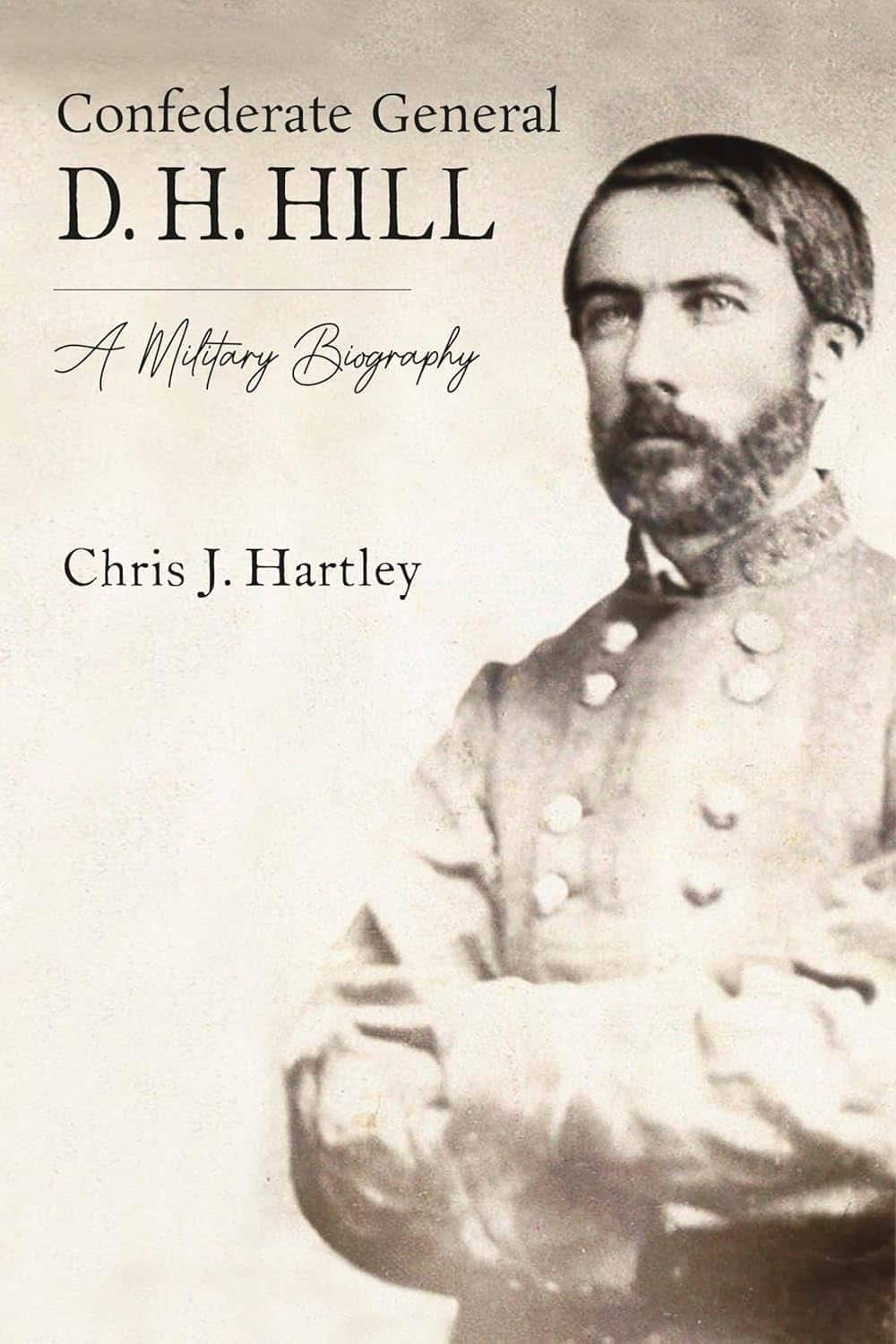
Confederate General D.H. Hill: A Military Life. By Chris J. Hartley. El Dorado Hills: Savas, Beatie, 2026. Hardcover, 536 pp. $39.95.
Reviewed by John B. Sinclair
When students of the Civil War think of D.H. Hill, their first thought might be that of a prickly, caustic, and dyspeptic Confederate general whom even the patient Robert E. Lee could not abide and removed from the Army of Northern Virginia. Other reactions may include blame for Lee’s Lost Order at Antietam and for a botched performance at Chickamauga and then leading a cabal against Braxton Bragg. Still others blame Hill’s dour personality on his many health problems. How much of it is true and how much of it is a two-dimensional view of Hill?
Many noted historians from Douglas Southall Freeman to R.E.L. Krick have included assessments of D. H. Hill in their works on the Civil War. Until now, however, there has been only one significant biography of Hill, which was published in 1961.[1] This new book on D.H. Hill was over ten years in the making. Author Chris Hartley has burrowed deeply into Hill’s letters, papers, books, and articles along with a bevy of other archives and primary sources to produce an authoritative and reader-friendly biography. Disagree with Hartley as you might (I did a few times), this book is the starting point for newborn or veteran Civil War readers interested in D.H. Hill
Hartley starts his work with an excellent review of contrasting historian views of Hill, giving readers a welcome primer on what is to come. His early life is explored in detail, including being raised by his widowed mother after the early death of his father. Spinal and other health problems dogged him his entire life. While Hill is described as standing 5 foot 10 inches tall, his back problems apparently caused him to assume a bent walk.[2]
Hill’s Presbyterian religious faith was a central feature of his life. It instilled in him a strong sense of rectitude, leading Hill to argue passionately throughout life about what was right and wrong, a trait that caused him particular trouble during the Civil War. The author opines that Hill’s critical nature was also caused by his drive to succeed due to his father’s financial failures and not, as thought by many, due to various physical ailments that afflicted him.
Part of the West Point Class of 1842, Hill had many friends and acquaintances who later became officers and generals in the Civil War. During the Mexican War, he took part in the storming of the heights of Contreras and the Fortress of Chapultepec. A harbinger of his future tendencies, Hill wrote anonymous articles during that war criticizing the volunteer system and the management of the American military. His friendship with Stonewall Jackson also began during that war, which deepened as they became brothers-in-law.[3]
Hill married Isabella Morrison in July 1850 and went on to have nine children with her. He enjoyed a successful teaching and administrative career at several southern colleges. He authored a successful book on mathematics, controversial because it included humorous, anti-Yankee math examples. Hill also wrote a book on the Bible along with other religious articles.
Hill felt the South’s way of life was under siege by the North, and he favored secession. He became the colonel of the 1st North Carolina Infantry Regiment. Hill was conspicuous leading his men at the battle of Bethel to defeat a larger Union force. Reflecting his complexity and contradictions, Hill expressed distress to his wife[4] at the thought of fighting his former West Point and prewar comrades despite his visceral hatred for Yankees. Indeed, during the war when encountering former friends taken prisoner, Hill took pains to ensure they were treated properly, had adequate medical attention, and even gave them money. Despite criticism that Hill was a cold character, Hartley provides various instances of Hill’s humor and concern for his men’s welfare from their physical to spiritual needs.
Hill was fearless during combat, inspiring his men even when exposing himself to fire. Hartley provides many examples where staff members around Hill were killed or wounded (as well as horses). Time and space do not permit examining all the battles in which Hill was engaged (the text accompanied by fine maps from Edward Alexander). A few examples may suffice. Hartley asserts that Hill “fought the best of any senior Confederate leader at Seven Pines” and showed fitness for one day assuming corps command. (212) Hartley quotes with approval Douglas Southall Freeman’s assessment of Hill at Gaines’s Mill: “No division commander that day had done better.”[5] (232) Hill dissented regarding the attack at Malvern Hill, but was overruled by Robert E. Lee and James Longstreet. Still, he vigorously pursued an assault on the heavily fortified Union position, resulting in heavy casualties and his bitterness regarding the loss of so many men. Hill emerged from the Seven Days with a bright military future based on “a strategic sense and sound tactical skills.” (247) This record was marred by disputes with fellow officers (including duel challenges from them) and perhaps unwelcome opinions on military strategy.
With some reservations, Hartley praises Hill’s great tenacity in defending South Mountain and later at Bloody Lane at Antietam. Hill was against Lee dividing his forces before those battles. The famous loss of Special Orders No. 191 for which Hill had to defend himself during and after the war is examined. Relying in part on excellent scholarship by Alex Rossino, Hartley absolves Hill from any blame.[6]
Hill’s complaints continued after Antietam, including over excessive furloughs and whether his division received a fair share of Union artillery seized over the preceding months. He was also upset over not receiving a promotion to lieutenant general. Hill resigned on January 1, 1863. Contrary to what Hartley describes as the “trope” that Lee sought to rid himself of Hill, Lee attempted to dissuade Hill from resigning. (346) Lee also urged the War Department not to lose the services of this valuable officer and to assign him to take charge of troops in North Carolina (where Hill’s home was located). The assignment occurred, with Hill later becoming Department Commander in April 1863.
Hill predicted in private that Lee’s invasion of the North in 1863 would be “fruitless if not disastrous.” (378) In an underappreciated episode, while Lee was away from Richmond, Union authorities launched a major raid on Richmond hoping to cut Lee’s supply lines and to occupy Richmond briefly if possible. Taking control during this emergency, Hill took the measure of his Union opponent and launched an aggressive attack, stopping the Union raid and causing Union forces to retreat back to Fort Monroe.[7]
Shortly after this episode, Davis promoted Hill to lieutenant general and transferred him to command a corps in Braxton Bragg’s army. After Chickamauga, however, Davis never submitted Hill’s name to the Confederate Congress for confirmation, which then of course incurred Hill’s ire. Describing September 20, 1863 at Chickamauga as Hill’s “worst day of his military career,” Hartley attributes Hill’s failure to attack on time that morning on “a communication breakdown of monumental proportions.” (404 & 410) Hartley places blame mostly on Bragg and Leonidas Polk, albeit with some fault resting on Hill.
Hill participated in the officer group that produced a petition to the Confederate government to remove Bragg from Army command. After Davis decided to retain him in place, Bragg acted swiftly to remove Hill from his army. Hill made an easy scapegoat as Longstreet and Polk were considered politically untouchable. After his removal in October 1863, Hill requested a court of inquiry, but his request was denied by Confederate Secretary of War James Seddon as unnecessary because no formal charges were lodged against Hill.
Thus began Hill’s journey into the proverbial wilderness. While he would have been allowed to take other commands, Hill first insisted on a full expression of confidence from the Confederate government, which was declined. Hill was allowed to act as a volunteer staff officer, but his full skills as an excellent combat officer were lost to the Confederacy until near the end of the war when he relented and put in a solid performance at Bentonville.
After the war, Hill returned to teaching and business ventures. He also published a magazine (The Land We Love) and newspaper that promoted the memory of the Confederacy. Themes of Southern pride and corrupt Reconstruction practices were prevalent in these publications. His brand of the Lost Cause focused on the bravery of the common Confederate soldier whom he considered had no equal when led by competent leaders. While he respected Lee, Hill criticized the efforts of Virginians to deify Lee. Hill died due to stomach cancer at the age of 68 in 1889.
Hartley’s biography is a thoughtful rebalancing of the strengths and weaknesses of D.H. Hill, one of the Confederacy’s best division combat commanders. In 1991, historian Gary Gallagher wrote about the need for a full biography of Hill. In his customary wordsmithing, Gallagher said, “The materials exist for a full life, awaiting the attention of a biographer with the temperament to spend several years in Hill’s prickly company.”[8] Thirty-five years later, that biographer has now arrived with this impressive book on a fascinating, talented, and yet flawed military commander.
John B. Sinclair is a retired charitable foundation president and a retired attorney. He is a member of the Baltimore Civil War Roundtable, a member of the Sons of Union Veterans of the Civil War (James A. Garfield Camp No. 1), and a Life Member of the Lincoln Forum.
[1] Lee’s Maverick General: Daniel Harvey Hill, Hal Bridges (New York: McGraw-Hill, 1961).
[2] My favorite physical description of Hill comes from Bentonville: The Final Battle of Sherman & Johnston, Nathaniel Cheairs Hughes, Jr. (Chapel Hill, University of North Carolina, 1996) 27: “An odd man was this Harvey Hill. Small and crooked, bookish, he looked like a character from Dickens. Yet he had ability.”
[3] Author Hartley notes how much alike Hill and Jackson were: “[T]he two men were birds of a feather, from their tastes to their ideals. Even Hill’s personality was a match for Jackson’s.” (57) Jackson, a highly secretive commander, apparently even on occasion shared his military plans with Hill.
[4] Hill’s letters to his wife, children, and others reveal a softer side to his personality and at times even a lack of self-confidence, though retaining an abiding confidence in God’s plans for him.
[5] In his recent study, The Battle of Gaines’s Mill, Volume 2: Race Against the Setting Sun, Robert E.L. Krick (Washington D.C.: The American Battlefield Trust, 2025) 855, Krick has a distinctly contrary view.
[6] Calamity at Frederick: Robert E. Lee, Special Orders No. 191 and Confederate Misfortune on the Road to Antietam, Alexander B. Rossino (El Dorado Hills, Savas, Beatie, 2023).
[7] An outstanding book on this subject is Gettysburg’s Southern Front: Opportunity and Failure at Richmond, Hampton Newsome (Lawrence, University Press of Kansas, 2022). One can only imagine the deep blow to Confederate morale had this raid been successful coupled with the Confederate defeat at Gettysburg.
[8] Gallagher made this statement in his introduction to the paperback edition of Lee’s Maverick General: Daniel Harvey Hill, Hal Bridges (Lincoln: University of Nebraska Press, 1991) xviii.


Many thanks, John, for the thoughtful and in-depth review of what I believe is one of the most important Civil War biographies published in many years. I very much enjoyed working with Chris to make this a reality. Onward.
John, I echo Ted and appreciate the review. Researching and writing this biography of D.H. Hill was a long but rewarding journey, and it was made better thanks to Ted and his fine company. If you or anyone visiting this review has questions, I’m happy to help!
Hands down one of the best Civil War biographies I’ve read. Congratulations to Ted Savas for a beautiful job of publishing, especially the footnotes on every page, instead of at the end. The maps and photographs are first class. Hartley is a fine writer – judicious, balanced and scholarly.
Thank you for reading my book and for your comments, Michael! It was great working with Ted Savas to bring this story of D.H. Hill to life.
I recently completed reading this book and it’s quite well researched and written. It’s an easy read and it flows well and I recommend it to anyone I know that is into the civil war. This is a real winner!