Custer’s Camouflage
Wednesday, June 17, 1863 was a sweltering day in Northern Virginia. By 2 p.m. the thermometer registered in the mid-90s.[1]
Through the heat, the Army of the Potomac’s Second Cavalry Division was marching west on the Little River Turnpike in search of Robert E. Lee’s army. The Confederates were rumored to be moving north in the Shenandoah Valley, screened by the Blue Ridge Mountains. Brig. Gen. David M. Gregg pushed his men west through the Bull Run Mountains toward the little village of Aldie. Spearheading Gregg’s column was the brigade of newly promoted Brig. Gen. H. Judson Kilpatrick.
As the column approached Aldie, the air was “intolerable; [making it] absolutely difficult to breath.” Billowing clouds of dust were kicked up from the moving column. The horses’ shoes and the wheels of the wagons and horse artillery passing over the inches- thick dust in the road created a thick, brown cloud. The dust stuck to the sweaty troopers and their mounts and obscured their vision. One cavalryman complained that he could not see beyond the set of fours in front of him.[2]

Kilpatrick’s brigade soon encountered Confederate resistance just west of Aldie where the Snickersville Pike diverges from the Little River or Ashby Gap Turnpike. Both roads lead to gaps in the Blue Ridge Mountains.The sounds of cannon and small arms fire echoed back along the Yankee column to where Gregg and his staff had halted east of Aldie. Among Gregg’s staff was Brevet-Captain George Armstrong Custer. Custer, a member of cavalry chief Maj. Gen. Alfred Pleasonton’s staff was riding with Gregg as a liaison between Gregg and his commander.
Taking advantage of the temporary halt, members of Gregg’s staff watered their horses and filled their canteens by a stream beside the road. “Custer at once attracted the attention of the entire command,” wrote 19-year-old Henry Coddington Meyer of Gregg’s staff. “On that day he was dressed like an ordinary enlisted man, his trousers tucked in a pair of short-legged government boots, his horse equipment being those of an ordinary wagon master. He rode with a little rawhide whip stuck in his bootleg, and had long yellow curls down to his shoulders, his face ruddy and good-natured.” In addition, he wore a wide brimmed, non-regulation hat against the blazing sun.[3]
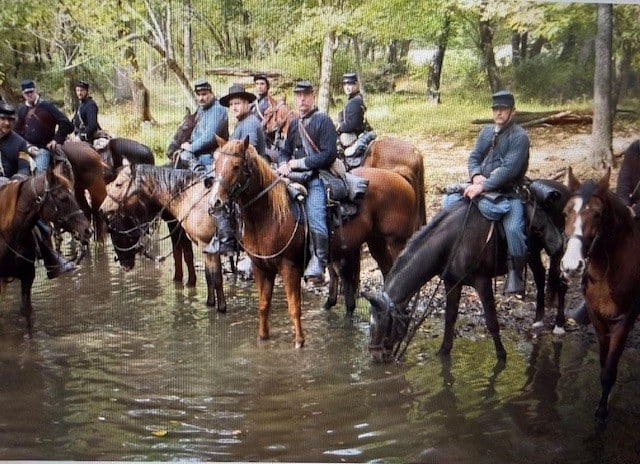
Mounted on his large, black horse, “Harry,” Custer crossed the stream to reach the undisturbed water on the far side away from the rest of Gregg’s staff. “He did not know how deep the water was; and after his horse was satisfied, instead of turning by the way he went in, concluded to cross the stream and come out on the other side.” When Custer urged “Harry” to climb out, the horse slipped on the steep, slippery bank. Horse and rider fell backwards, plunging into the water, disappearing beneath the surface. In an instant Custer “was on his feet and he and the horse struggled out amid the shouts [and laughter] of the spectators.” They all watched as, chagrined and soaking wet, Custer sheepishly rejoined the staff. As the column proceeded, the “dust settled on his wet clothes and wet hair, Custer was an object that one can better imagine than I can describe,” recalled Meyer.[4]
With the firing ahead unabated, Gregg sent a courier to bring up Col. Calvin Douty’s 1st Maine Regiment. Gregg ordered Douty to reinforce Kilpatrick, and Custer was to accompany them. As they trotted along the dusty road, Custer’s appearance changed. Historian Robert F. O’Neill wrote: “Custer’s blue tunic and pants quickly took on the color of the road as the dust clung to his wet uniform like iron shavings to a magnet.”[5]
With a swarm of rebel horsemen charging down the Snickersville Pike toward and his exposed horse artillery, Kilpatrick spotted the lead squadron of the 1st Maine Cavalry. Without waiting for the rest of the regiment to arrive, Kilpatrick, standing in his stirrups, implored the men of Maine to charge. Capt. Andrew Sprurling ordered his squadron to draw sabers, and they dashed forward. The resulting clash of blue and gray horsemen resulted in a melee with many saddles on both sides emptied before they disengaged.[6]
With the Confederates withdrawing uphill to the safety of the stone walls near Furr’s farm, Kilpatrick had Douty deploy the rest of the 1st Maine in preparation to charge after the retreating rebels. Legend has it that Custer, “waving his broad-brimmed hat,” rode up to join Kilpatrick and Douty in front of the line, shouting, “Three cheers for General Kilpatrick!”[7] Seeing what was about to take place, Custer couldn’t keep himself out of the fight.
As light was beginning to fade and the Mainers starting forward, Custer dug his spurs into Harry’s flanks and shouted, “Come on boys!” In the charge, Kilpatrick’s horse was killed – shot through the neck sending both horse and rider sprawling in the dust. Custer was soon ahead of the formation and in amongst the fleeing rebels. One Confederate swiveled and fired his revolver at the captain but missed. Custer swung his blade, striking the man and almost cutting his arm off. Another galloped behind Custer with sword in hand. Custer reined to a stop, only to have the man speed past. Custer spurred after him and caught up to the Confederate, who tried unsuccessfully to parry Custer’s saber blows and was cut down.[8]
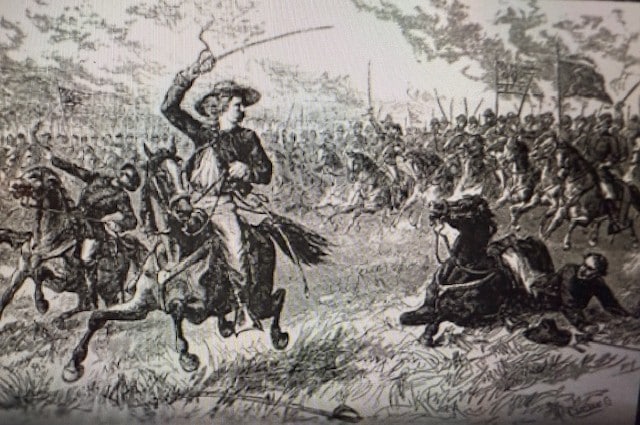
Custer, Kilpatrick & Douty at Aldie by Alfred Waud for Harpers Weekly
The Maine troopers following, drew up at the Confederate line, posted behind a stone wall supported by cannons. A rebel volley greeted them, and Col. Douty was shot out of the saddle, killed instantly. Custer’s horse must have been spooked as he “suddenly bolted carrying his powerless owner at breakneck speed” through the ranks of Confederates to their rear. In the dusty darkness “it was scarcely possible to distinguish friend from foe,” wrote a Maine trooper.[9]
Custer regained control of his horse and was surprised to find himself in the midst of the enemy. He was equally surprised that none of them recognized him as an enemy. He turned and started for an opening in the enemy ranks to escape. In a letter written to his sister on June 25, Custer explained:
“I was surrounded by rebels, and cut off from my own men, but I made my way out safely, and all owing to my hat, which is a large broad brim, exactly like that worn by the rebels. Everyone tells me that I look like a rebel more than our own men. The rebels at first thought I was one of their own men, and did not attack me, except one, who rushed at me with his sabre, but I struck him across the face with my sabre, knocking him off his horse. I then put spurs to ‘Harry’ and made my escape.”[10] Custer made no mention of how his dirty brown-stained uniform helped to camouflage that he was a Union officer.
Historian Edward Longacre wrote that word of Custer’s exploit “got back to Kilpatrick, Gregg,” and Pleasonton. “If he had been looking to make an impression on those who could promote a soldier’s career,” Longacre wrote, “he seems to have achieved his purpose.” E.A. Paul, The New York Times correspondent, wrote about Custer’s heroic exploit, and Michigan newspapers, including the Monroe Commercial, lauded Custer’s actions. The story prompted noted Civil War artist Alfred Waud to sketch a drawing for Harper’s Weekly illustrating Custer leading the charge while Kilpatrick and Douty were falling. Twelve days later Custer was promoted from brevet captain to brigadier general.[11]
When you read the accounts of the exploits, some things don’t make sense. First, why would Custer ride with the fleeing rebels all the way through the Confederate lines and into their rear unless his horse had bolted and he had lost control of the animal? In Whitaker’s account and the account in the Michigan newspaper quoted in Merington’s book, Custer knocks one enemy from the saddle and then pulls the reigns in on Harry so a second assailant chasing him dashes by. If the horse had taken the bit in its teeth and was bolting, how did Custer manage this? And, if he did gain control before the Confederate line, why did he continue into mortal danger behind their lines surrounded by foes? Of course, it wouldn’t be the last time Custer found himself surrounded by foes, like at Trevellian Station and the Little Bighorn[12]
Custer was ambitious and had goals to achieve. The first was to be promoted and get a command of his own. He had been trying to pull strings to get command of a Michigan cavalry regiment, but was unsuccessful.[13] He attached his hopes to Pleasonton’s success. Pleasonton liked Custer, and Custer thought that if Pleasonton was promoted, he would be too. The cavalry chief wanted to get rid of ineffective cavalry officers (many of whom were foreigners) and wanted aggressive officers “with the proper dash to command cavalry,” and Custer fit the bill.[14] It was not unusual for ambitious staff officers to try and prove their worth and competence to gain a promotion or field command. Much like in the corporate world many young executives hitch their star to the success of their superior in hopes of being raised along with them. Pleasonton was promoted to major general and that general’s patronage and Custer’s publicized exploits at Aldie got him his promotion.
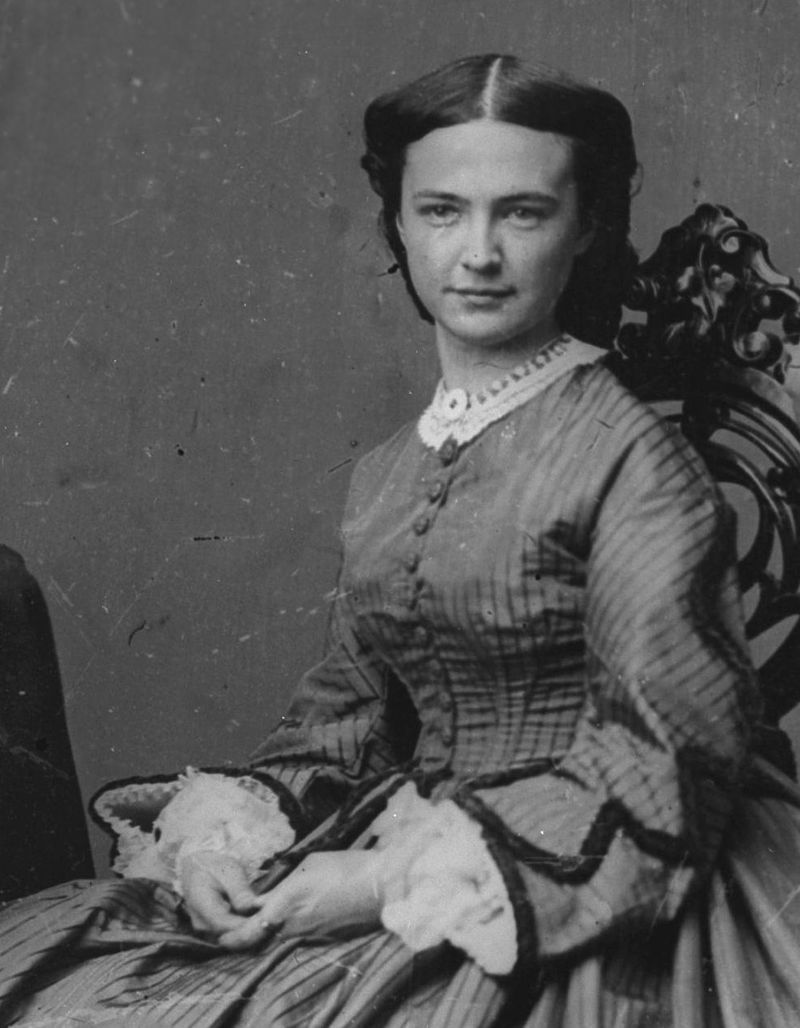
Custer was also trying to win the hand of Elizabeth Bacon, whose father thought Custer not suitable. On July 5, after Aldie and Gettysburg, Libbie received a huge envelope containing favorable press clippings about Custer and the picture from Harper’s. By Christmas, Custer and Libbie were engaged.[15]
Custer had ample motivation to embellish his actions on June 17 to achieve these two goals. Most modern historians are skeptical of the extent of Custer’s exploits that day. While members of the 1st Maine saw Custer on that hot summer day, none could substantiate or refute the story of his wild ride. Other than being at the head of the line with Kilpatrick and Douty, and dashing up the Snickersville Road, none saw him penetrate the rebel line. They were too much pre-occupied with their own fights to watch a staff officer. Cavalry expert Edward Longacre would say that, “Over time, Custer’s wild ride would be deemed so improbable that historians would consider it stuff of fiction.” Jeffery Wert in his Custer book thought “the account seems dubious,” and historian Jay Monoghan said, “the records fail to substantiate it . . . the only basis for the spectacular charge is in the accounts printed in The New York Times, Michigan newspapers,” and Custer’s own letter to his sister. Interestingly, that letter does not exist in the book of letters between Custer and his wife edited by Marguerite Merington. In fact, Longacre claims that the letter cited was in the Elizabeth Bacon Custer Collection reposited at the Little Bighorn Battlefield National Monument in Montana. However, upon his examination of the file, the letter could not be located. It is unknown what if anything newsman E.A. Paul witnessed of Custer’s escapades. He was behind the lines with Gregg’s staff. It is questionable how much he could see of the action around the Furr house due to the distance, the fading light, and the dust and gun smoke. Maybe he got his facts from Custer himself. There was no mention of Custer in Tobie’s History of the First Maine Cavalry or in the Official Records of that regiment. Moreover, the official reports of Pleasonton, Gregg, and Kilpatrick in the OR likewise make no mention of Custer either.[16]
We may never know what really happened. We can only rely on Custer’s account, and he was never one to hide his light under a bushel. Maybe it was just part of the Custer legend or Custer’s luck. Whatever the case, as the slogan goes, never let the truth get in the way of a good story.
[1] Krick, Robert K., Civil War Weather in Virginia, Tuscaloosa, AL. The University of Alabama Press, 2007, p. 101.
[2] O’Neill, Robert F., Small but Important Riots: The Cavalry Battles of Aldie, Middleburg, and Upperville, Lincoln, NB, Potomac Books, an imprint of the University of Nebraska Press, 2023, p. 61. Meyer, Henry Coddington, Civil War Experiences Under Bayard, Gregg, Kilpatrick, Custer, Raulston, and Newberry, 1862, 1863, 1864, New York, NY, privately printed by Knickerbocker Press, G.P. Putnam’s Sons, 1911, p. 34. The Project Gutenberg eBook of Civil War Experiences, by Henry C. Meyer.
[3] Meyer, Civil War Experiences, pp. 33-36. Custer’s own account states he was wearing a wide-brimmed straw hat, but others thought it was a soft-felt hat in the Confederate style.
[4] Ibid. pp. 33-34.
[5] O’Neill, Small but Important Riots, p. 91.
[6] Reunions of the First Maine Cavalry, 1879-1880, Augusta, ME, 1881, p. 79. Maine Bugle, July 1894, pp. 260-262. Tobie, Edward P., History of the First Maine Cavalry, 1861-1865, Published by the First Maine Cavalry Association, Boston, MA, Press of Emery & Hughes, 1887, p.161.
[7] Merington, Marguerite (Ed.) 1950, The Custer Story: The Life and Intimate Letters of General Custer and His Wife Elizabeth, New York, NY, The Devin-Adair Company, p. 55. The passage is a quote from a June edition of a Michigan newspaper for which the editor does not give a more detailed reference.
[8] Stiles, T.J., Custer’s Trials: A Life on the Frontier of a New America, New York, NY, Alfred A. Knopf, 2015, p. 91. Longacre, Edward G., Custer: The Making of a Young General, New York, NY, Skyhorse Publishing, 2018, p. 142. Frederick Whittaker, A Complete Life of General George A. Custer, Vol. 1: Through the Civil War, reprint Lincoln, NE, University of Nebraska Press, 1993, p.159. Originally published by Sheldon & Company, New York, a Bison Book edition.
[9] Tobie, History of the First Maine Cavalry, pp. 161-164. The New York Times, June 20, 1863, article written by correspondent E.A. Paul.
[10] Stiles, Custer’s Trials, pp. 91-92. Longacre, Custer, pp. 142-143. Whittaker, Complete Life of Custer, Vol. 1, p. 159.
[11] Longacre, Custer, pp. 196-197. Alfread Pleasonton to John F. Farnsworth, June 18, 23, 1863, Pleasonton MSS, Library of Congress.
[12] Whittaker, Complete Life of Custer, p. 158-159. Merington, The Custer Story, p. 55-56.
[13] Stiles, Custer’s Trials, p. 84-85. Harris, Samuel, Personal Reminiscences of Samuel Harris, Chicago, Il, The Robertson Press, 1897, pp. 17, 23-24. Urwin, Gregory J.W., Custer Victorious: The Civil War Battles of General George Armstrong Custer, Lincoln, NE, University of Nebraska Press, 1983, p. 53.
[14] Whittaker, Complete Life of Custer, Vol. 1, p. 160.
[15] Leckie, Shirley A., Elizabeth Bacon Custer and the Making of a Myth, Norman, OK, University of Oklahoma Press, 1993, pp. 30-31.
[16] Longacre, Custer, pp. 142 -143, & endnote 32, p. 235. Wert, Jeffery D., Custer: The Controversial Life of George Armstrong Custer, New York, NY, Simon & Schuster, 1996, p. 80. Monaghan, Jay, Custer: The Life of George Armstrong Custer, Lincoln, NE, University of Nebraska Press, 1959, pp. 130-131. Whittaker, Complete Life of Custer, p. 159. The letter to his sister is quoted in Whittaker’s book who is an unabashed promoter of Custer. The War of the Rebellion: A Compilation of the Official Records of the Union and Confederate Armies, 4 series, 128 vols., Washington D.C., Government Printing Office, 1880-1901. Vol. 27, series 1, pt.1, pp. 906-908, 913, 952-955, 979-980. #1006 – The War of the Rebellion : a compilation of the official … ser.1:v.27:pt.1:Reports. – Full View | HathiTrust Digital Library


AUTIE!
Great story, Brian. But sham eon you for ever doubting the word of G.A.C.
Great article and professionally done, thank you. Probably a fairly common technique employed by many during the Civil War. But apparently a standard issue Custer modus operandi. Didn’t Custer manipulate the press in 1874, reporting a highly exaggerated amount of gold in the Dakotas (Indian lands) to initiate a gold rush by white people and break a US treaty with the Sioux. While on the subject of press manipulation, young pre-professional Ty Cobb wrote to an Atlanta newspaper under an alias exclaiming the virtues of baseballer Ty Cobb.