U.S. Navy Parallels: 1863 and 2026
Like many Americans, I have been closely watching the United States naval activity related to Iran in the past weeks. Unlike most however, I keep drawing parallels between the U.S. Navy’s activity against Iran now with the U.S. Navy’s activity 165 years ago during the Civil War. Politics aside, these parallels center around four primary themes: power projection inland, blockades, convoys, and viability of sustained naval activity.
Power Projection Inland
When military activity against Iran began on February 28, 2026, the campaign began as one of power projection from the air and sea inland. Missile and air strikes into Iran commenced, with the goal of destroying infrastructure and command and control systems, as well as to gain air superiority. All of this would allow the United States to project its own power far inland in the hope of destabilizing Iranian political and military forces, as well as transportation and communication networks.
In many ways, this power projection is no different than what United States military and naval forces attempted along the littoral coastline against the Confederacy during the U.S. Civil War. Federal forces sought to strike inland using amphibious activity, hoping to isolate parts of the Confederacy, create inland fronts, sever rail and telegraph connections, and target Confederate economic output via freeing enslaved laborers or disrupting their normal activity.[1]
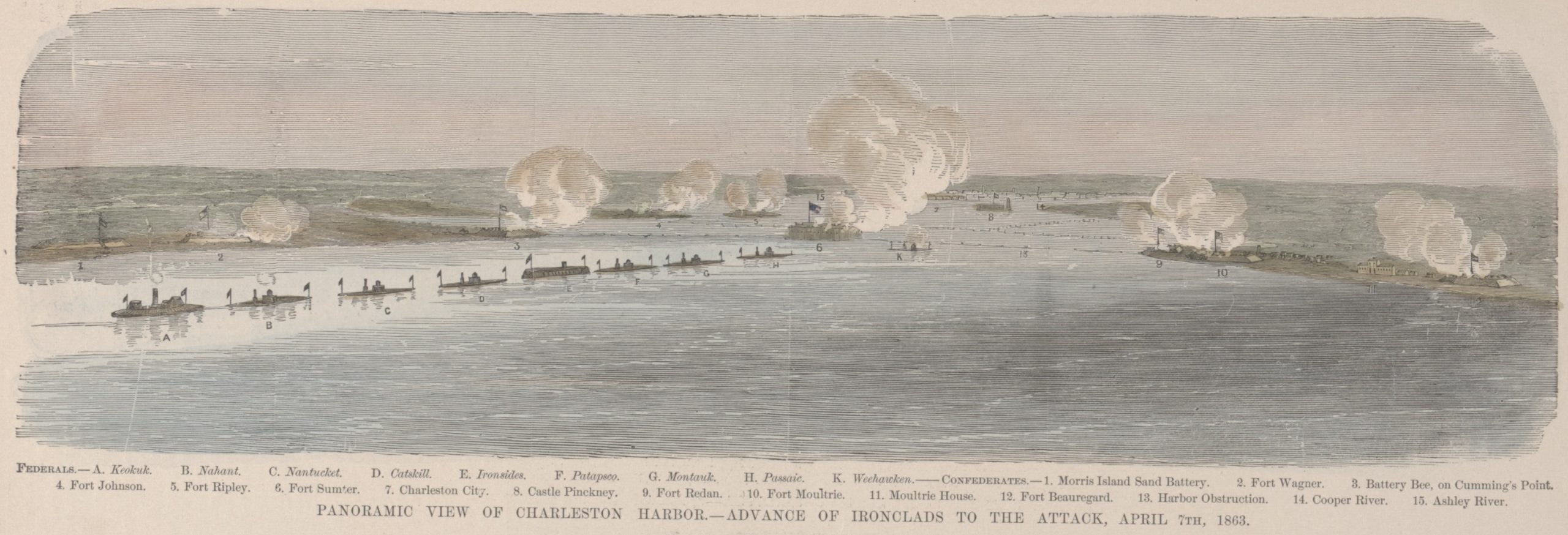
These two conflicts both worked to project power ashore, in different ways and for different distances true, but nonetheless mirror one another in goals regarding disruption of economic, communication, and transportation systems. This is a common overall operational goal of a more powerful naval power over a weaker one.
Blockade
On April 12, 2026, President Donald Trump declared a blockade of Iran’s coastline and port cities.[2] The goal is to isolate Iran’s merchant fleet, as well as those providing support to Iran via their own merchant marine. Isolated by sea, Iran will have great difficulty exporting its oil production – its chief economic system. As of May 1, U.S. Central Command has reported the seizure of three merchant ships and having turned back 45 commercial vessels.[3] At least 26 vessels have successfully passed through the blockade in some fashion or another, at least as of April 20.[4]

The first question asked by most news organizations when President Trump announced his blockade was whether such a move was legal. It was the same question everyone asked in 1861 when Abraham Lincoln declared a blockade of Confederate coastline as well. Blockades are legal measures under the laws of armed conflict today, just as they were 165 years ago when Lincoln declared his own. However, there are legal requirements for blockades, both then and now. Blockades need to be physical, as in they cannot simply be declared. Warships must physically block passage when challenged, and need to remain on station indefinitely.[5]
Blockades, both then and now, are naval measures meant to influence economics of the adversary. Generally, most neutral or third-party countries condemn blockades, for a blockade of a port impacts their neutral trade as well as any of belligerents. Just as the People’s Republic of China demands the U.S. blockade of Iran end to ensure oil shipments, likewise did British supporters of the Confederacy do so in efforts to continue flow of southern cotton to English textile mills. The same challenges with keeping ships posted, intercepting those attempting to breech the blockade, and determining what to do with captured vessels remains the same today as in 1861.
Convoys
In 2026 Iran declared the Strait of Hormuz closed to all traffic, later updating their policy to allow for neutral transit so long as vessels followed their newly declared traffic separation scheme hugging the Iranian coastline closer than normal. On May 4, 2026, the U.S. Navy steamed through the strait while two U.S.-flagged merchants steamed out, beginning a quasi-escorting mission. Though initial statements are that this move is limited and not meant to indicate a new escalation in the area, it could very well be the start of a sustained convoy system seen in the Bab al-Mandab Strait in the last few years, or akin to convoys through the Strait of Hormuz in the 1980s Tanker War. It could also be a modified version of such where the U.S. Navy uses multiple platforms (ships, aircraft, and more) to help protect merchants as they transit, essentially acting as a convoy without a warship alongside the entire time.
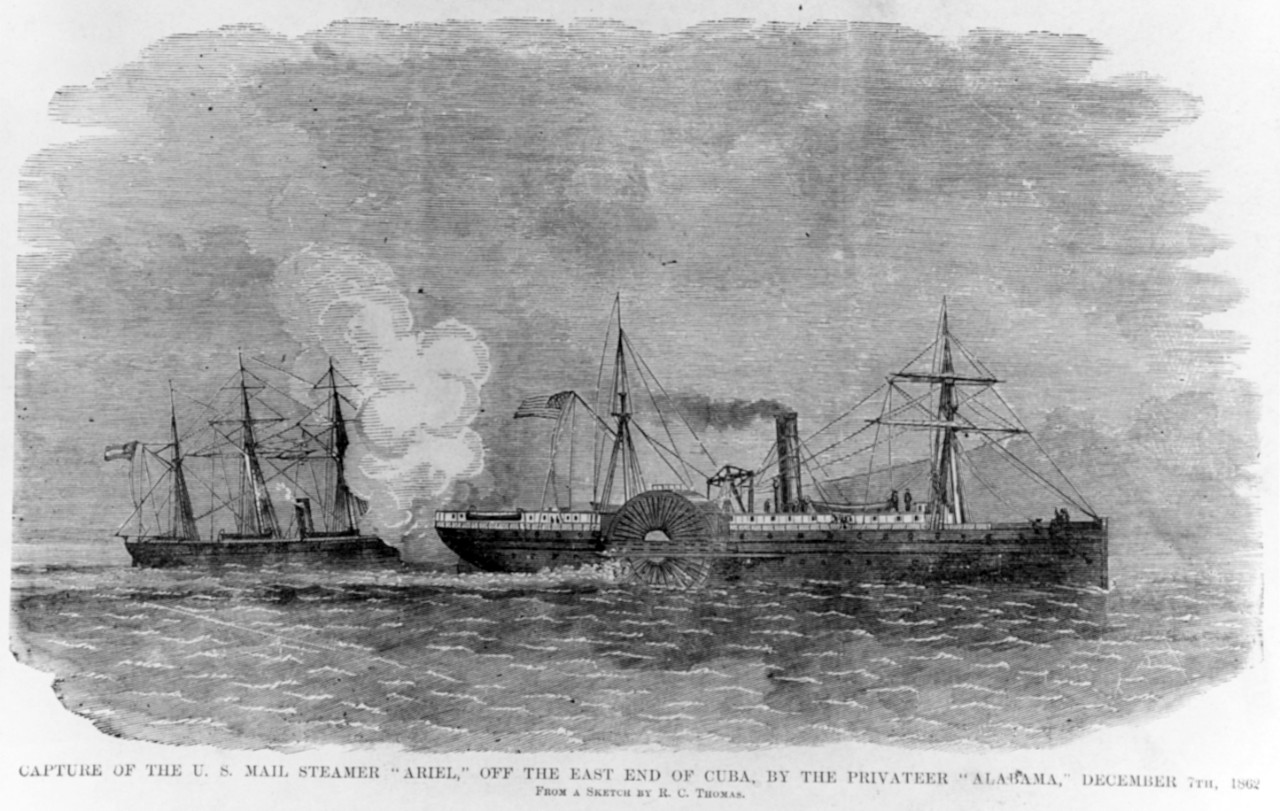
Largely unknown today, the U.S. Navy also created a sustained convoys system through a strategic chokepoint in 1863. Following outcry from New York business elites, and after the Confederate commerce raider Alabama captured the treasure steamer Ariel, the U.S. Navy West India Squadron began convoying steamers of the Atlantic and Pacific Mail Company through the Windward Passage between Haiti and Cuba – the exact location Ariel had been captured and the most dangerous area for civilian steamers traversing the Panamá route with bullion from California. During the Civil War, 87 convoys were completed without incident.[6]
Sustainment
Logistics and overall support of the fleet are critical in maintaining littoral activity blockades, or convoys. Today the U.S. Navy is relying on a global system of resupply and communication to sustain everything. Fleet oilers and logistics vessels are keeping the Fifth Fleet forward deployed via underway replenishments, especially at a time when land installations that have been previously relied upon have faced themselves targeted by Iranian strikes. Ships, such as the aircraft carrier Gerald R. Ford, have suffered equipment breakdowns and casualties over extended deployments to remain on station.[7]
The same sustainability challenges unsurprisingly were faced by U.S. naval forces in the Civil War. Just like warships have been on deployment for nearly a year straight today, Civil War deployment of vessels for a year or more at a time was commonplace. Just as fleet oilers keep warships resupplied today, in the Civil War logistics vessels were dispatched to keep blockading vessels supplied.[8] Just as the U.S. Navy uses Expeditionary Mobile Bases today backed by land installations, Abraham Lincoln’s fleet established forward staging bases to support blockade and convoy operations including at Port Royal Sound, South Carolina; Ship Island, Mississippi; and Cap-Haïtien, Haiti.[9]

Conclusion
This is by no means a scientific comparison, but instead just some musings about initial observations. Politics aside, when it comes to naval activity near Iran in 2026, history seems to be rhyming. When combining a sustained blockade, convoys, and inland power projection, the U.S. Navy facing Iran and the U.S. Navy facing the Confederacy simultaneously endured many of the same missions. However, the parallels between 1863 and 2026 are just one comparison, and there are a host of others to be made between U.S. naval forces today and during the World War I, World War II, the Tanker War of the 1980s, and even Korea and Vietnam (just like there are rhymes to all of these and the Civil War). The challenges, mission, and goals naval forces face today are, in many respects, timeless, and it is a good idea to keep studying the history of the U.S. Navy to help learn how best to manage some of those enduring trials.
Endnotes:
[1] For a good overview of these littoral assaults see Neil P. Chatelain, This Great Contest Afloat: The Civil War on the Seas, Coastlines, Rivers, and Oceans (El Dorado Hills, CA: Savas Beatie, 2026), 37-76.
[2] Megan Messerly, “Trump announces Strait of Hormuz blockade after Iran talks collapse” POLITICO, April 12, 2026.
[3] Filip, Timotija, “Pentagon says US naval blockade has cost Iran $4.8 billion,” The Hill, May 1, 2026.
[4] Bridget Diakun, Joshua Minchin, and Tomer Raanan, “At least 26 Iranian shadow fleet vessels bypass US blockade,” Lloyd’s List, April 20, 2026.
[5] Emerging Civil War has previously explored the legality of Abraham Lincoln’s blockade. See Neil P. Chatelain, “Blockades, Privateering, and the 1856 Declaration of Paris,” Emerging Civil War, May 6, 2022; Dwight Hughes, “Civil War Surprises – The Blockade Proclamation: An Act of International War,” Emerging Civil War, April 21, 2023. See also Scott Simon, “International maritime law expert explains legality of U.S. blockade of Iranian ports,” NPR, April 18, 226.
[6] Neil P. Chatelain, Treasure and Empire in the Civil War: The Panamá Route, the West, and the Campaigns to Control America’s Mineral Wealth (Jefferson, NC: McFarland, 2024), 218; Neil P. Chatelain, “The US Marine Corps’ Greatest Defeat … and Greatest Defiant Act in the Civil War,” Emerging Civil War, December 7, 2022.
[7] Sam Lagrone, “USS Gerald R. Ford is Now Operating in the Red Sea,” USNI News, April 19, 2026.
[8] In 1861, the U.S. Navy deployed the warships Rhode Island and Connecticut as supply vessels to support the blockade. Edgar Stanton MaClay, ed., Reminiscences of the Old Navy: From the Journals and Private Papers of Captain Edward Trenchard, and Rear Admiral Stephen Trenchard (New York: G.P. Putnam’s Sons, 1898), 106.
[9] Neil P. Chatelain, “Cap-Haïtien: Lincoln’s Forgotten Forward Operating Naval Base,” Emerging Civil War, February 26, 2024; Neil P. Chatelain, “Ship Island, Mississippi: Versatile Key to the Gulf,” Civil War Navy – The Magazine, Vol. 10, No. 3, Winter 2023, 25-37; Dwight Hughes, “Sea Power at Port Royal: A Missed Opportunity?” Emerging Civil War, May 1, 2018.


Excellent post, Neil! Thank you for providing these comparisons between the two blockades!
I think the USN had some advantage in the civil war due to the topography of the southern coasts. The barrier islands and extensive coastal wetlands provided opportunity for local tactical superiority. The Iranian coast doesn’t seem to offer the same sort of advantages for forces from the sea.
Fascinating. Especially learning about Civil War era convoys. Thank you Neil.
Finally, an article that discusses contemporary parallels with the ACW in a thoughtful and accurate way, in a way only Neil can. Well done!
Great stuff. Simple me, Hormuz reminds me of Vicksburg.
Thanks for the interesting post and the parallels between the Civil War Navy and what is happening at the Strait of Hormuz. so many history connections.