“Saving the Dish” at Spindle Field
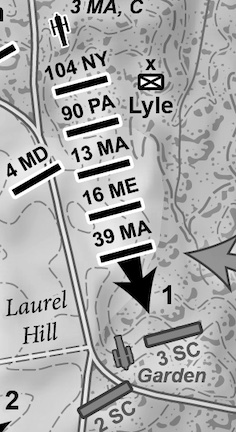
As the battle of Spotsylvania Court House opened on the morning of May 8, Col. Peter Lyle’s brigade of Brig. Gen. John C. Robinson’s V Corps division was first to drive into the action. Lyle’s five regiments stacked one behind the other in column, arranged in the same order they’d marched in and fought their way down the Brock Road in during the previous several hours. Rather than a traditional line of battle, the formation looked more like the fist-like attack columns that would be used on May 10 by Hobart Ward and, more famously, Emory Upton.
Sgt. Austin C. Stearns of the 13th Massachusetts, Company K, wrote about the column’s approach in his excellent memoir, Three Years with Company K. The 13th Massachusetts was stacked third in line in the column, which had come to “a clearing with a house, and to the right a battery, which was sending shot after shot at is.” The clearing was Spindle Field, and the house was that of Sarah Spindle. One of the artillery shells “struck the colors, breaking the staff without any injury to the bearer.”
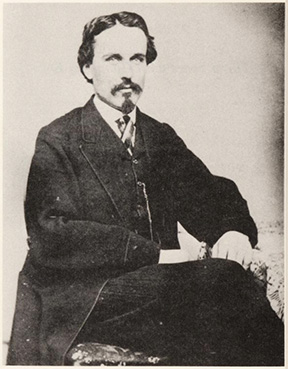
But here’s the cool thing about this particular account (beyond Stearns descriptive writing). Stearns’s diary, edited by his great-grandson, Arthur Kent, contained more than 200 sketches Stearns made during the war, 43 of which appear in the version published in 1976.
As I was working on my upcoming book on the battle of Spotsylvania, my friend Noel Harrison reminded me that Stearns had sketched something related to the battle, although Noel couldn’t quite remember what it was. Looking it up, I not only found the sketch but the account that goes with it—the kind of surprising story that makes Stearns book so enjoyable to read. The sketch was titled “Saving the Dish”:
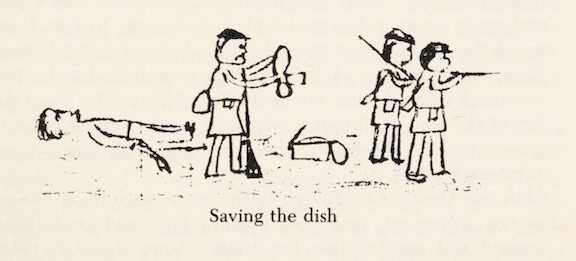
The zyps, zyps of the bullets were coming thick and the prospect of warm work ahead caused me to unhook my knapsack and let it drop. When it struck the ground I heard the old dish rattle and the thought of coffee, soups and the other dishes that had been made in it, and besides it was the same old dish that I had started with, caused me to stop, turn round, and unstrap the dish from my knapsack and, taking off my canteen, run the strap through the bail and, slipping it over my head, go on.
I’ve written about Stearns before, including an amusing anecdote and image following Mine Run, “The Evening Smoke” and Armchair Generalling after Mine Run. Not all of Stearns’s accounts are so amusing, though. His “Effects of a Shell” from the Chancellorsville campaign is, for all its simplicity, a bit grisly.
If you can find a used copy of his diary, I strongly encourage you to check it out for yourself.
————
Austin C. Stearns, Three Years with Company K: Sergt. Austin C. Stearns, Company K, 13th Mass. Infantry, Arthur A. Kent, ed. (Cranbury, NJ: Farleigh Dickinson University Press, 1976), 263.
————
For more on this action, see Chris’s A Tempest of Iron and Lead: Spotsylvania Court House, May 8–22, 1864, available from Savas Beatie.


Great piece. Thanks.