Nathaniel Hawthorne Goes to War
ECW welcomes guest author Richard Smith.
In early March 1862 novelist Nathaniel Hawthorne, sitting far removed from the war in Concord, Massachusetts, found himself distracted by the national crisis, so much so that he had difficulty writing. After consulting with his friend, ex-President Franklin Pierce, he decided to visit the seat of war, Washington, D.C.
As Hawthorne himself later wrote, “I gave myself up to reading newspapers and listening to the click of the telegraph, like other people; until, after a great many months of such pastime, it grew so abominably irksome that I determined to look a little more closely at matters with my own eyes.”[1]
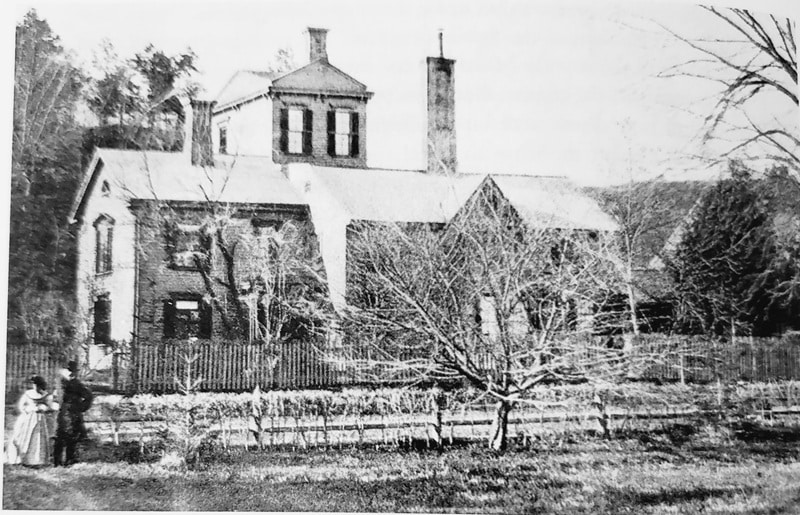
Hawthorne was perhaps the most politically involved of all the writers who called Concord home. A loyal Democrat, Pierce was one of his best friends; Hawthorne’s campaign biography of Pierce played a big part in getting his friend elected president in 1852. As a reward, Hawthorne was awarded the consulship to Liverpool, England. He and his family returned to Concord after nearly eight years abroad and moved into the home they called The Wayside.
When the war began in April 1861, Hawthorne was, like much of the country, distracted from his daily routine. “The war continues to interrupt my literary industry,” he told his editor, William Ticknor. ‘We seem to have…a very misty idea of what we’re fighting for.”[2] Still, the war also brought out Hawthorne’s patriotism: he told a friend that the war had a “beneficial” effect on his spirits and that he even found the war “delightful”. If he were younger (he turned 57 in the summer of 1861) he said that he would have even joined the army.3
But as the war entered its second year, Hawthorne’s enthusiasm was waning. “People must die, whether a bullet kills them or no,” he wrote sardonically to a friend.
A close friend and old college chum of Hawthorne’s, Horatio Bridge, was the paymaster general for the United States Navy, and in April 1862 he invited Hawthorne to visit Washington. Hawthorne accepted: He was getting no writing done anyway.
He wrote Bridge, “I am not very well, being mentally and physically languid. But I suppose there is about an even chance that the trip and change of scene might supply the energy I lack.”[3] Ticknor went along to keep Hawthorne company as a special favor to Sophia, Hawthorne’s wife, and he managed the entire trip, from arranging their train schedules to paying their way. “He says this is the only way he can travel in comfort, and it is no trouble to me,” Ticknor wrote to his wife.[4]
Setting out on March 6 and taking the train through New York and Philadelphia, they arrived in Washington City four days later. The city was now a wartime capital, teeming with soldiers, horses, wagons, cannons, and everything else needed to wage war.
“Upon reaching the capital,” Hawthorne wrote, “we filed out of the station between lines of soldiers, with shouldered muskets, putting us in mind of similar spectacles at the gates of European cities.”[5] In fact, on the day of their arrival, Gen. George B. McClellan had just moved his 60,000-man Army of the Potomac across the river into Virginia at the start of the Peninsula Campaign.

Thanks to their connection with Horatio Bridge, the two men were fortunate enough to latch onto a Massachusetts delegation that was going to the White House to present that “man of men” – President Lincoln – with a “handsomely encased”, ivory-handled leather whip made in Pittsfield, Massachusetts. The party arrived at 9:00 a.m. on Thursday, March 13. But Lincoln was late and sent word he was still having breakfast. “His appetite, we were glad to think, must have been a pretty fair one,” wrote Hawthorne, “for we waited about half an hour in one of his ante-chambers.”[6]
Finally, they were led into another room, where sat Secretary of War Edwin Stanton and Secretary of the Treasury Salmon Chase. Apparently, the Massachusetts delegation was not the only appointment delayed by the President’s breakfast.
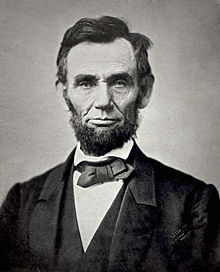
Hawthorne remembered the moment they’d all come for: “By and by there was a little stir on the staircase and in the passage-way, and in lounged a tall, loose-jointed figure.” His first impression on seeing Lincoln? “Being about the homeliest man I ever saw, yet by no means repulsive or disagreeable it was impossible not to recognize Uncle Abe.” Scrutinizing the president with “his lengthy awkwardness… [and] uncouthness of movement,” Hawthorne concluded that it was easier to assume he was a back-country schoolmaster, rather than the president of the United States.[7]
Hawthorne later wrote a detailed account of Lincoln, a vivid picture that only a novelist could write: “He was dressed in a rusty black frock-coat and pantaloons, unbrushed, and worn so faithfully that the suit had adapted itself to the curves and angularities of his figure. He had shabby slippers on his feet. His hair was black, still unmixed with gray, stiff, somewhat bushy, and had apparently been acquainted with neither brush nor comb that morning, after the disarrangement of the pillow; and as to a nightcap, Uncle Abe probably knows nothing of such effeminacies…The whole physiognomy is as coarse a one as you would meet anywhere in the length and breadth of the States; but, withal, it is redeemed, illuminated, softened, and brightened, by a kindly though serious look out of his eyes, and an expression of homely sagacity, that seems weighted with rich results of village experience.”[8]
Yes, the devoted Democrat seemed to admire the Republican president: “On the whole, I liked this sallow, queer, sagacious visage, with the homely human sympathies that warmed it; and, for my small share in the matter, would as lief have Uncle Abe for a ruler as any man it would have been practicable to put in his place.” And he wrote to his daughter Una, saying almost proudly, “I have shaken hands with Uncle Abe.”[9]
A visit to the Army of the Potomac the next day brought Hawthorne face to face with the man that the North was resting its hopes on to capture Richmond, end the Rebellion, and restore the Union: Maj. Gen. George B. McClellan. He was introduced to Hawthorne, meeting the writer “with a good deal of dignity and martial courtesy.”
While Hawthorne admitted that there were “loud and low” outcries and detractions against the general, “accusing him of sloth, imbecility, cowardice and treasonable purposes,” he had to admit that McClellan had “great physical vigor,” “a strong, bold, soldierly face” and a “Roman nose” that “may be pretty confidently trusted to guide him aright…” He concluded that McClellan’s soldiers “believed in him, and so did I…”[10]
As it turned out, McClellan would not be the savior of the Union. The Peninsula Campaign found the Army of the Potomac retreating from the outskirts of Richmond after a series of bloody defeats. In September 1862, McClellan salvaged a victory at the battle of Antietam in Maryland, but Lee’s army escaped, and Lincoln had enough; McClellan was permanently removed from command in October.
Perhaps Hawthorne wasn’t as confident about McClellan as he let on; not too long after meeting the general, Hawthorne said in a letter to Una, “Unless he achieves something wonderful…he will be removed from command and perhaps shot – at least, I hope so. I never did more than half believe in him.”[11]
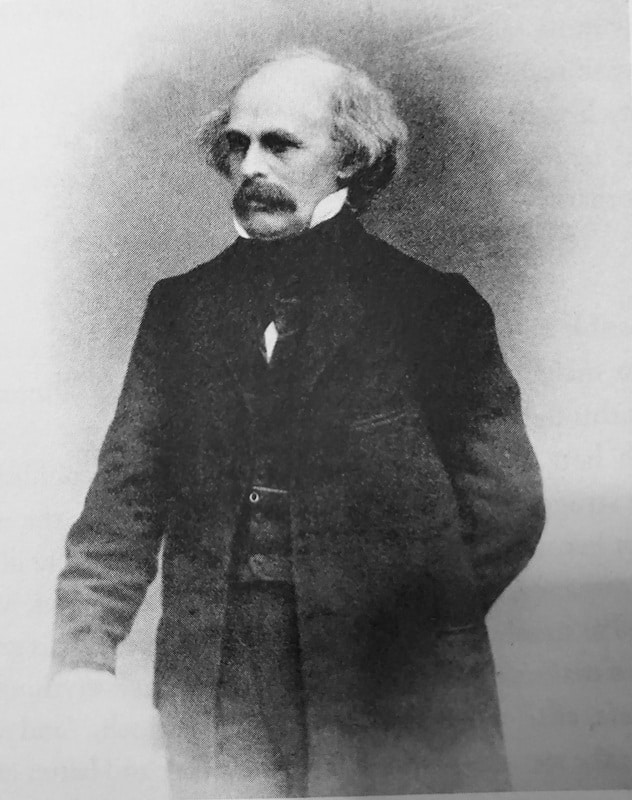
After visiting Alexandria, Hampton Roads (where they boarded the USS Monitor), and Harpers Ferry, Hawthorne and Ticknor returned to Concord on April 10. Sophia said that the family was “crazy with joy” to have him back.
Hawthorne soon set to work writing an article about his travels for the Atlantic Monthly. He wrote the essay in less than a month and sent the manuscript to publisher James T. Fields in May. Fields was one of Hawthorne’s biggest fans, and approved it without reading it, much to the disappointment of Hawthorne, who wrote to Ticknor, “I wanted to benefit of somebody’s opinion besides my own, as to the expediency of publishing two or three passages in the article.”[12]
Hawthorne’s account of the trip appeared in the July 1862 issue of the Atlantic Monthly. Called “Chiefly About War Matters by A Peaceable Man,” the essay caused quite a scandal among the Atlantic’s readers. The “Peaceable Man” did not seem entirely on board with the Union war effort and even seemed to have some sympathy with the Southern states now in rebellion! In truth, Hawthorne was just looking at both sides of the national crisis that engulfed the country. His unpolished, truthful views of the war were seen as unpatriotic and treasonous to many; one review said that the essay was “pure intellect, without patriotism, with our sympathy, without principle.”[13]
Nathaniel Hawthorne did not live to see the end of the Civil War. He died on May 19, 1864, at the age of 59. Franklin Pierce had been with the writer on a trip to New Hampshire when Hawthorne died, and it was Piere who notified Hawthorne’s family. He was at the funeral but was not asked to be a pall bearer. Emerson, Longfellow, Oliver Wendell Holmes, and James Russell Lowell handled that detail, while Pierce, a loyal friend to the end, sat with the bereaved family.
Concord would miss Hawthorne, just as it missed Thoreau, who had died two years before. “Hawthorne no longer traverses the hillside near my house,” Bronson Alcott wrote after the funeral. “Screened behind the shrubbery and disappearing like a hare into the bush when surprised. He has gone, where he is now surpriseless by us.”[14]
————
Richard Smith has lectured on and written about antebellum United States history and 19th-Century American literature since 1995. He has worked in Concord, Massachusetts as a public historian and Living History Interpreter for 26 years and has written and edited 13 books for Applewood Books/Arcadia Publishing.
Check out Richard’s appearance on the Emerging Civil War Podcast in June 2025: Emerson and Lincoln.
Endnotes:
[1] Nathaniel Hawthorne, “Chiefly About War Matters,” The Atlantic Monthly, July 1862.
[2] William Charvat, ed. The Letters of Nathaniel Hawthorne (Columbus: Ohio State University Press, 1985), Vol. 18, 379.
[3] Ibid, 61.
[4] Caroline Ticknor, Hawthorne and His Publisher (Boston: Houghton Mifflin Company, 1913), 297.
[5] Ibid, 76.
[6] Nathaniel Hawthorne, “Chiefly About War Matters.” The Atlantic Monthly, July 1862.
[7] Ibid.
[8] Ibid.
[9] Julian Hawthorne, Nathaniel Hawthorne and His Wife (Boston: Houghton, Mifflin and Co., 1884), Vol. 2, 310.
[10] Nathaniel Hawthorne “Chiefly About War Matters.” The Atlantic Monthly, July 1862.
[11] Charvat, The Letters of Nathaniel Hawthorne, Vol. 18, 437-438.
[12] Brenda Wineapple. Nathaniel Hawthorne: A Life. (New York: Random House, 2004), 350.
[13] Philip McFarland, Hawthorne in Concord (New York: Grove Press, 2004), 270.
[14] Bronson Alcott, Concord Days (Boston, Roberts Brothers, 1872), 195.


Thank you. I consumed with relish. I wonder if Hawthorne suspected that his Liverpool would be a Confederate hub of intrigue.
Thank you for his description of Lincoln near his inauguration from an even-keeled observer. Too bad he doesn’t mention a beard. I’m saving that description. Letter to the editor: there is an image of Lincoln taken in Springfield just before he left for inauguration which may have been period appropriate for this article vs the 1863 image presented.