Book Review: Preeminent Strategist: General Joseph Eggleston Johnston, The Confederacy’s Most Agile General

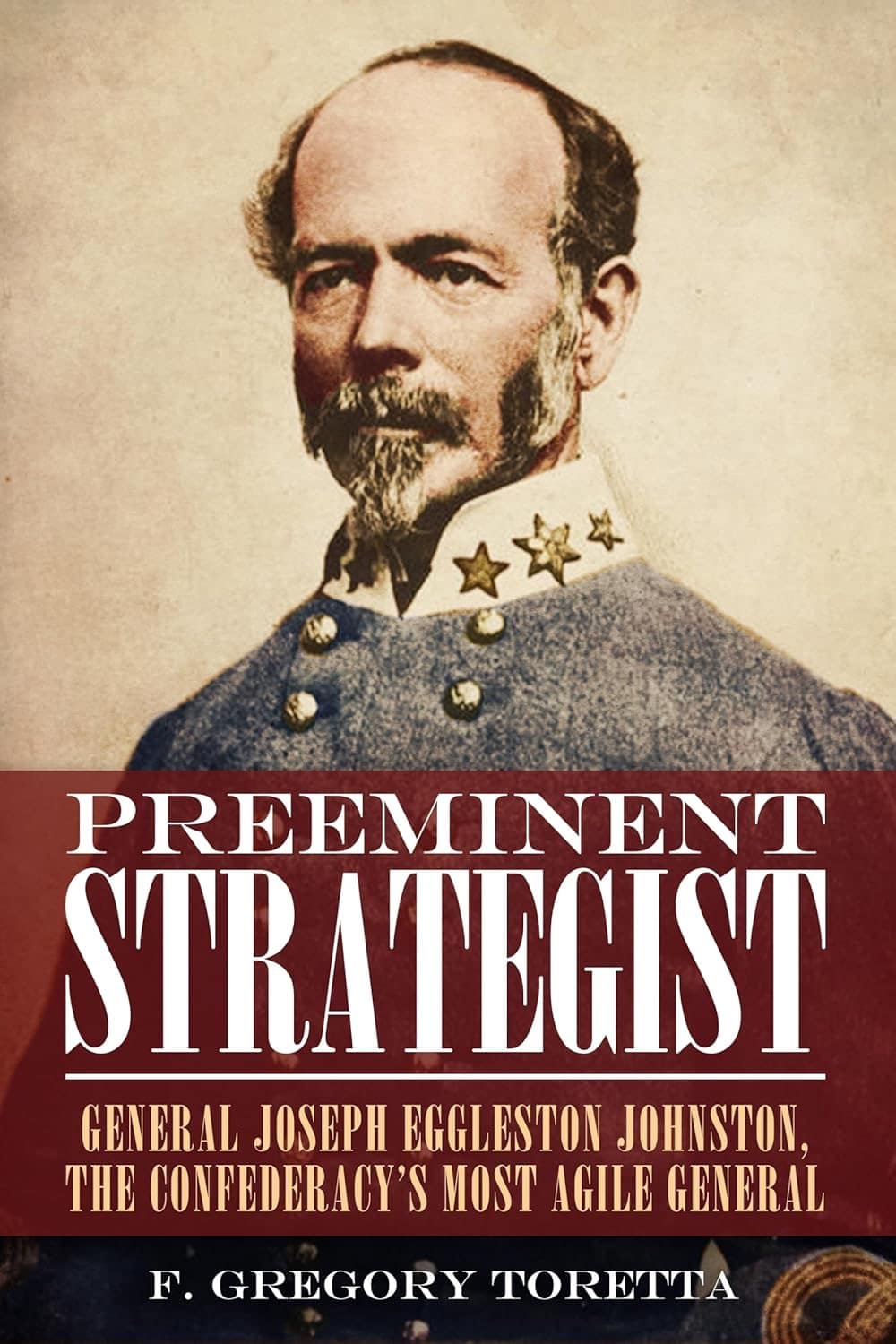
Preeminent Strategist: General Joseph Eggleston Johnston, The Confederacy’s Most Agile General. By F. Gregory Toretta. Havertown, PA: Casemate Publishers, 2026. Hardcover, 272 pp. $34.95.
Reviewed by Riley Sullivan
Confederate generals such as Robert E. Lee, Thomas J. “Stonewall” Jackson, and Albert Sidney Johnston are often hailed as the most effective battlefield commanders that emerged out of the American Civil War for the Confederacy. However, in F. Gregory Toretta’s latest work, Preeminent Strategist, Toretta makes the argument that Joseph E. Johnston should be considered in the same light. Drawing on well-known memoirs, correspondence, and newspaper accounts, Toretta attempts to recast how historians should consider Johnston as a military strategist.
From the opening of his work, Toretta asserts that he intends to demonstrate “Johnston’s strategic genius and superior military skill.” (x) While his opening chapters focus on his early career as a soldier, the majority of the work is dedicated to discussing Johnston’s strategic mind during the Civil War. As the author analyzes Johnston’s strategic aims, he also provides context to how his strategy was well suited for combat in the Civil War. At moments in his work, Toretta focuses on how technology impacted both combat and Johnston’s sense of strategy, ultimately coming to the conclusion that Johnston’s preference for the defensive was due to his understanding of the advancements of weaponry.
Particular attention throughout the book is given to Johnston’s command of forces during the Peninsula, Vicksburg, and Atlanta campaigns. While previous historians like Craig Symonds having been critical of Johnston’s preference for retreat, Toretta argues that Johnston often was forced to retreat rather than pursue a more aggressive strategy because of the constant interference of Confederate President Jefferson Davis.
Throughout many of his chapters, Toretta places the mangled relationship that Johnston had developed with Davis at the center of the discussion. The author depicts Davis as the antagonist that often works against the talents of Johnston. At several key moments, the author claims that “President Jefferson Davis wanted to micromanage military operations and made decisions in Richmond which hampered his field commanders.” (117) Ultimately, the author contends, it was this strained relationship that cost the Confederacy the war in the Western Theater.
While the author certainly is correct to an extent in his interpretation of Davis, this ultimately leads him to overlook many of Johnston’s flaws as a commander and even overstate his case. Throughout much of the work, the author fails to address how Johnston did not fully comprehend the political implications that adoption of his strategies would bring. While militarily, it might have been more logical to abandon the Peninsula or Vicksburg, politically it would have been a disaster.
Notably, when discussing the Atlanta campaign, Toretta opines that “there is every indication that had Johnston been adequately and properly supported by President Davis and the Confederate government during the Atlanta Campaign, the South would have obtained a favorable outcome in the war.” (x) However, given Johnston’s track record during campaigns like Vicksburg, if the city were to be threatened by an encirclement, he would have abandoned it without a fight; thus, resulting in a similar outcome. None-the-less, for the author, the failures of Johnston came down to the simple fact that “Davis disliked Johnston and viewed everything he did with a prejudiced eye” often at the expense of the Confederate cause. (200)
As Toretta’s statements about Johnston’s strategic exploits are at times over-stated, the author also unfairly judges some of his subordinates. This proves to be the case when the author discusses John C. Pemberton. When writing about Pemberton in the Vicksburg campaign, the author states that he had “no military experience.” This ignores the fact that, like Johnston, Pemberton had seen combat as an officer during the Mexican-American War (where Pemberton won two brevets), as well as fighting in the Second Seminole War and on the frontier. (118) Such flaws may have occurred as the bibliography and research for this work appear relatively limited in scope. Also, when citing individuals like Virginia newspaper editor Edward Pollard, the sources are often taken at face value without much critical reflection on them.
While Toretta’s work thus has certain flaws, it does nevertheless present an interesting prospect for historians. Should we be so easy to discredit the strategic mind of Johnston? Certainly, Johnston understood the military situation that the Confederacy faced and understood the limitations of the manpower shortage that the South faced. Toretta’s work demonstrates that the debate of Johnston’s conduct as a field commander is anything but settled.
Riley Sullivan earned his MA in History at Sam Houston State University and is a Professor of History at San Jacinto College in Pasadena, TX. He has published works on Civil War Memory that have appeared in the Tennessee Historical Quarterly. He is also a doctoral student in the Department of History at the University of Houston.


The author might overstate his case a touch. I don’t think Johnston was a military genius, but I do think he’s criminally underrated. I’ve often wondered why Lee gets all the attention and Johnston takes a back seat. Maybe it’s because he maintained friendships with his former adversaries after the war.
In reading a great book detailing the Battle of Jackson, Pemberton comes across as obeying Johnston’s orders, and Johnston comes across, to me, as unreliable. I’m sure General Hood would have something electric to say about this biography. Having read Hood’s side, I’ll look forward to reading this.
“Preeminent strategist?” LOL!! Washington employed a Fabian strategy to outlast the British in the Revolution. Johnson simply avoided any combat at all. If the author of this book is impressed by Johnson, he must consider George McClellan the second coming of Napoleon. Like Mac himself.
I’d be inclined to agree he’s underrated, but boy am I struggling with “The Confederacy’s Most Agile General.” Authors may get limited say in the title a publisher chooses, but that’s a big reach right there.
The “debate about Johnston’s conduct as a commander” is a long-settled one for me.
Joe Johnston’s own comment after his wounding at Seven Pines resulting in Lee’s promotion to command of the Confederate forces in Virginia- “The shot that struck me down is the very best that has been fired for the Southern cause yet. While I possess no degree the confidence of the government, now they have in my place one who does
possess it.” -says as much about Gen. Joseph E. Johnston’s own opinion about himself as much as his relationship with Davis.
I get the argument — to be considered the south’s preeminent strategic retreater, the expert on giving ground, and the master of falling back, you have to also be the Confederacy’s “most agile general.”
I can’t speak to the Western Theater, but can say that Johnston advocated for an attack strategy throughout his entire tenure as commander in the east. Davis repeatedly denied Johnston the resources required to lead his army across the Potomac River, not because he preferred standing on the defensive, but because he couldn’t provide what Johnston needed in either men or materiel. Confederate military weakness is the dominant theme of the first year of the war. In addition, as President Davis was commander in chief of the Confederate army. He could intervene in military affairs whenever he wanted. Lincoln did the same thing repeatedly and look how badly he screwed up in 1862.