Book Review: Abraham Lincoln and the Heroic Legend: Reconsidering Lincoln as Commander in Chief

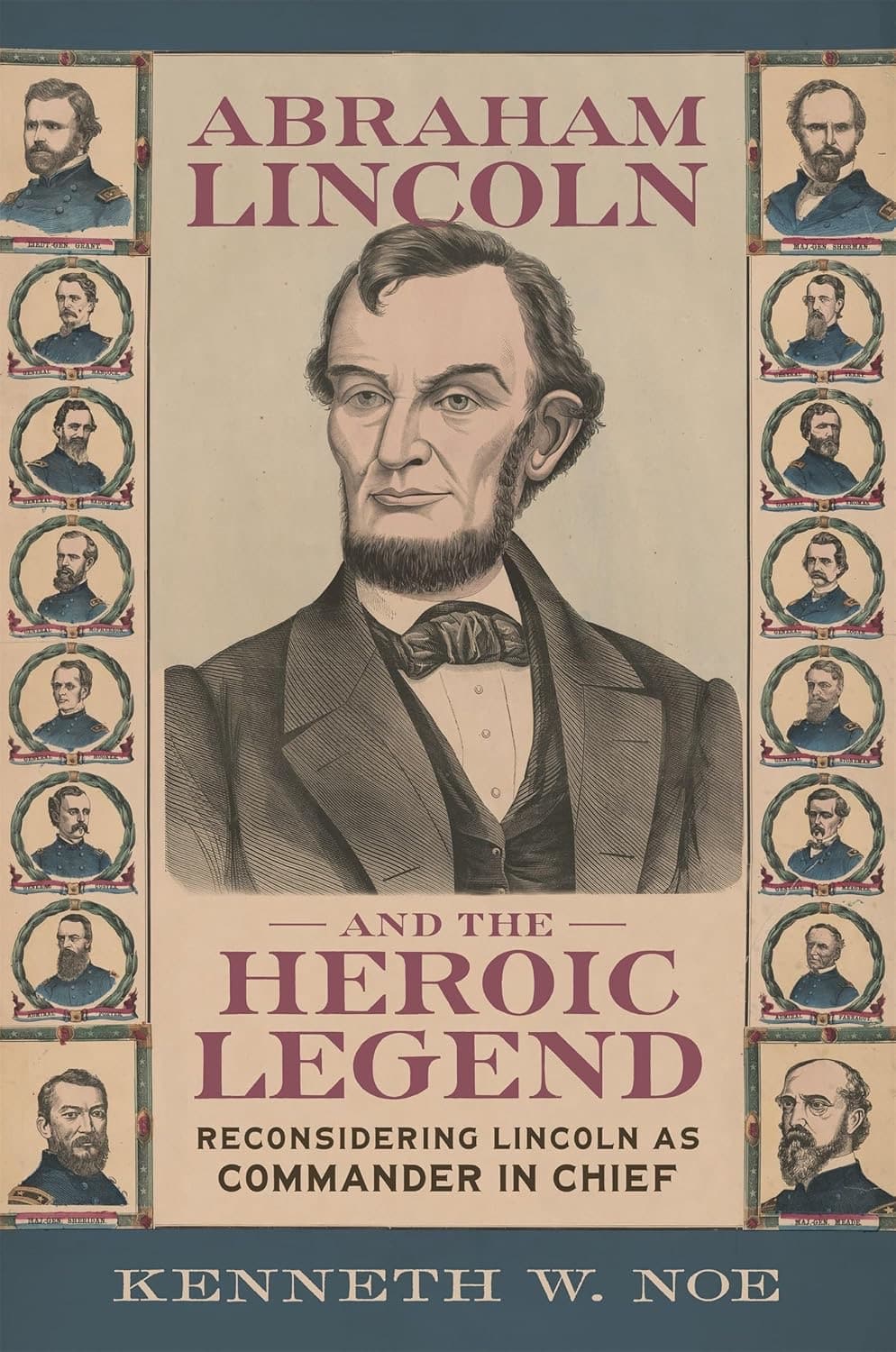
Abraham Lincoln and the Heroic Legend: Reconsidering Lincoln as Commander in Chief. By Kenneth W. Noe. Baton Rouge: Louisiana State University Press, 2026. Hardback, 424 pp. $49.95.
Reviewed by Sean Michael Chick
Kenneth W. Noe has never had a problem tackling offbeat topics. Instead of a book on Gettysburg or Shiloh, he did what is still the definitive account of Perryville. Reluctant Rebels: The Confederates Who Joined the Army after 1861 and The Howling Storm: Weather, Climate, and the American Civil War also covered less discussed topics. At first glance, Abraham Lincoln and the Heroic Legend steps out of this mold. Lincoln is up there with Jesus, Hitler, and Napoleon as one of the most written about figures in history. Yet Noe, as always, surprises yet again.
The book is divided into two sections, which are in a way separate books. The first, and slightly shorter one, chronicles Lincoln’s career as commander in chief. Most of it is a narrative of Lincoln as war master with analysis and opinions. Noe occasionally discusses things he considers well-worn myths, such as George McClellan ignoring Lincoln when he visited McClellan and Lincoln pouring over books on military history in early 1862. Noe argues that most likely Lincoln read one book, Henry Halleck’s Elements of Military Art and Science. The second half is a detailed historiography of Lincoln as commander in chief.
The first half is rather harsh towards Lincoln all things considered, though not exactly complimentary to McClellan either. The Lincoln of these pages is overly confident in his judgment, sometimes confused, underhanded, fails to follow protocol, and is even downright mean. According to Noe, his understanding of weather, terrain, and logistics had serious shortcomings, at least in the war’s first years. The most telling thing is that Lincoln starts off being very involved in military matters, at least in Virginia (where the North suffered most of its defeats). He then gradually fell into the shadows while still dictating overall strategy. Noe convincingly asserts that the Overland campaign was not Ulysses S. Grant’s idea, but rather Lincoln’s, and it came close to costing him the presidency.
The second half is quite impressive. Noe chronicles the ups and downs of what he calls the heroic legend, or the often told tale of a wise and naturally capable commander in chief struggling to find a general until Grant takes Vicksburg. This narrative started right away with Lincoln’s death, which made him the Christ figure of American history and legend. It was told in its strongest form by John G. Nicolay and John Hay, Lincoln’s secretaries, who created the legend of the evil McClellan vs. the wise Lincoln. This reviewer is convinced they took a page from George Bancroft and others who made George Washington’s real foes Horatio Gates and Charles Lee instead of George III and William Howe. The Lincoln legend reemerged among British historians in the 1920/30s and came to the fore in the Cold War, helped along by the popularity of T. Harry Williams’s Lincoln and His Generals. That book came just as Harry Truman had his own spat with Douglas MacArthur. It became canonical during the Civil War Centennial. Noe forgets to add that it was reinforced by the work of Ken Burns decades later.
Between the two halves, the reviewer gives a slight edge to the second half as the better. Putting my cards on the table, I too am a critic of Lincoln as commander in chief, but even I thought Noe got carried away in places. That said, with so many books, particularly popular works, repeating the legend Noe offers a well written, lively, and accessible antidote. Perhaps the greater weakness is that the politics of the war and emancipation are present in the first half, but considered less against more purely military matters. I contend that Lincoln’s success in that regard gives one a better rounded view of Lincoln, as both were entangled with purely military matters. Certainly Lincoln had more success on both counts. The second half is truly for the devoted, but Noe’s prose is lively, and his arguments are balanced between how the times and the author’s own ideas influenced how Lincoln was understood at that time.
It might be suggested that contemporary scholarship has gotten away from Noe’s arguments. Clearly the work of several authors has cut a bit into Lincoln, such as Brooks Simpson, William Marvel, and Ethan Sepp Rafuse. Yet, Noe believes the Lincoln legend remains intact. He points to the work of Elizabeth Brown Pryor. Her work Reading the Man was timely, in that enough people of influence were receptive to a less generous take on Robert E. Lee. The book was pushed in popular magazines. By contrast, her equally biting critique in Six Encounters with Lincoln fell on mostly deaf ears. To this point, Noe believes that is because the Lincoln legend works to the benefit of contemporary American politics and the imperial presidency, a trend he asserts knows no party boundaries.
Abraham Lincoln and the Heroic Legend is another fine and unique book by Noe. The prose is strong and clear. The fact that Noe in the first half is willing to take Lincoln to task makes that section something of a page turner as you wonder what he will say or reveal next. The second half could have been a slog. Instead, it is masterfully told, leaving the impression Noe poured over all the volumes discussed (well, maybe not every word of Nicolay and Hay’s multi volume monster). I highly recommend this book.


Thank you for this insightful review. While I enjoyed parts of this impressive book, I found the final chapter concerning modern Lincoln scholarship a bit incomplete. Quite a few notable Lincoln historians are not included (though some appear in the bibliography); perhaps they do not agree with the author’s thesis?
Lincoln’s own military resume was thin to say the least and it almost always turns out badly when politicians meddle in military planning. Still, I think he was energetic about prosecuting the war and finding the right generals for the job.
Your first sentence makes a good point. Of course, the obverse is equally true – things turn out badly when generals meddle in political planning. I’ll leave a name unstated …
Hah, you’re definitely right about that!
It’s poring over books, and pored over all the volumes.
I weep for the English language.
thanks Sean, nice review … given the excellent scholarship on Lincoln as commander in chief — T. Harry Williams’ Lincoln and His Generals, James McPherson’s Tried By War, and Eliot Cohen’s Supreme Command — the author has set a high bar for himself arguing Lincoln was not a very good war leader … will have to give this one a read.
Thank you Sean.